|
"Frame Drums and Tambourines"
Introduction
Technically,
a frame drum is a drum that has a shell depth smaller than
the diameter
of the drumhead, which can be from 6" to 20" (15
cm to 50 cm) or more; in simple terms, it is a hoop with
a skin stretched across it. Although the frame is most commonly
round, it can be square or hexagonal; it is made from various
woods, metals or clay, and has a single or double head.
The drumhead of a frame drum is made either from an animal
skin—cow (calf), goat, fish, lizard, deer, whale,
seal, or snake—or from an animal's internal organs.
The skin is attached to the frame with glue, tacks, or a
counter-hoop system with tuning hardware (devices such as
screws to tune the skin to a particular note or pitch by
tightening or slackening its tension over the frame). Construction
styles for most frame drums often vary from region to region.
North American drum companies such as Cooperman and Remo
have successfully made synthetic plastic skins and frames.
There are
two major types of frame drum: those without jingles, which
can be played with the hands or with sticks; and those with
jingles, which are played with the hands (tambourines).
Tambourine jingles are usually round metal discs set into
the frame, but they can also be pellet bells or brass rings
attached to the inside of the frame.
Frame drums
are found in many cultures and have a long history. Examples
of different types are depicted in pottery, reliefs, paintings
and folk art. The earliest depictions of frame drums appear
in Mesopotamian art from the third millennium BCE. These
frame drums are much larger than those used in popular music
of the late twentieth century. Depictions of smaller frame
drums similar to some still used can be found in the artwork
of Greece, Egypt, Persia, and India. They mainly show women
playing frame drums in ritual, but men often appear in Arabic
examples when a frame drum is employed for martial purposes.
An early appearance of a frame drum with disc jingles attached
to the frame is found on the 190 ADE Roman sarcophagus,
The Triumph of Bacchus (in The Walters Art Museum,
Baltimore, Maryland, USA).
Grips and Technique
A consistent
feature of the depictions of frame drums throughout their
history has been the use of two main grips for holding the
instrument. From the iconographical evidence Glen Velez
gathered, the most common grip was what he called the "Oriental
grip." The player is always shown with the
left hand holding the instrument at the bottom with the
skin facing away from him/her and the fingers of both hands
playing. This grip allows the player to produce numerous
sounds from the skin: for example, a low-pitched natural
ringing sound produced by striking the drum off-center;
a high-pitched sound produced by striking the edge; a stopped
stroke produced by slapping the instrument in the center;
various jingle sounds; brushing sounds produced by grazing
the skin with the fingernails or fingertips; a drone produced
by the friction of a moistened finger rubbed on the skin;
and the sound produced by knocking the frame with the knuckles.
In Arab drumming, the first three sounds mentioned above
are onomatopoeically known as doum, tek,
and kah. Persian drumming makes use of different
strokes, employing snapping techniques for the high-pitched
rim sounds. Indian drumming has similar names for drum strokes,
as well as rhythmic solfege systems known as bols
and solkattu (konnakol). The Indian technique
has developed in such a way as to allow fast and clear repetitions
of specific sounds, usually stopped sounds.
The other
grip Glen Velez identified was the "European
grip" based on a European iconography from
the seventeenth century and his background as an orchestral
percussionist. This grip seems to be reserved largely for
specific tambourine playing, such as that used in African-American
gospel, rock, European orchestral playing, and folk musics
Brazil, Chile, Bolivia, Mexico, and various Caribbean Islands.
The player holds the instrument in the left hand so that
the drumhead faces up toward the sky, with the thumb touching
the skin; most of the playing is done with the right hand.
Compared with the multiple skin sounds (and jingle sounds,
if the instrument is equipped with jingles) that the "Oriental
grip" permits, the "European grip" allows
for a more jingle-based sound.
Terms for
these two grips that more accurately reflect the multiple
contexts that frame drums are found in among both historical
and contemporary cultures would be "Traditional
grip" and "New grip."
The terms originally coined by Glen Velez in his early publications
can be misleading in that few of the frame drums found in
Europe are held in "European grip" with the exception
of the orchestral tambourine (which has multiple playing
positions). A term such as "Traditional grip"
is suggested to be used in place of "Oriental grip"
as it more accurately describes the holding positions of
many frame drums with a culturally neutral terminology.
A term such as "New grip" is suggested to be used
in place of "European grip" as this grip is newer
and found more often in the New World where it seems likely
that Sub-Saharan African musicians had reoriented the tambourine
so that the skin faces upward much in the way that most
Sub-Saharan African drums are oriented.
The sitting
position facilitates another playing grip commonly referred
to today as "Lap style." The
seated player holds the instrument on the left knee with
the left hand resting on top; this allows for similar manipulations
of the skin as with the "Oriental grip." This
"Lap style" position becomes a necessity when
the frame drum is too large for handheld playing.
Numerous
grips are used for frame drums played with sticks, as for
Native American frame drums, the Irish bodhrán,
the tapou of Martinique & Guadeloupe, Ukrainian
stick-beaten tambourines called buben, frame drums
in Chinese opera (jing xi) called bangu
and in the silk and bamboo music (jiangnan sizhu)
of Shanghai called biqi gu, the Japanese paranku
(Okinawa) and kacho (Ainu), and frame drums with
handles attached, such as uchiwa daiko (daimoku
daiko) from Japan, the sogo of the Republic
of Korea (South Korea), and the North American kilaut
(cauyuq) played by the Inuit. These grips constitute
exceptions to the three already discussed. The hand-beaten
frame drum of Brazil’s bumba meu boi rituals,
the pandeirão, is also an exception.
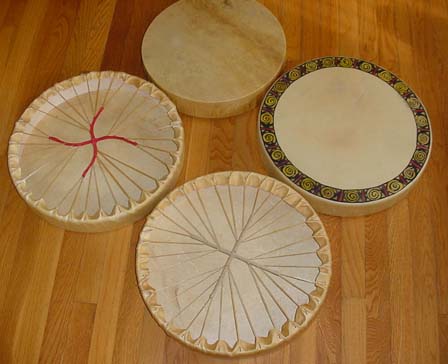
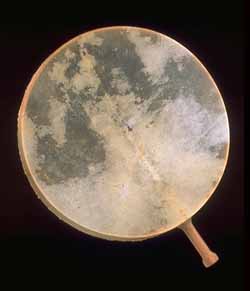
Apache frame
drums (SW USA)

Frame drum
from British Columbia (NW coast)
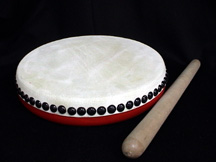
Paranku
from Okinawa, Japan
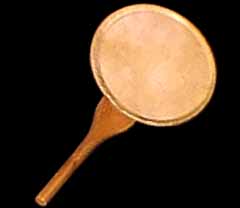
Uchiwa
daiko (daimoku daiko) from Japan
Inuit
kilaut (cauyuq)
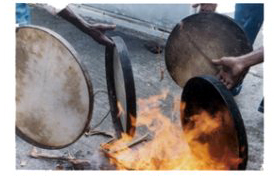
Tuning the
tapou of Martinique
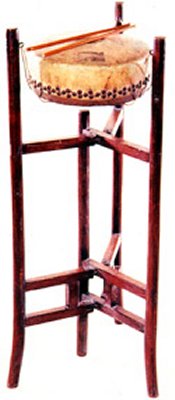
Bangu
from China
Lastly,
a grip called "Free-hand position"
was popularized by John Bergamo in the USA. The player holds
a frame drum between the legs so that the skin slants away
from him/her; this allows both hands to be used for playing.
A similar style was used in New York in the early 1980s
by electric tambourinist Peter "Akiva" Wharton,
who damped the jingles and amplified the tambourine while
playing with the tambourine resting on his lap. The free-hand
grip is traditionally used for large frame drums in Cuba
and in Turkey and pre-dates the popular spread of these
playing positions among frame drummers in the USA.
Nomenclature
The nomenclature
for frame drums is problematic, as similar instruments have
different spellings and names in different cultures, which
demonstrates variations in regional preferences. In some
cases, the term "tambourine" (with various spellings
such as tamborens, tamberins, tambereen, and tamboruin)
was used to describe frame drums without jingles (particularly
those of various Native American tribes in the 1804-1805
writings of William Clark and John Ordway during the Lewis
& Clark expedition). In addition, drum companies such
as Remo have continued to market newly invented versions
of frame drums simply as "frame drum." Other named
inventions have included the Remo ocean drum (a double-head
frame drum with metal shot inside), Glen Velez's Mediterr-Asian
tambourines made by Cooperman some of which feature
small tunable frame drums with wooden jingles, a one-piece
all-wooden
frame drum used by Glen Velez, a one-piece all-clay
frame drum known as "claypan"
made by the Wright Hand Drum Company, Barry Hall's ceramic
"didjibodhrán"
(a ceramic circular didjeridu with a skin stretched
across making both a frame drum and didjeridu in
a single instrument), and Carlo Rizzo's "polytimbral
tambourine" (with which he can control the tension
of the skin, damping of the jingles, and application of
snares to the skin while playing).
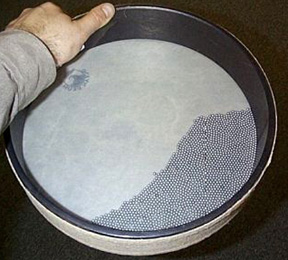
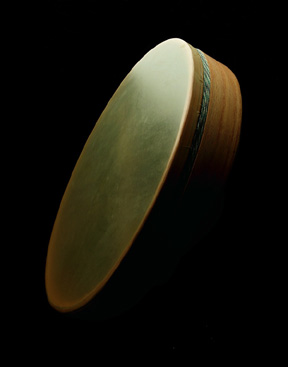
12"
ocean drum
22"
Cooperman tunable bodhrán with synthetic
skin
Frame
Drums (Without Jingles)
Following
are brief descriptions of the most common frame drums (without
jingles) found in popular music.
The adufe
(pandeiro quadrado, pandero cuadrado de
Peñaparda) is a double-headed square frame drum,
12"-16" (30 cm-40 cm) in diameter, mainly played
in Portugal, Spain, but also found in Egypt, Morocco, Guatemala,
and Brazil. It can have pellet bells attached to the inside
frame, and is held in the Traditional grip. The Egyptian
version is quite old, dating back as far as 1400 BCE. The
Brazilian version was stick-beaten and may have been a precursor
to the tamborim (see below). The European versions
are usually hand beaten and triangular shaped drums may
also be found. The pandero cuadrado de Peñaparda
is held on the lap while the right hand uses a stick to
strike the frame and skin with the left hand playing the
skin as well. It is only in the village of Peñaparda
(in the province of Salamanca, in Castile and León,
Spain) that the stick technique is used and those drums
are slightly larger and deeper than the hand held pandeiro
quadrado or Galician adufe. The hand-held
pandeiro quadrado is thinner and held with a corner
against the belly while beaten. The Galician adufe
is often held flat against the chest and beaten with the fists
of each hand.

Adufe from Galicia, Spain
The bendir
(bendyr, bendire) of Morocco and Tunisia
is similar to the tar (see below), with the addition
of snares stretched across the inside of the skin so that
the instrument produces a buzzing sound. This drum can range
from 10"-16" (25 cm-40 cm) in diameter, and is
held in the Traditional grip. Large variations can sometimes
be found that include jingles in Morocco, which may be called
tarr or târa (tar and bendir
are often used interchangeably in Morocco for frame drums
with or without snares).
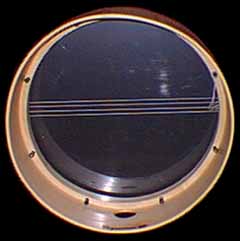
Moroccan
bendir
Traditionally
used in Irish pub music, the bodhrán is
16"-20" (40 cm-50 cm) in diameter and is played
with a double-ended stick known as a "tipper."
Both traditional and innovative hand techniques also exist.
Although the bodhrán can have jingles, it
is a frame drum that is usually without jingles. This is
probably because prior to 1950, tambourines were used in
Irish folk music since the 1830s but died out by the mid-1900s.
The switch to a frame drum without jingles may have to do
with preferences in the recording studio at that time Irish
traditional music began to be recorded. Many playing styles
exist including the Kerry style (use of both ends of tipper),
the Limerick style (use of a shorter, single-sided tipper),
the Roscommon style (use of bare hand only), and the Top
End style (from Northern Ireland, makes use of a larger
variety of left hand dampening and accented sounds while
playing with the a single end of the tipper on
the skin towards the top of the drum).
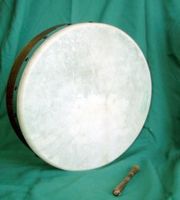
Traditional
Irish bodhrán with tipper
The gombe
(gome) is a large square frame drum played by the
Ashanti and Ga people in Ghana, usually 18" x 15"
(45 cm x 38 cm). This drum is set on the ground with the
player sitting down on the drum. The player reaches down
between the legs to strike the goat skin to achieve open
tones, slaps, and bass tones much in the way an Afro-Cuban
conga drum is played with the exception that the gombe
player uses the heels of the feet to press into the skin
to change the pitch. This drum may be used in highlife music
in place of a bass player (similar drums are played in Sierra
Leone and by the Maroon people in Jamaica).
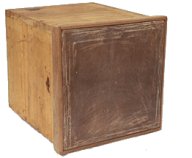
Gome
from Ghana
The panderão
and panderinho are frame drums used in the Brazilian
bumba meu boi folk music in Maranhão and Amazonas.
The pandeirão is a large frame drum of about 20"
(50 cm) that is held in the left hand with the skin facing
the player while it is beaten with the right hand. The panderinho
is a smaller frame drum of about 12" (30 cm) that is
held in the left hand with the skin facing up towards the
sky while it is beaten with the right hand. These two frame
drums traditionally play in a polyrhythmic texture along
with wooden sticks and other percussion.

Panderão from Brazil
The Puerto
Rican pandereta (also known as pandero)
is usually in three sizes 10" (25 cm), 12" (30
cm), and 14" (35 cm) in diameter, has tuning hardware
and a thick skin, and is used in traditional la
plena music. The playing technique is similar to
that for playing the congas, and the instrument is held
in the Traditional grip.
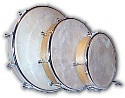
Panderetas
from Puerto Rico
The pandero
is a large frame drum from Spain and Portugal, 16"-20"
(40 cm-50 cm) in diameter. It can be played in the sitting
position, or held in the Traditional grip if the frame depth
is shallow enough. (Pandero and panderoa
are also terms sometimes used for tambourines in Portugal).
The patenge
is a rectangular frame drum that was used in an urban style
of music in Zaïre (now Democratic Republic of Congo)
known as maringa. The drum has two wooden legs
and is played with the hands while seated resting back against
the player. It resembles a rectangular and more shallow
gombe drum and is played much in the same manner
in terms of performance practice. A similar frame drum is
found further down the Atlantic African coast known as malinga.
The rammana
is a frame drum, 10" (25 cm) in diameter, used in the
classical music of Thailand and Cambodia. It is often played
simultaneously, either by the same player or another, with
a clay or wooden goblet drum called a thon. The
instruments are known collectively as thon-rammana.
The thon lies on the player's lap and is played
with the right hand, while the player holds the rammana
in the Lap style position and plays it with the left hand.
The playing technique involves low-pitched, rim, and stopped
sounds similar to those used in Arab drumming, and snapping
techniques similar to those of Persian drumming are used
on the rammana (left in photo below).

Thai rammana
& thon
The ravann
(or ravanne) is a large frame drum, 20" (50
cm), held on the lap and played in sega music on
the island of Mauritius (in Indian Ocean between Madagascar
and Australia, south of Sri Lanka).
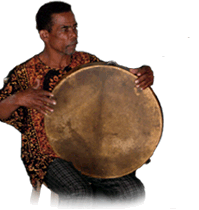
Ravanne
of Mauritius
The samba
drum is a rectangular frame drum from Nigeria usually 14"
(30 cm) in diameter and was used along with tambourines
in early forms of jùjú music. The
Christian church introduced tambourines and Nigerian made
versions (jùjú drum) may be square,
octagonal, or hexagonal but they are often referred to as
simply tambourines. Both drums were also used by street
musicians and small ensembles of Yoruban palmwine and asìkó
(ashiko) musicians. (Round clay
stick-beaten frame drums without jingles called sakara,
usually 12" (30 cm) or more, are also played in Nigeria
and Liberia).
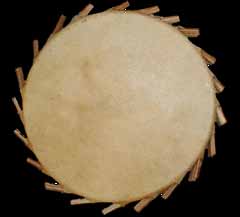
Nigerian
sakara
The sogo
is a small frame drum with a wooden handle played for
rhythmic accents by dancers in samul nori in South
Korea.
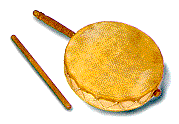
Sogo
from South Korea
The tamalin
is a large rectangular frame drum played in parts of Ghana
in three sizes, usually 17" x 14" (42 cm x 35
cm), 19" x 16" (47 cm x 40 cm), and 24" x
19" (58 cm x 47 cm) in diameter. These drums are used
by the Ashanti and Ga people in traditional ensembles as
well as their urban music called highlife. Each drum has
a cross piece in the back by which it is held (as in the
Irish bodhrán) and the drum is played with
the hand achieving open and closed sounds.
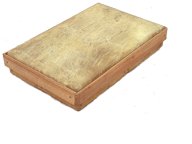
Tamalin
from Ghana
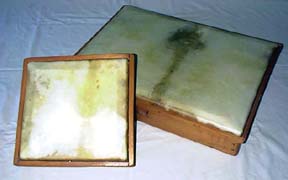
Tamalins
from Ghana
The Brazilian
tamborim (tambourim) is a frame drum used
for samba. It is 6"-8" (15 cm-20 cm)
in diameter, and has a wooden or metal frame, with a plastic
or skin head. The stick used to play the tamborim
has a frayed tip that produces a thicker sound than a regular
stick. Using the New grip, the player employs a technique
that involves turning the hand holding the drum so that
rhythms are produced on the skin as the drum rotates around
the stick. The hand holding the instrument also damps the
skin from underneath.
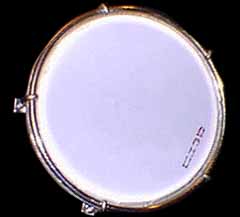
Brazilian
tamborim
The dappu (dap, thappu, thappattai, tharai, or parai) is a stick-beaten frame
drum found throughout India and Sri Lanka. Sizes vary from 11 inches in
diameter to 18 inches. The shell depth ranges from 3 to
4 inches approximately and the shell can be made from wood,
brass, steel, or aluminum. Traditionally, a goatskin was
used but modern versions make use of plastic skins. The dappu is used in traditional funeral music in Tamil
Nadu (thappattam) and Karnataka, has been used in some popular Tamil film
music, and has a long history of use in martial processions across India. A large ensemble of these frame drums with bass drums can be called thappu melam in Tamil Nadu.
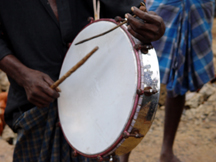
Dappu (dap or parai) in southern India
The Egyptian
tar—not to be confused with the tar
used in Persian music, which is a lute—is a circular
frame drum found in Arab music traditions throughout North
Africa. It ranges from 12" to 16" (30 cm to 40
cm) in diameter, and is held in the Traditional grip (tar
and bendir are often used interchangeably in Morocco
for frame drums with or without snares).
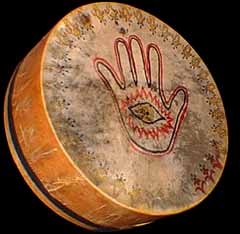
North African
tar (reconstruction)
Tambourines
Tambourines
vary in size, shell, skin and jingle type, as well as in
playing technique, and are usually circular (the Chinese
octagonal snake-skin tambourine bafanggu [or bajiaogu,
which is also the term for the ballad-chanting music in
Beijing this tambourine is used in] is an exception).
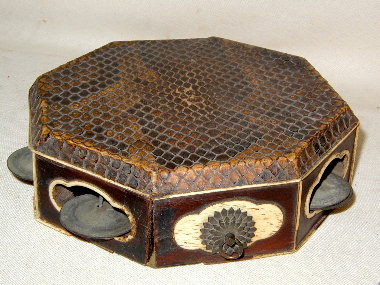
Chinese
bajiaogu (or bafangu)
The generic
tambourine, used in popular and orchestral music of the
West, is often held in the New grip. The playing technique
involves shaking the frame to activate the jingles and striking
the skin for accents. This approach seems to be focused
on producing a jingle sound, with no exploration of the
expressive possibilities of the skin. The playing techniques
of African-American tambourinists are an exception: in gospel
music and in vaudeville, the players rock the instrument
from side to side while striking it with the thumb for low
sounds and slapping it with the palm in the center for stopped
sounds. The famous vaudeville tambourinist, "Juba"
(William Henry Lane), performed in this style between 1840-1850.
Both the Traditional and New grips can be found in these
contexts.
The tambourine has long been used in Western art music orchestras in works by Wolfgang Amadeus Mozart (in various German Dances/1787-1789), and later in such famous pieces as the opera Carmen (Bizet/1875), Nutcracker Suite (Tchaikovsky/1892), and The Planets (Holst/1914/1917), among many other orchestra compositions.
What is
most commonly called a tambourine in the context of popular
music often does not have a skin and is technically neither
a tambourine nor a frame drum. Its proper name is "jingle
ring." The distinction between a tambourine and a jingle
ring is rarely made and usually only by knowledgeable percussionists.
Similar instruments are also common to India.
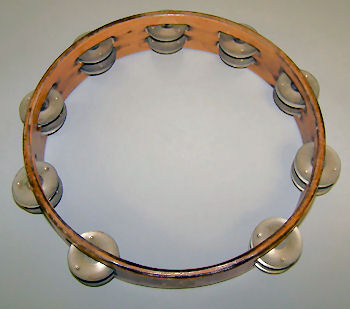
Jingle ring
from USA
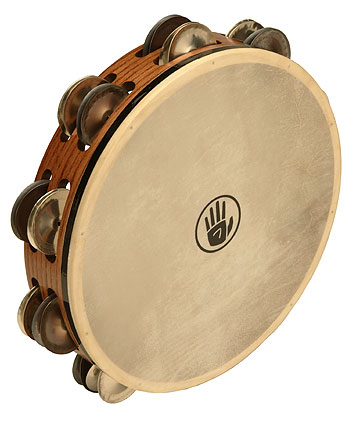
Orchestral
tambourine
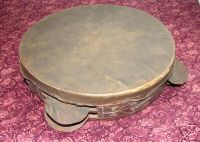
Vaudevillian
Tambourine
Following
are brief descriptions of tambourines found in popular music.
The bassé
(bas, tanbourin) is a Haitian frame drum,
12"-16" (30 cm-40 cm) in diameter, that can be
with or without jingles. Used traditionally in some rara
and voodoo music, it is also sometimes played in
Haitian popular music along with other traditional drums.
Held by a cross-brace or rope-tension system at the back,
the instrument is slapped for stopped and low sounds.
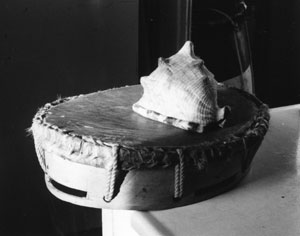
Haitian
bas (no jingles) & lambi (conch shell
trumpet)
The buben
is a Ukrainian stick-beaten tambourine, which features a
cord cross-brace on the inside frame from which various
other jingles, such as pellet bells, are hung.
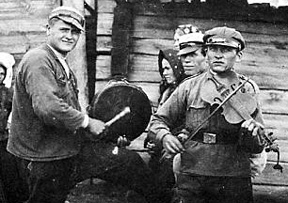
Ukrainian
buben player with fiddler
The doira
(or ghaval) is a tambourine played in Azerbaijan,
Afghanistan, Xinjian (China), Turkey, Uzbekistan (doyra),
Iran (dayereh), and in parts of the former Soviet
Union (doira). The preferred skin is fish but other
skin types such as cow, goat, and horse are used, and the
jingles are brass rings and/or pellet bells attached to
the inside of the frame. The instrument is held in the Oriental
grip, and the playing technique involves snapping the fingers
against the rim for accented high-pitched sounds, as well
as stroking the fingers toward the center to produce low
ringing sounds as well as sharp sounding slap strokes (doyra).
The frame can also be struck or shaken to activate the jingles.
The rings of the ghaval or dayereh tend
to be lighter than the heavier rings and much higher tuned
(& thicker) skin of the Uzbek doyra with the rings of the Persian dayereh being the lightest.
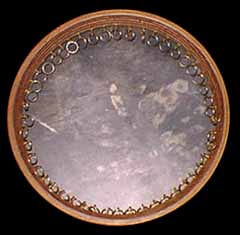
Azerbaijani
ghaval
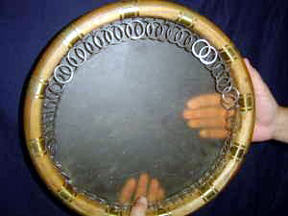
Uzbek doyra
The term
daf is used in Iran (Persia)/Kurdistan for a large
drum that has a series of four interlinked rings in the
frame where the ghaval (other terms for this drum
are dayereh or dayré) has only
a single ring. On the daf, the playing technique
involves shaking the frame so that the rings strike the
skin in conjunction with the player’s hand.
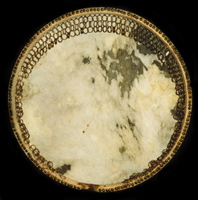
Daf
from Iran
Although
frame drums in India are numerous, there is one that has
been incorporated into western popular music. The kanjira
(also ganjira in Tamil and khanjira in
Kannada), used in the Carnatic classical tradition in southern
India, is a tambourine with a 6-7" (15 cm) lizard-skin
head and one pair of coin jingles. The skin, held in the
Traditional grip, is moistened so that it is loose enough
for the player to bend the low sound by pressing into it
with the holding hand. The playing technique involves double
strokes and rotating the right hand so that two different
sets of fingertips alternate on the playing surface. This
technique allows fast, clear repetitions of the stopped
sound along with a low sound produced by strokes of the
index finger.
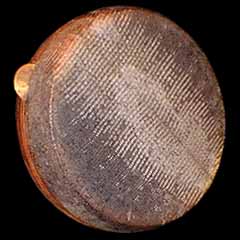
Kanjira
from India
Kanjari
is a term used in North India for tambourines used in folk
music. Sometimes the term duffli or duff (and
even kanjari) are used for the common Western tambourine
as well as a small frame drum without jingles in Northern
India.
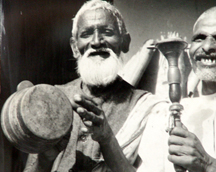
Duffli
from northern India
The Egyptian
mazhar looks like a large riqq (see below).
It is about 12"-14" (30 cm-35 cm) in diameter,
has huge brass jingles and is very loud. The playing technique
involves shaking the instrument and striking the skin for
low and stopped sounds.
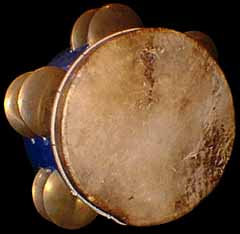
Egyptian
mazhar
The pandeiro
is a tambourine used in traditional Brazilian music, such
as samba, choro, and capoeira,
and in Brazilian pop music. It is 10"-12" (25
cm-30 cm) in diameter, with a plastic head or a skin head
of goat, calf, or boa constrictor. The frame can be made
of plastic, wood, or metal. The jingles are arranged in
a single row in the frame with sometimes three per slot;
the third jingle is usually flat and inserted in the middle
and restricts jingle movement, which allows the skin articulations
to be heard clearly. The New grip is used, and several playing
techniques exist that involve the player damping and turning
the drum from right to left with the holding hand while
striking it with different parts of the playing hand, moving
the instrument up and down to get jingle articulations while
striking, a non-turning flat style, a continuously turning
style, and playing on the edge of the skin with the fingers.
The term pandeirola is used for a jingle ring in
Brazil.
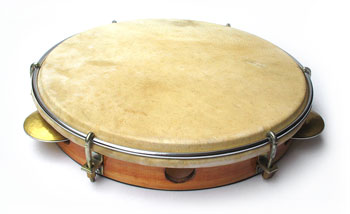
Brazilian
pandeiro
The octoganol Mexican tambourine,
the pandero, is usually 12"-14" in diameter,
with a single row of jingles. Played in Veracruz, Mexico,
it is used in an ensemble that performs
music in the son jarocho tradition (fandango),
a multicultural mix of Spanish, African, and indigenous
influences. Since the 1990s, there have been many groups
in California in the USA and southern Mexico playing a modern
version of this music with electric instruments and cross-cultural
performers including Conjunto
Jardín (USA) and Chuchumbé (Mexico).
A small heaxagonal pandero (6"-7") is also used in Chile (see
recordings by the group Illapu
and Héctor
Pavéz).

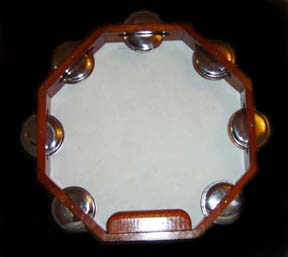
Mexican
pandero

Pandero
used in Chile in the group Illapu
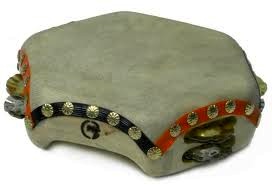
Pandero from Chile
The Spanish tambourine,
the pandereta, is usually 10-13 inches (25 cm-30
cm) in diameter, with usually a staggered row of jingles,
and is held in the Traditional grip but there are many variations in size and jingles. In Galicia (the northwestern
corner of Spain), the technique involves holding the pandereta
(also spelled pandeireta) in the right hand while often keeping the
left hand stationary (but some players do hold with the
left and play with the right). In this manner, the right
hand moves the pandereta around the left hand to
execute a variety of duple and triple rhythms. The thumb
and middle finger of the left hand are also used to articulate
rhythms across the surface of the skin and the instrument
can also be shaken and beaten much in the way a common tambourine
is played. In Basque Country, northern Spain (just left of
the border with France), a technique used for playing the
pandereta (also spelled panderoa) involves
bouncing the tips of the middle and/or ring fingers across
the skin in alternation with the thumb for duple rhythms
with the right hand (if the instrument is held with the
left but some players do hold with the left and play with
the right). This panderoa is also played in the French Basque Country of southern France in Gascony. In Asturias, northern Spain just next to Galicia,
and Cantabria (next to Basque Country), the pandereta
is used in annual festivals of folk music. The pandereta
from Asturias and Cantabria usually have smaller jingles
than those found on pandereta in Basque Country
and Galicia. In southern Spain there are two additional tambourine traditions. In Málaga, where the tambourine is called pandero, the tradition involves a very large tambourine (14-18 inches) with an excessive amount of jingles in a staggered triple row and different playing techniques. The pandero is used in ensembles called panda de Verdiales during annual festivities in late-December that feature Verdailes Flamenco music. In Seville, there is an old tradition of university student ensembles known as tuna that perform music and a dance in which a performer strikes a small pandereta while dancing. The tuna ensembles date back to the 1700s and are also found today in many parts of Latin America such as Mexico, Peru, Chile, Venezuela, and Colombia. The terms pandeiro and pandeireta
may be used generically in either Spain or Portugal indicating
tambourine. Basque terms for tambourine include panderoa
and pandero. The Galician term is pandeireta
and also pandera (with pandeira referring
to a large tambourine). Pandereta is the common
term for tambourine used in Asturias. Terminology can be
confusing for non-natives. Different terms and spellings
are often based on regional (and historical) differences,
the size of a particular drum, and feminine vs. masculine
language practice. Xabier Berazaluze, also known as "Leturia,"
is one of the most refined players of panderoa from the Basque Country in Spain and
has been recording on the instrument since 1986 primarily
with Tapia eta Leturia. Anerlis Gonzalez is pandereta
player from Asturias who records with Xuacu Amieva. Alba
Gutiérrez and Conchi Garcia are pandereta players from Cantabria. Rafael Barba is a pandero player in Málaga. Vanesa Muela is a pandereta player from Castile and León. Davide Salvado is a pandeireta and adfue player from Galicia.
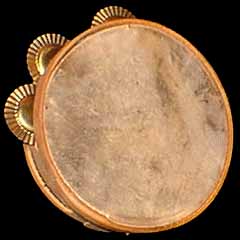
Pandeireta from Galicia, Spain
.jpg)
Pandereta from Asturias, Spain
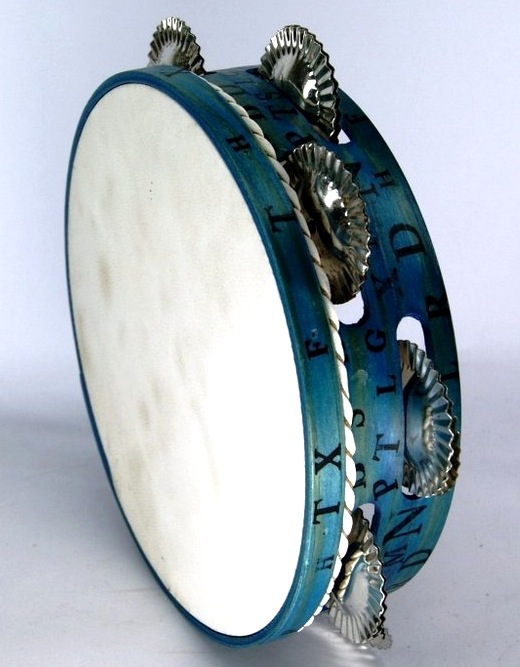
Panderoa from Basque Country, Spain
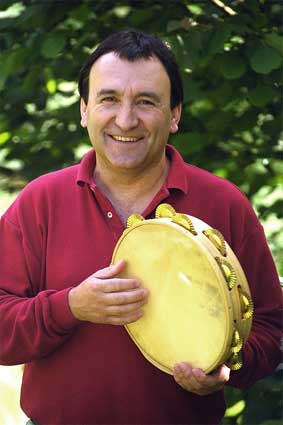
Basque Country
panderoa player Xabier Berazaluze "Leturia"
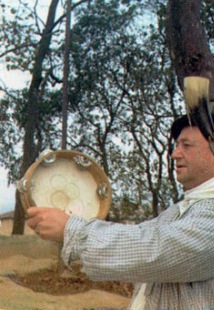
Panderoa player in French Basque Country, Gascony, France
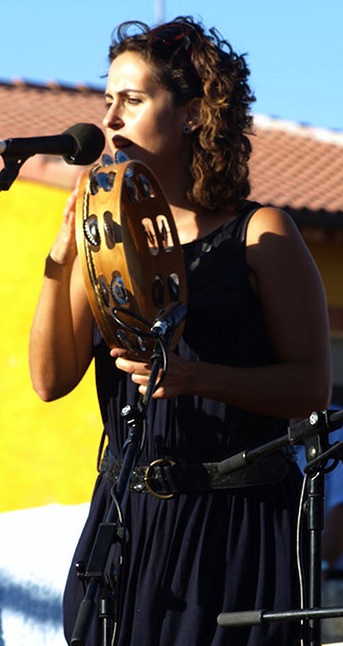
Vanesa Muela, pandereta player from Castile and León, Spain
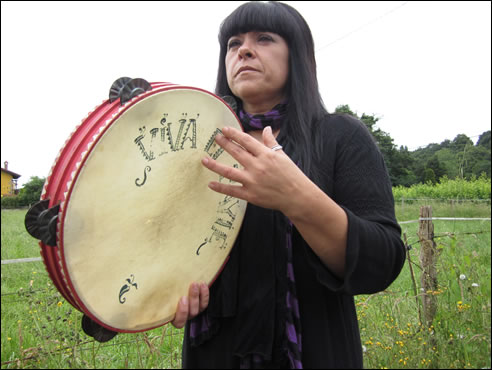
Conchi Garcia, pandereta player from Cantabria, Spain
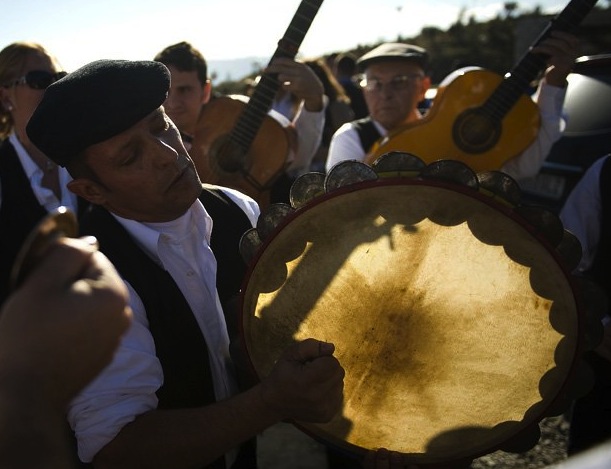
Pandero player from Málaga, Spain
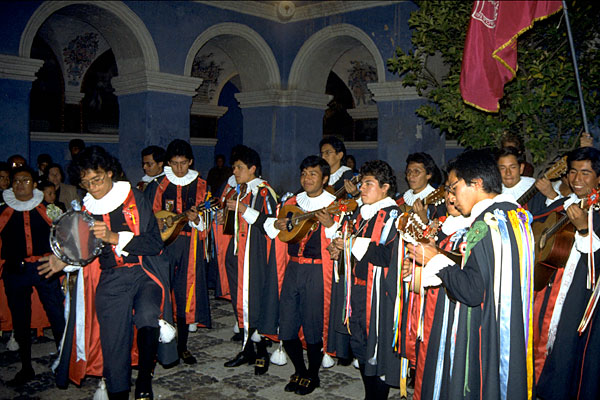
Pandereta player in a tuna ensemble from Peru
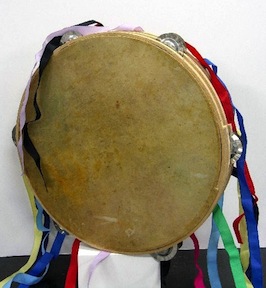
Pandereta for a tuna ensemble from Seville, Spain
The riqq
or deff (riq, duff), a tambourine
played in many parts of the Arab Middle East, North Africa,
Turkey (tef), and Israel, is 10" (25 cm) in
diameter, with five double pairs of jingles set into a wooden
or metal frame. The preferred skin is fish or plastic, but
it can also be goat or calf. The instrument is used in both
popular belly dance music and the Arab classical traditions.
The Traditional grip is used, and the playing technique
involves three basic skin sounds (doum, tek,
pa), playing on the jingles with the fingers (the
resultant sound can be called tik), shaking the
frame, and striking the frame itself. The instrument can
be played dramatically with a great deal of jingle strokes
and shaking, or in a softer style in which no jingle strokes
are used and the index fingers of both hands damp the skin
while the middle and ring fingers of both hands alternate
skin sounds.
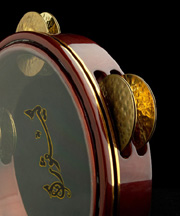
Arab riqq
The tamburello,
a southern and central Italian tambourine, is usually 10"-14"
(25 cm-35 cm) in diameter, with tin-can jingles but there is a great variety in size and jingles. It is held
in the Traditional grip. The playing technique, which involves
mostly right-hand strokes, is demanding and is based on
producing a triple stroke by means of a pivotal motion in
the center of the skin that moves from the back of the thumb
to the side of the hand to a full-hand slap. The left hand
is used in some traditions to shake or turn the drums to
activate the jingles (as in the Sicilian tradition). A variety
of playing styles for tamburelli (plural) exist in the different
regions of central and southern Italy including those found in Lazio,
Campania (Salerno & Naples), Montemarano, Puglia, Abruzzo,
Molise, Calabria, Marche, Basilicata, and Sicily. Terminology
can be confusing for non-natives. Different terms and spellings
are often based on regional practices and issues such as
the size of a particular drum.
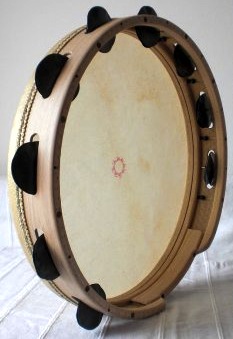
Tamburello for pizzica pizzica from Salento, southern Italy
(Pizzica pizzica is sometimes referred to as taranta)
A larger
version of the tamburello, with a deeper frame,
less jingles, and lower tuning, is called tammorra.
This tambourine is typically 14"-18" (35 cm-45
cm) or more in diameter, is held in the Traditional grip,
and requires a different technique, which involves bouncing
the playing hand across the skin to produce duple rhythms.
The tammorra is used for playing duple rhythms
in the traditional folk music dance known as tammorriata
(or tammuriata), which is found in Campania (particularly
Naples). Tammorra muta is a tammorra without jingles but more of a modern development.
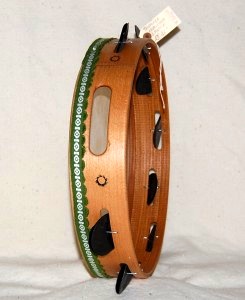
Tammorra for tammuriata from Naples, Campania, southern Italy
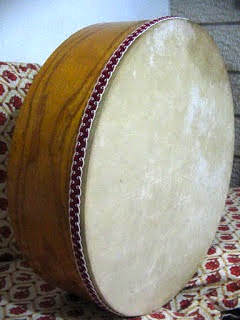
Tammorra muta from Campania, southern Italy
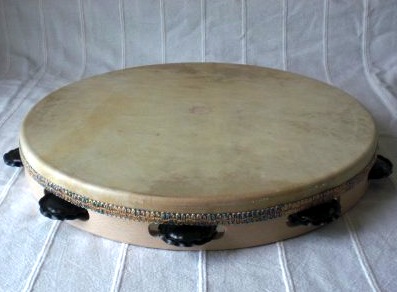
Tamburello from Sicily, southern Italy
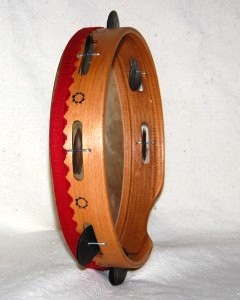
Tamburello for saltarello from Lazio, central Italy
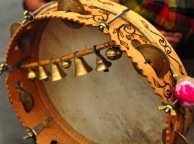
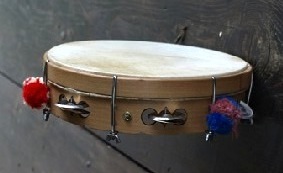 ----- ----- 
Tamburello from Marche, central Italy

Tamburello from Calabria, southern Italy
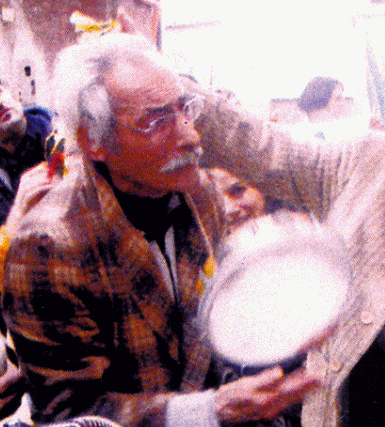
Tamburello player from Montemarano, southern Italy
The tamburo is
another tambourine variant from southern Italy found in central
and northern Puglia. It tends to be 12"-15" in diameter
with a deeper shell and handle much like a tammorra
with 4 sets of jingles arranged in overlapping double pairs
at each position on the drum and typically pellet bells
suspended across the back of the frame. The playing technique
involves prodigious use of the left hand for turning (at
times with a stationary right hand) as well as right hand
techniques that are similar to those used in pizzica
pizzica and saltarello tamburelli
traditions.
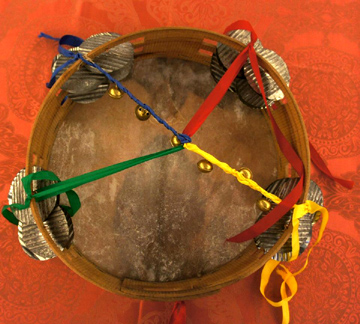
Italian
tamburo
Tamburello or palla tamburello is the name of a sport in Italy that is similar to tennis but with no net and small frame drums are used in place of rackets to bat a ball back and forth between two teams of five players each. This game is an old Italian tradition with thefirt tournaments being held in 1896. The rules for modern tamburello were established in 1920 with the Federazione Italiana Palla Tamburello being established in 1988. Several variations on the sport exist for play on the beach, with nets, and with three-player teams.
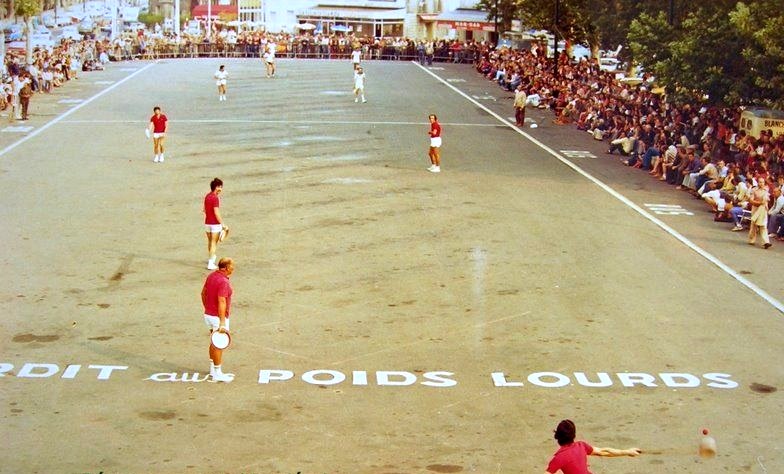
A game of palla tamburello
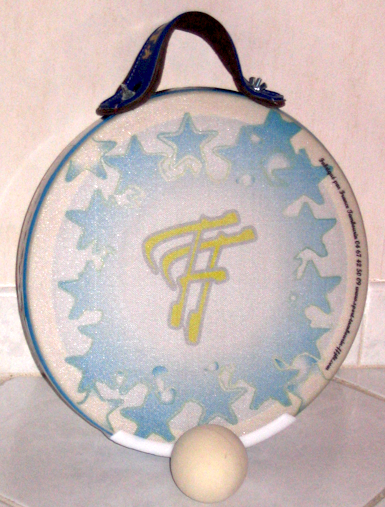
The frame drum bat and ball for the Italian sport of palla tamburello
The tambour
di bass is a large tambourine played in Martinique
of 20" (50 cm) in diameter. This tambourine is played
in an ensemble along with two barrel drums, bamboo flute,
shaker, a stick-beaten bamboo tube, singers, and dancers.
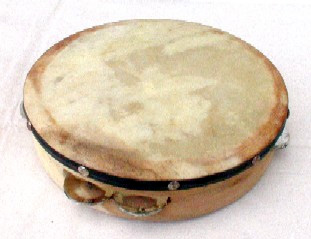
Terbang
from Indonesia
The terbang
is an Indonesian tambourine (known as rebana kercing
in Malaysia) with four to five pairs of jingles and is usually
10"-12" (25 cm-30 cm) in diameter. Held in Traditional
grip, the drum is played with the fingers utilizing the
doum and slap-style sounds. The frame is made from
wood and has a characteristic convex shape in the same manner
as the Thai rammana, Malaysian frame drums (marwas,
rebana besar, rebana ubi, kompang), and
Mongolian frame drums. Coming to Indonesia via Islam, the
terbang was used in older Central Javanese Islamic
ritual music called terbangan and was rarely used
in some Central Javanese gamelan ensembles and
other parts of Indonesia. Rebana is also a term
for a large frame drum (with or without jingles) in Indonesia
played in Lombok and in Betawi rebana biang ensembles.

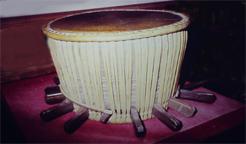
Rebana
besar & rebana ubi from Malaysia
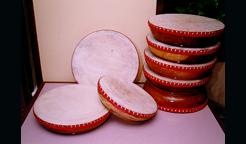
Kompang
from Malaysia
.jpg)
Singapore
Hadrah and Kompang Association
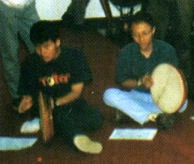
Malay kompang
players in Singapore
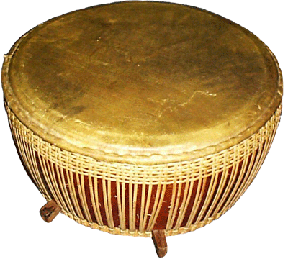
Rebana
from Indonesia

Rebana
player from Indonesia
Frame
Drums in Popular Music
Frame drums
in popular music is perhaps too broad a category to cover
in a single entry given the diverse musics of Egypt, India,
Brazil, Africa, USA, Native America, and Europe as there
is not always a binding common thread that unites these
instruments and musics in a single category. For this reason,
more ethnic musics that may be included within the popular
realm, such as Irish or Brazilian, will not be detailed
here. Instead, popular music of the West will be the focus
to bring attention to the more recent innovations in frame
drum playing and their subsequent adoption by many percussionists
in the 1980s-2000s.
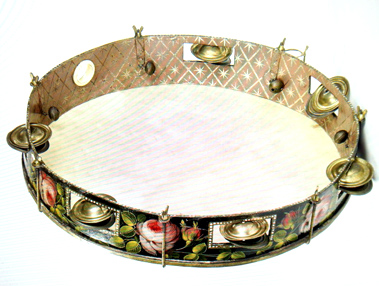
Tambourine
made by Tebaldo Monzani, ca. 1800, England
Between
1780-1840, the tambourine was popular
briefly in the salon music of England and even had locally
based composers and tambourine builders, such as organist
Joseph Dale, Sr. (1750-1821) along with his son Joseph Dale,
Jr., Thomas Bolton, the German Daniel Gottlieb Steibelt
(1765-1823), and the Italian builder/composer Tebaldo Monzani,
and composers G.P. Salner, Arthur Betts, Giacomo Ferrari,
Joseph Mazzinghi, and Muzio Clementi. The music these composers
wrote for tambourine involved a graphic notation that called
for highly specialized techniques with up to 30 different
strokes (some for show) that involved different types of
rubbing (bafs), twirling, and striking. Dale composed
eight waltzes that included this specialized tambourine
playing as well as The Favorite Grand Sonata,
for Piano Forte and Tambourine, with Accompaniments for
a Flute, Violin and Bass, Opus 18 (1800). Tambourines
in England at this time had a thumbhole spinner that allowed
the drum to spin freely around the thumb of the holding
hand, an effect called for in the notation.
Although
the tambourine does appear in European art music literature
before the compositions mentioned above (Christoph Willibald
Ritter von Gluck's opera Echo et Narcisse, 1779,
André-Modeste Grétry's opera La Caravane
du Caire, 1783 & Wolfgang Amadeus Mozart's Six
German Dances, K. 571, 1787), the specialized techniques
en vogue in England were not called for in those compositions
and the tambourine's use in them is most likely due to the
influence of martial music. Frame drums without jingles were first used much later in the Western art music compositions Le Marteau sans maître (Pierre Boulez/1955/1957), Inscape (Aaron Copland/1967), and both types of frame drums in John Cage's aleatoric solo composition Composed Improvisation for One-sided Drums With or Without Jangles (1988), among many other peices.

Minstrel tambourine
made in USA, 1858
In the
USA, it was with the rise of the minstrelsy (and later vaudeville) performers
that the tambourine experienced an innovation in playing
techniques and a rise in popularity as the primary minstrel
rhythm instrument. By the 1840s, an African-American tambourinist
known as Juba (William Henry Lane) was said, by Charles
Dickens, to astound audiences with a highly stylized way
of playing that included the ability to mimic the sounds
of trains and other mechanical devices (holding the tambourine
in the Traditional grip). Breaking the color barrier by
performing for White audiences, he toured the USA with a
group called the Ethiopian Serenaders in 1843 ending up
in London in 1848. By 1929, recordings featuring an African American
tambourine style were made by Paramount Records, featuring
tambourinist Uaroy Graves of the Mississippi Jook Band playing
a variety of gospel and blues songs. More contemporary African American
tambourinists from New Orleans include Sister Gertrude Morgan
and Rosalie "Lady Tambourine" Washington (both
performers using the New grip).
The distinctive
African American technique, however, remained exclusive to
gospel music. During the post-World War II era, the Salvation
Army adopted the tambourine for its efforts. Preferring
the biblical term, "timbrel," the Salvation Army’s
use of the tambourine did not involve an innovative playing
technique; rather, it was a symbolic and militaristic use
in the style of a marching band. Routines for large ensembles
of timbrel players were choreographed for visual appeal.
Two editions of a manual for timbrel were published between
1955 and 1960 that detail such routines involving formation
marching into various shapes with ensemble movement of timbrels
to various positions. Such routines were part of the Salvation
Army’s efforts through the 1960s.
With the
free jazz movement from the late-1950s-1960s, psychedelic
rock music of the 1960s, and jazz fusion during the 1970s,
ethnic influences on popular music began a steady stream
of influence culminating in the 1980s and 1990s with the
popularization and commercial packaging of "world music."
The term is often used generically for traditional ethnic
musics, rock/pop music with ethnic influences, creative-like
new age offerings, and an off-shoot of jazz fusion involving
multi-ethnic influences with a jazz aesthetic. It is within
this jazz context that a new innovation and subsequent rise
in popularity of frame drums occurred, influencing western
percussionists to learn non-western instruments. The first
recording of a jazz inspired world music fusion involving
frame drums was in 1958 by Ahmed Abdul-Malik called Jazz
Sahara. Along with American jazz saxophonist Johnny
Griffin, this recording features jazz musicians playing
with North African Arabic musicians and features the riqq
throughout in a typically traditional style. The recording
in 1967 by George Grunz, Noon in Tunisia: Jazz Meets
Arabia, along with several other European and American
jazz musicians, features traditional Bedouin musicians from
Tunisia and the bendir prominently. A subsequent
hour-long performance film of the same title was also released
in Germany in 1969 but with the added feature of trumpeter
Don Cherry. The bendir players on these recordings
performed in a traditional manner in a non-traditional setting;
jazz.
Use of
native frame drums and players on jazz recordings was not
that common but there are several recordings that provide
an historical continuum up to the major innovations in the
1980s. For example, in 1971 Native American jazz saxophonist
Jim Pepper, along with his father Gilbert Pepper, featured
Native American frame drums on several tracks of his recording
Pepper’s Powwow. To continue, the addition
of Brazilian percussionist, Airto Moreira to high profile
jazz artists like Miles Davis in 1969-70, Weather Report
in 1971, and Return to Forever in 1972 began featuring traditional
percussion instruments of Brazil within this new jazz context.
Brazilians Dom um Romão and Paulinho da Costa, along
with Airto Moreira (who became known for wild pandeiro
solos), began to feature the Brazilian frame drums, pandeiro
and tamborim, on their jazz inspired solo recordings
through the 1970s. Again, these frame drums outlined here
were played very much as they would be in traditional settings
as far as technique and rhythm patterns go. Another example
within the jazz context would be Natural Elements
by the group Shakti in 1977 as master percussionist of India
T.H. "Vikku" Vinayakram (sometimes spelled "Vinayakaram")
performs on kanjira alongside jazz guitarist John
McLaughlin. Jazz inspired recordings throughout the 1970s
that featured frame drums did so mainly with native players
of respective traditions performing much in the same way
they would within traditional contexts, which was a restriction
that led to frame drum use only where native rhythmic patterns
were compatible within the jazz context. Collin Walcott,
on the Paul Winter Consort’s Road in 1970,
is most likely the first western percussionist to use a
foreign frame drum technique on a jazz recording, the buben
(Ukraine-style sick-beaten tambourine), while Diga
in 1976, by the multi-cultural percussion group Diga Rhythm
Band, features Zakir Hussain of India on the Egyptian tar,
making these last two examples notable exceptions. Other
exceptions would be Afro-American tambourinist Joe Habad
Texidor, who performs on several recordings by jazz virtuoso
Rahsaan Roland Kirk (Volunteered Slavery in 1969)
in a style not typical of Afro-American musics featuring
tambourine, and Afro-American jazz percussionist Don Moye,
who used the bendir on his 1975 improvisatory solo
recording Sun Percussion Volume One.
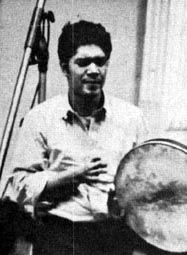
Bruce Langhorne,
folk-rock singer-songwriter in NY scene, 1965
In the
New York City folk-rock/singer-songwriter scene of the early-1960s,
Bruce Langhorne was a session musician who played a large
Turkish frame drum with pellet bells around the interior
(credited on recordings as simply "tambourine")
on several recordings by Richard & Mimi Fariña,
Bob Dylan, and others. Langhorne was not schooled in the
technique of playing frame drum and developed his own way
of striking the drum and obtaining timbres used in his work
as a session musician. Angus MacLise was another New York-based
percussionist that worked with the earliest version of The
Velvet Underground and used to some degree frame drums in
his work. A more traditional frame drummer that played with
rock musicians in the 1970s was the great Nubian musician
Hamza El Din, who played tar with The Grateful
Dead and others on numerous occasions.
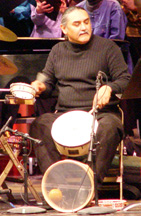
Glen Velez
with frame drums & brushes set-up
The use
of frame drums in popular music during the 1980s blossomed
into an innovative renaissance largely as a result of the
work of frame drum virtuoso Glen Velez. A type of new percussionist,
the innovation in the work of Velez centers around detailed
studies of unrelated frame drum techniques, such as Egyptian
riqq and tar, Azerbaijani ghaval,
Moroccan bendir, South Indian kanjira,
Brazilian pandeiro, and southern Italian tamburello,
with subsequent application of these techniques as a composite
performance technique to drums such as Irish bodhrán
(with bare hands or drumset brush and hand), Thai thon-rammana,
Native American frame drums, Spanish adufe, as
well as to the riqq, tar, ghaval,
bendir, kanjira, pandeiro, and
tamburello. This approach was successful because
nearly all frame drums have a similar basic physical construction
that allows for the transposition of techniques and ideas
resulting in a unified sonic possibility (such as three
onomatopoetic sounds from Middle Eastern drumming—used
in the West as doum, tak, and kah/pa).
The only criterion for this unified approach to frame drumming
is that the skin be thin enough to respond to the various
hand techniques (stick-beaten frame drums usually have thicker
skins and are not always the best choice for the application
of hand-drumming techniques). Later in his career, Velez
had also pioneered the use of brushes in conjunction with
hand drumming and drumset techniques and has even devised
a drumset-like set up of frame drums in which a tar
is held in the freehand grip between the legs while a kanjira
and tamborim are mounted on a stand with a ride
cymbal. With the addition of a maraca on his foot and brushes,
the range of sounds he can produce is quite expansive (see
recordings by Trio Globo). The early work of Velez demonstrates
his innovative approach in recordings by Horizontal Vertical
Band (duo with Charlie Morrow) in 1980-1981, Manzanita in
1981, and with Paul Winter in 1983. Velez’s first
solo recording Handance in 1984 shows a refinement
in his unified technique, which continued to develop both
in breadth and depth throughout his recorded work in the
1990s.
The unified
approach to frame drumming by Velez had a resultant impact
on western popular music in two ways. First, his stylized
approach created interest in many other percussionists causing
the Velez approach to playing in a unified manner to spread
amongst his students resulting in more performers of this
style in the New York area (Mark Nauseef, Layne Redmond,
N. Scott Robinson, Jan Hagiwara, Eva Atsalis, Randy Crafton,
Yousif Sheronick, and Shane Shanahan are all proficient
frame drum specialists with recording careers). Second,
the Velez unified and improvisational approach freed the
frame drum in western music from a reliance on compatibility
of traditional rhythmic patterns, which subsequently made
the kinds of musics they could be used in go beyond the
jazz context (see recordings featuring Glen Velez by Rabih
Abou-Khalil, Kimberly Bass, Malcolm Dalglish, Horizontal
Vertical Band, Patty Larkin, Manzanita, Mokave, New York’s
Ensemble for Early Music, Pilgrimage, Steve Reich, Akira
Satake, Richard Stolzman, Trio Globo, Suzanne Vega, and
Paul Winter).
Another
innovator during the latter 1980s, is multi-percussionist
John Bergamo. Located on the American west coast at California
Institute of the Arts (a music school with diverse world
music opportunities), Bergamo began applying North Indian
tabla and South Indian kanjira and thavil
techniques as well as conga, dumbeck, and other
drumming techniques to generic tambourines and frame drums
as well as the bodhrán, developing his own
unified approach to frame drumming. Differing widely from
the Velez School, Bergamo developed a grip where large frame
drums were held between the legs so that both hands were
free for playing. His approach also explored the sonic possibilities
of frame drums in new ways, such as obtaining harmonic pitch
bends with a sweeping of the hands upwards across the skin
and rubbing superball mallets on the skin for increased
sustain and harmonics. Bergamo did not limit his unified
approach to drumming to frame drums and explored possibilities
with African and Indonesian hand drums as well as suspended
Indonesian nipple gongs and found objects, such as metal
pots and jars of water, all played with the hands. Being
a leading instructor at a prestigious music school, Bergamo
was successful at creating his own pool of students that
went on to professional careers (Mark Nauseef, Rich Goodhart,
Austin Wrinkle, Andrew Grueschow, Peter Fagiola, and most
notably Randy Gloss who remains a highly innovative frame
drummer). His impact on popular music as a recording artist
with frame drums is more restricted to highly creative styles
of music (see recordings by Bracha, Mokave, Repercussion
Unit, and Hands On’semble). In the 1990s, another
contemporary American percussionist, Jamey Haddad, began
teaching his own unique style of frame drumming producing
a third frame drum "school" of playing and a pool
of highly proficient performers (such as Matt Kilmer). This
process of newer generations developing more refined frame
drum schools is ongoing (most notably in the work of the
Israeli percussionist Zohar Fresco and the German percussionist
David Kuckhermann, among others).
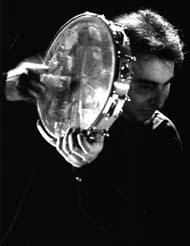
Carlo Rizzo
& polytimbral tambourine
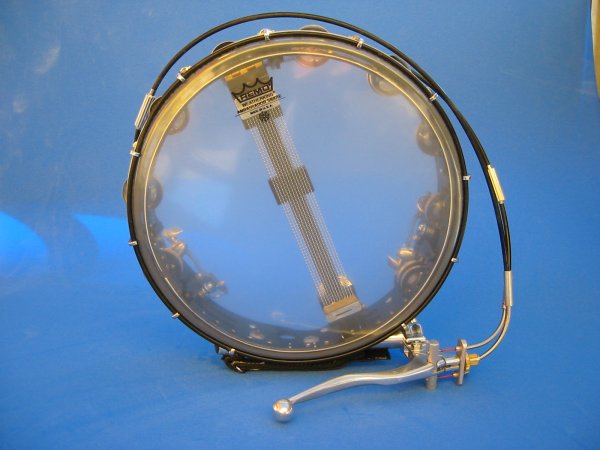
Melodic
tambourine (copy of Rizzo's polytimbral tambourine) by
Guillaume Toutain
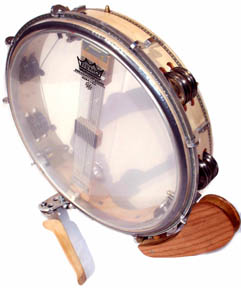
Melodic
tambourine by Guillaume Toutain
By the
late-1980s in Europe, Italian tambourinist Alfio Antico
had developed numerous new techniques for tamburello
and tammorra for non-traditional playing. Many
of the modern virtuoso performers in Italy of tamburello
have studied with Antico and employ his techniques as well
as having developed some of their own. The Italian virtuoso
Carlo Rizzo developed a unique and highly individual unified
approach to tambourine playing with a synthesis of Italian,
Persian, and Indian drumming techniques. By engineering
his own "polytimbral tambourine," Rizzo could
control the tension of the skin, application of snares,
and dampening of jingles making his instrumental solos sound
distinctly like tamburello, tammorra,
kanjira, bendir, dumbeck, or
a snare drum within a single performance. Residing in France,
he recorded with a host of diverse European artists (Luc
Ferrari, Michael Riessler, André Velter, Justin Vali
Trio, Valentin Clastrier, Antonio Placer, and Rita Marcotulli)
throughout the 1990s before his first solo recording Schérzo
"Orientale" was released in 1997. Arnaldo
Vacca and Andrea Piccioni are examples of the younger generation
of performers who have built upon their studies with Alfio
Antico and developed their own innovations. Many of the
younger contemporary performers have mastered all of the
regional tamburello and tammorra styles
and have invented new versions of the tamburello
with new techniques including a quadruple stroke with a
single hand motion (see recordings by Indaco & Xicrò).
In Brazil
in the 1950s and 1960s, Jackson do Pandeiro [whose real
name was José Gomes Filho] was a popular artist known
for singing in a variety of styles and his pandeiro
playing but it was in the 1990s that the pandeiro
experienced a liberating renaissance as a result of the
work of percussionist Marcos Suzano (particularly in his
work with the group Aquarela Carioca). Taking a technique
initially developed by Jorginho Silva and Celsinho Silva,
Suzano played in a style that seemed to combine Brazilian,
Indian, and drumset techniques/rhythms in a way as to sound
like pandeiro, kanjira, and funk drumset
during performance by employing a constant sixteenth-note
shaken subdivision with the left hand (pandeiro
holding hand). This technique was actually revived by Suzano
not invented by him but the younger generations of pandeiro
players use it almost exclusively to play non-Brazilian
music (such as funk). Residing in Brazil, he recorded with
many artists local to Brazil and the USA (Hendrik Meurkens,
Maria Bethania, Joan Baez, Ana Gabriel, Ashley Cleveland,
Gilberto Gil, Marisa Monte, Boca Livre, Joyce, Carlinhos
Brown, and Carlos Malta). In 1996, his solo recording Sambatown
was released.
In the
1990s, several percussionists from South India had developed
newer playing styles for the kanjira outside of
Carnatic music. With the death of one of the most proficient
kanjira players in India in 2002, G. Harishankar,
younger players such as N. Ganeshkumar and T.V. Selvaganesh
became known for playing the instrument outside of classical
music and India in the 1990s (along with Trichy Sankaran
in Canada). These musicians developed rhythmic styles on
the kanjira that mimicked typical funk rhythms
of the drumset and drew somewhat on the rhythmic and technical
complexity of G. Harishankar's earlier innovations. While
both had performed and recorded with fusion groups in India,
Ganeshkumar recorded with Béla Fleck and the Flecktones
(Little Worlds—2003) and John Wubbenhurst
(Facing Beloved—2003) while Selvaganesh recorded
with Remember Shakti (The Believer—1999 and
Saturday Night in Bombay—2000) and Jonas
Hellborg (Good People in Times of Evil—2000).
Kanjira artists within India that continued in
the much deeper and more complex playing style of G. Harishankar
since 2000 include B. Shreesundarkumar in Chennai, N. Amrit
in Bangalore, and Nerkunam Sankar in Chennai who have played
together in a unique kanjira trio. In 2001, Ganesh
Anandan, a South Indian percussionist who lived in Canada,
developed a frame drum kit that involved multiple frame
drums bolted on top of each other and played as a single
instrument. Anandan's technique involved kneeling in between
two sets of multiple frame drums bolted on top one another
on either side of him while employing both traditional and
non-traditional strokes such as use of the thumb, scrapes
with the fingernails, and striking the back of the wooden
shells with thin sticks (featured on the GaPa 2003 CD Imaginaria).
Daf
player Houman Pourmehdi is known for using the traditional
Iranian tambourine in new musical contexts. After arriving
in Chicago in 1988, he later relocated to California where
he founded the Liän Ensemble for playing traditional
Persian music as well as a fusion of Persian, Hindustani,
and creative contemporary music. Throughout the 1990s and
2000s, Pourmehdi has performed and recorded with Ishmael
Wadada Leo Smith, John Bergamo, Hands On'semble, David Johnson,
and Rajeev Taranath, among others.
Following
its use in Irish folk music in Kerry, the bodhrán
started being used more in the late-1950s after it was featured
in a Dublin theater production of Sive by
John B. Keane in 1959. Later bodhrán
players in Ireland expanded the technical possibilities
of their instrument. Leading innovators have developed pitch-bending
techniques with the left hand since the 1970s. Perhaps the
best known of these inventive players is John Joe Kelly
of the group Flook.
Other innovators include Tommy Hayes, who bends the pitch
of the bodhrán by pressing the left hand
fingers against the skin. Rónán Ó’Snodaigh
developed a technique in the 1990s in which the left hand
places a 6-inch piece of steel pipe against the skin to
achieve tabla-like pitch bends. Brian Fleming,
who regularly uses the steel pipe pitch bending technique,
also sometimes uses a drumset brush in his right hand in
place of the traditional tipper to achieve helicopter-like
effects (many leading bodhrán players are
featured on the double compilation CD Pure Bodhrán:
The Definitive Collection-1927/2000).
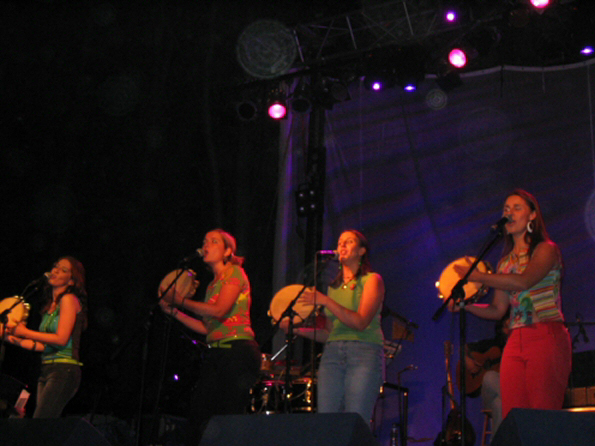
Faltriqueira—One
of the Galician pandereteira ensembles
In Spain, both Basque
panderoa and Galician pandeireta players
worked with groups that combined traditional instruments
with electric instrumentation and crossover musical styles.
The Basque group Oskorri
has been recording since 1976 and features Natxo de Felipe
on the Basque tambourine known as panderoa. In
Galicia, a revival of pandeireta playing and singing
began in the early-1990s when the Spanish government started
to fund schools for learning traditional music. Currently,
the movement has developed to feature all-female groups
such as Leilía
and Faltriqueira
who perform traditional music with some new twists (polyphonic
vocals). Perhaps the best-known and most experimental Galician
pandeireta player is Mercedes
Peón, who mixes many musical styles and electronic
effects in her music. Eliseo Parra is a singer and player
of pandereta who performs a blend modern popular
music with folk styles from all over Spain. Recordings of
his music have been released since 1984.
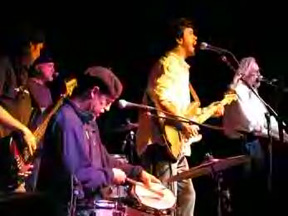
Steve Amedée
with The Subdudes
In rock music, some percussionists
specialized in the use of frame drums. Jack Ashford was
the percussionist with the Motown label’s premier
soul backing group known as The Funk Brothers (featured
in the DVD Standing in the Shadows of Motown—2002).
Ashford played a common tambourine on many of the Motown
hits from 1959 to 1972 and continued recording with many
artists. Since the late 1960s, English studio percussionist
Ray Cooper has performed on tambourine with rock artists
such as The Who, George Harrison, Elton John, and Eric Clapton,
among others (featured in a special duet with Elton John
in the video To Russia With Elton—1979).
During tours in the 1980s, Phil Collins, the drumset player
and singer from the pop group Genesis, frequently performed
short features with a common tambourine as part of an elaborate
stage show. The innovative Steve Amedée (often spelled
Amadee) of the New Orleans group The Subdudes (also with
the trio known as The Dudes) plays a modified 11-inch plastic-headed
Cosmic Percussion brand tambourine made by Latin Percussion
and plays it with a single modified brush/stick called Blastick
made by Calato-Regal Tip. His technique also involves close
proximity of a microphone, and he is able to fully support
an entire acoustic ensemble in place of a drumset player
with snare drum and bass drum types of sounds and pitch
bends (Lucky by The Subdudes—1991 and his
instructional video The Amedée Way). Irish
percussionist Jim Sutherland played bodhrán
with Jimmy Page and Robert Plant in 1994 (featured on the
DVD No Quarter: Unledded) while English percussionist
Terl Bryant plays a specially built synthetic tunable bodhrán
and other frame drums having worked with John Paul Jones,
Robin Mark, and Peter Murphy, among others. Pete Lockett
is another English percussionist who works creatively with
frame drums in a variety of popular music styles.
Lastly, unique festivals
exclusively for frame drumming have been occurring annually
in the 2000s as the result of several frame drum organizations
that hold workshops on every type of frame drumming and
feature concerts of both traditional and modern frame drummers.
The first of these contemporary organizations was Frame
Drums Europe, organized by the Italian artist and frame
drummer Gianluca Baldo, who held the annual European Frame
Drummers Meeting in the early 2000s in Spain on three occasions.
A second organization, Caravansary, organized by Lennie
Charles, held annual frame drum festivals in England from
2005-2008. Another organization, Tamburi
Mundi, organized by Turkish percussionist Murat Coskun,
has been holding annual frame drum festivals in Germany
since 2006 and they have held regional smaller events in
Germany, Iran, Italy, and Turkey. The Greek Frame Drums
Meeting, organized by Gerasimos Siasos, held its first event
in 2008 in Greece while the annual Festa da Pandeira in
Spain, organized by Juanjo Fernández since 2005,
held its 5th event in 2010. The North
American Frame Drum Association, Inc. began holding
regional events around the USA (in New Jersey, Vermont,
Missouri, California, and Georgia) and Canada (Ontario)
since 2008, organized by N. Scott Robinson, among others.
In 2010, a new organization, Frame Drums Italia organized
by Andrea Piccioni, held its first event preceded by other
Italian organizations/festivals including the Società
Italiana Tamburi a Cornice, led by Paolo Cimmino, that has
held the annual Meeting Italiano del Tamburello since 2007.
Other associations for frame drumming include the Japan
Frame Drum Association and the National Percussion &
Frame Drum Association in Taiwan. With the growth and popularity
of online social networks, such as MySpace (since 2006)
and Facebook (since 2008), numerous social networking frame
drum groups have formed of every type all over the world.
Conclusion
By a new kind of western
percussionist approaching frame drums as a single family
of instruments, it has become common to mix the playing
techniques, grips, and ideas associated with each instrument
to create a unified composite vocabulary that can be used
on almost any frame drum as its playing technique. Since
this approach operates mostly outside of each instrument’s
respective cultural tradition, innovative use of frame drums
in western popular music continues alongside traditional
frame drum use in various regional ethnic musics. Although
modern frame drumming in Western music contexts remains
a small culture, it shows signs of a continued growth and
expansion while the traditions modern frame drummers draw
upon remain strong in the respective cultural contexts of
traditional areas, most notably Iran, the Middle East &
North Africa (in both Arab & Jewish musics), Uzbekistan,
Azerbaijan, southern India, Brazil, southern Mexico, Puerto
Rico, northern Spain & Portugal, southern Italy, Turkey,
Ireland, and Malaysia.
[An edited and older version
of this article was published as "Bodhrán"
and "Frame Drums and Tambourines" in Continuum
SPACE SPACE
Encyclopedia of Popular Music of the World, Volume
2: Performance and Production. Edited by John
Shepherd, David SPACE Horn,
Dave Laing, Paul Oliver, and Peter Wicke. New York: Continuum,
2003, 349-350, 362-372].
Bibliography
Adolfo, Antonio. Brazilian Music Workshop.
Rio de Janeiro: Advance Music, (year unknown).
Alaja-Browne, Afolabi. "The
Origin and Development of JùJú Music." Popular Music
8, no. 3 (1989): 231-242.
________. "The Origin and
Development of JùJú Music." The Black Perspective in
Music 17, no. 1/2 (1989): 55-72.
al-Faqih, Elie. Eastern Percussion
Methods. (Lebanon: publisher & year unknown).
Anand, A.V. "Uniqueness and Limitations
of Khanjari & Ghata in Relation to Mrudanga." In
Talavadya Seminar—2. Edited SPACE
SPACE by Bangalore K. Venkataram. Bangalore: Percussive
Arts Centre, 1996, 67-68.
Anandan, Ganesh. Solkattu:
South-Indian Drumming Techniques for Bodhran. Canada:
SOCAN, 2004. [Book & DVD].
Ashford, Jack with Charlene
Ashford. Motown: The View from the Bottom. New
York: Bank House Books, 2003.
Avtar ‘Vir,’ Ram. Musical
Instruments of India: History & Development. New
Delhi: Pankaj Publications, 1983.
Aziz-zadeh, Siamak. Forty
Pieces for Daf. Tehran: Moassésé Farhangi
Honari-e-Sohail Pouyesh, 2002.
Baazm, Said. Pieces
for Playing Daf. Tehran: Chang Publications, 2002.
Belloni, Alessandra. "Sud
E Magia—South and Magic: A Living Tradition of Southern
Italian Frame Drums and Tambourine SPACE
SPACE Festivals."
Percussive Notes 35,
no. 5 (October 1997): 37-41.
________. "Tarantella:
The Dance of the Ancient Spider." Percussive Notes
42, no. 1 (February 2004): 10-16.
________. "Tamburello
e Tarantella: Southern Italian Tambourine and Frame Drum
Style." Percussive Notes 45, no. 1 (February
SPACE 2007):
32-35.
________. Rhythm is
the Cure: Southern Italian Tambourine. Pacific, MO:
Mel Bay, 2007 (book & DVD).
________. Healing Journeys with the Black Madonna: Chants, Music, and Sacred Practices of the Great Goddess. New York: Bear SPACE & Co., 2019.
Bergamo, John with Janet
Bergamo. "Exploring Tambourine Techniques."
Percussive Notes 28, no. 3 (1990): 12-14.
Blank-Edelman, David N.
"Glen Velez: A Unified Approach to the Frame
Drum." Rhythm Music 3, no. 8 (1994), 38-43.
________. "Glen Velez:
From South India to Azerbaijan, Velez Finds a Unified Approach
to the Frame Drum." Percussion Source SPACE
1, no. 1 (1995), 10-12.
________. "Randy Crafton on the Care and Feeding of Frame Drums." Crafton Percussin Works (1996 catalog), 6-7.
Bolton, Thomas. Six
Waltz's Composed and Adapted as Lessons, for the Piano-forte,
with Accompaniments for a Tambourine and SPACE
Triangle ad libitum and Instructions
for Performing on the Tambourine, Opus 5. London: Goulding,
Phipps & D'Almaine, SPACE
1799.
________. Bolton's
Op. 7, for the Piano Forte (with Accompaniments ad libitum,
for the Tambourine, Triangle & Cymbals) SPACE
SPACE Consisting
of Marches, Rondos & Other Movements. London: Goulding,
Phipps & D'Almaine, 1799.
Braund, Simon. "Tambourine
Man: Airto Moreira." Rhythm: Total Percussion Magazine
2, no. 4 (1989), 23-24, 27-28.
Brooks, Iris. "Meet the
Composer: Glen Velez." Ear: Magazine of New Music
12, no. 6 (1987), 16- 19.
________. "Around the
World: Glen Velez." Modern Drummer 11, no.
9 (September 1988), 76-79.
________. "Glen Velez:
Hands Dancing." Jazziz 8 (August 1995), 60,
61, 63, 65, 67.
________. "Meet Glen Velez." Crafton Percussion Works (1996 catalog), 2.
________. "Rhythm is
the Cure-Alessandra Belloni." Rhythm Music 5, no.
7 (1996), 20-23.
________. "Alessandra Belloni."
Percussion Source 1, no. 2 (1996), 26-29.
________. "Colors &
Scents: Glen Velez Draws Inspiration From the World Around
Him." Drum! 6, no. 1 (1997), 75-78.
________. "Glen Velez:
Embodies the Essence of Rhythm." Drum! 10,
no. 2 (March/April 2001), 67-68, 70, 72, 74, 76, 132.
Browning, Robert (editor).
"Kavkazi." In Maqam: Music of the Islamic
World and its Influences. New York: Alternative Museum,
SPACE 1984,
40.
Bugg, D. Doran. "The
Role of Turkish Percussion in the History and Development
of the Orchestral Percussion Section: A SPACE
SPACE Monograph."
DMA diss., Louisiana State University
and Agricultural and Mechanical College, 2003.
Cage, John. Composed
Improvisation No. 3 for One-sided Drum with or without Jangles.
New York: C.F. Peters, 1990. (Score for SPACE
solo frame drums).
Cally, Sully. Musiques
et Danses Afro-Caraïbes: Martinique. Gros-Morne, Martinique:
Sully-Cally/Lezin, 1990.
Caputo, Jennifer. "La
Tammurriata: Contamination and Recuperation of an Ancient
Tradition in Campania, Italy." Ph.D. diss., SPACEWesleyan
University, 2014.
Carroll, Raynor (compiler).
Orchestral Repertoire for Tambourine, Triangle, and
Castanets. Pasadena: Batterie Music, 2000.
Cimmino, Paolo. A New Way of Playing
Tamburello. Naples: Versand H. Brandt, 2003.
________. 5 Tamburello Solos.
Naples: Paolo Cimmino, 2007.
Clark, Owen. "Percussion
in the Opera Orchestra in the 17th & 18th Centuries."
Percussive Notes 5, no. 3 (March 1967): 11-14.
Clementi, Muzio. Twelve
Waltzes for the Piano Forte with Accompaniment for a Tamburino
& Triangle, Opus 38. London: SPACE
SPACE Longman
& Broderip, 1798.
________. Twelve Waltzes
for the Piano Forte with Accompaniment for a Tamburino &
Triangle, Opus 39. London: Muzio SPACE
SPACE Clementi & Co., 1807.
Cohen, Judith R. "'This Drum I Play:'
Women and Square Frame Drums in Portugal and Spain,"
Ethnomusicology Forum 17, no. 1 SPACE
(June 2008): 95-124.
Collins, John. Music
Makers of West Africa. Boulder, CO: Lynne Rienner Publishers,
1985.
________. "The
Early History of West African Highlife Music." Popular
Music 8, no. 3 (1989): 221-230.
Combs, F. Michael. "An
Experience in African Drumming." Percussionist
11, no. 3 (Spring 1974): 106-115.
Consolmagno, Peppe [Giuseppe
Consolmagno]. "Alessandra Belloni." Percussioni
10, no. 94 (1999), 56-63.
Courlander, Harold.
Haiti Singing. New York: Cooper
Square Publishers, 1939.
________. The Drum in
the Hoe: Life and Lore of the Haitian People. Berkeley:
University of California Press, 1960.
Crafton, Randy. Getting Started with Frame Drums (booklet & cassette). New York: Crafton Percussion Works, 1995.
________. Snapping Techniques on Frame Drums (booklet & cassette). New York: Crafton Percussion Works, 1996.
________. Kitatakas for Frame Drums (booklet & cassette). New York: Crafton Percussion Works, 1996.
________. Duets for Frame Drums (booklet & cassette). New York: Crafton Percussion Works, 1996.
Cronshaw, Andrew. "Tambourine
Queens." Folk Roots (August/September 2003),
20, 21, 23, 25.
Cunningham, Eric. "J.J.
Kelly: Sticking with the Roots." M.A. thesis, Ireland,
1999.
da Anunciação, Luiz Almeida.
A percussão dos ritmos
brasileiros sua técnica e sua escrita. Caderno II:
O pandeiro estilo brasileiro SPACE
(The Percussion Instruments of
the Brazilian Typical Rhythms: Their Technique and Their
Musical Writing. Book 2: The SPACE
"Pandeiro" Brazilian
Style). Rio de Janeiro: Europa Gráfica e Editora,
1990.
da Fonseca, Duduka and Bob
Weiner. Brazilian Rhythms for
Drumset. Miami: Manhattan Music, 1991.
Dale, Jr., Joseph. Dale's Instructions
for the Tambourine. London: Joseph Dale, 1800.
Dale, Sr., Joseph (with tambourine parts
by Joseph Dale, Jr.). The Favorite Grand
Sonata, for the Piano Forte and Tambourine, SPACE
with Accompaniments
for a Flute, Violin and Bass, Opus 18. London:
Joseph Dale, 1800.
Daly, Robert. The Bodhran: An Irish
Drum—Beginner. Robert Daly, 2008.
________. The Bodhran: An Irish Drum—Advanced.
Robert Daly, 2008.
Deal, Scott. "The
Eskimo Drums of Alaska." Percussive Notes 36, no.
1 (1998): 54, 56-59.
Deane, Christopher. "Improving
Your Tambourine Skills." Percussive Notes
31, no. 1 (October 1992): 29-30.
de Assis, Gilson. Brazilian Percussion.
Munich: Advance Music, 2003.
Deloche, Jean. A Study in Nayaka-Period Social Life: Tiruppudaimarudar Paintings and Carvings. Puducherry: Institute Francais SPACE De Pondicherry, 2011.
de Rosa, Gennaro. "Tamburellando
con Arnaldo Vacca." Percussioni 12, no. 117
(April 2001), 57-60. 62-64.
de Simone, Roberto. Canti
e tradizioni popolari in Campania. Rome: Lato Side,
1979.
Desroches, Monique. Tambours
des dieux: Musique et sacrifice d'origine tamoule en Martinique.
Montréal: Harmattan, 1996.
Deva, B. Chaitanya. Musical Instruments
of India: Their History and Development. Delhi: Munshiram
Manoharlal, 1987.
________. Musical Instruments in Sculpture in Karnataka.
Shimlai: Indian Institute of Advanced Study, 1989.
________. Musical Instruments. New Delhi: National
Book Trust, 1999.
Diagram Group, The. Musical
Instruments of the World: An Illustrated Encyclopedia.
New York: Paddington Press, 1976.
Dickens, Charles. American
Notes for General Circulation. England: Chapman &
Hall, 1842.
Dionisio, Giuseppe and Cinzia D'Aquino.
Il volto della tradizione: Riti e tammurriate nella
festa di Bagni. Sarno, Italy: Labirinto SPACE
Edizioni, 2003.
Doerschuk, Andy.
"Layne Redmond: Following in the Footsteps
of the Drumming Goddesses." Drum! 5, no.
2 (March 1996), 38, 40, SPACE
42, 45.
________. "Layne
Redmond: Chasing the Frame Drum Through History." Drum!
7, no. 1 (February/March 1998), 78-79, 81-82, SPACE
84.
Donald, Mary Ellen. Arabic
Tambourine: A Comprehensive Course in Techniques and Performance
for the Tambourine, Tar, and SPACE
Mazhar. San Francisco: Mary
Ellen Books, 1985.
Dopico Orjais, José
L. "Pandeireta, Pandeiro, ou adufe." Raigame
13 (2001): 50-56.
Dorsey, Ed. "An
Interview with Glen Velez." Percussive Notes 25,
no. 4 (Spring 1987): 56-60.
Doubleday, Veronica. "The
Frame Drum in the Middle East: Women, Musical Instruments
and Power." Ethnomusicology 43, no. 1 SPACE
(1999): 101-134.
________. "The Frame
Drum in the Middle East: Women, Musical Instruments, and
Power." In Ethnomusicology: A SPACE
SPACE SPACE Contemporary
Reader. Edited by Jennifer
C. Post. New York: Routledge, 2006.
Driver, Nicholas. Nicholas Driver's
Bodhrán & Bones Tutor. Crawley: Gremlin
Musical Instrument Company, 1988.
Durga, S.A.K. "Frame Drums and Pot
Drums in World Musics with Special Reference to Khanjari
and Ghatam." In Talavadya SPACE
SPACE Seminar—2. Edited by Bangalore K. Venkataram.
Bangalore: Percussive Arts Centre, 1996, 35-39.
El-Dabh, Halim. Hindi-yaat No. 1.
New York: C.F. Peters, 1965.
________. Tabla-tahmeel No. 1. New York: C.F.
Peters, 1965.
Emsheimer, Ernst. "On the
Symbolism of the Lapp Magic Drum." The World of Music
19, no. 3/4 (1977): 45-61.
Euba, Akin. "Jùjú, Fújì,
and the Intercultural Aspects of Modern Yoruba Popular Music."
In Essays on Music in Africa Volume 2. SPACE
Lagos, Nigeria: Elekoto Music Center,
1989, 1-30.
Fagiola, Peter. "A Discussion
of Frame Drums." Percussive Notes 35, no. 6 (1997):
30-33.
________. Frame
Drumming: Free Hand Style. Milwaukee: Hal Leonard Publishing,
1999.
Faleiros, Gustavo. "Marcos
Suzano: O Electrônico-Raiz." Batera &
Percassão 4, no. 35 (July 2000), 12.
Falvo, Robert. "Beginning
with the Tar." Sticks & Mallets 1, no. 1 (1997), 54-55,
64.
Farmer, Henry G. "Percussion and Petticoats."
Music & Letters 31, no. 4 (October 1950): 343-345.
Faue, Michael. A Guide
to Pandeiro. Los Angeles: Hit This Music, 2005.
Fernandes, Denis. "Alessandra
Belloni: O Pandeiro Mágico." Batera &
Percussão 4, no. 35 (July 2000), 38-40.
Friedman, Robert Lawrence.
"Jack Ashford: Motown’s Tambourine Man."
Drum! 12, no. 1 (February/March 2003), 60.
Galdua, Jira. Panderoa:
historia eta metodoa. Donostia [San Sebastián]:
Ikerfolk, 1999.
Gershuny, Diane. "Steve
Amadee [Amedée]: Sometimes Less is More." Drums
& Drumming 2, no. 5 (1990), 10, 12.
Girling, Sam. "The Tambourine, Joseph Dale's Grand Sonata and its Role in the Appearance of Women Musicians in the Salon." SPACE Nineteenth-Century Music Review 20, Special Issue 2: Tsarist Russia and the Musical World Nineteenth-Century Salonmusik SPACE (August 2023): 365-384.
Goldberg, Norbert.
"Brazilian Percussion." Percussive
Notes 22, no. 5 (1984): 51-52.
Goltheim, Vivien I. "Bumba-meu-boi:
A Musical Play from Maranhão." The World of Music
30, no. 2 (1988): 40-68.
Gonçalves, Guilherme and
Mestre Odilon Costa. O batuque Carioca: as baterias
das escolas de samba do Rio de Janeiro—SPACE
SPACE aprendendo
a tocar (The Carioca Groove: The Rio de Janeiro's
Samba Schools—Learning How to Play). Rio de Janeiro:
SPACE Groove,
2000.
Gorgoni, Patrizia and Gianni Rollin. Tammuriatta:
canto di popolo. Naples: Campania Felix, 1997.
Gottlieb, Gordon.
"The Percussion of Carnaval." Modern
Percussionist 1, no. 1 (1984/1985), 12-17, 46-47.
Gould, Michael. "Taiko
Classification and Manufacturing." Percussive Notes
36, no. 3 (1998): 12-14, 16-20.
Graham, Richard. "Glen Velez's
Tambourines." Modern Percussionist 2, no.
1 (1985/1986), 48-50.
________. "Trans-Atlantic
African Organology: The Tradition of Renewal." Experimental
Musical Instruments 8, no. 1 (1992): SPACE
29-35.
Graham, Richard and N. Scott
Robinson. "The Tamborim: Little Drum with a Big Sound."
LP Highlights in Percussion 4, no. 1 SPACE
SPACE (1989), 11,
14.
Gregory, Jonathan Alexander
Araujo. A Comprehensive Guide to Brazilian Pandeiro.
Denton, TX: Jonathan Alexander Araujo SPACE
SGregory,
2005.
________. "<Simbora>."
Rio de Janeiro: Jonathan Gregory Percussion, 2006. (Score
for pandeiro duo).
Grover, Neil W. "Creative Tambourine
Technique." Percussive Notes 30, no. 6 (August
1992): 18-21.
Grover, Neil and Garwood
Whaley. The Art of Tambourine and Triangle Playing.
Fort Lauderdale: Meredith Music Publications, SPACE
1997.
Guizzi, Febo. "The Continuity
of the Pictorial Representation of a Folk Instrument's Playing
Technique: The Iconography of the SPACE
Tamburello in Italy." The
World of Music 30, no. 3 (1988): 28-58.
Guizzi, Febo and Nico Staiti.
Le forme dei suoni: l'iconografia
del tamburello in Italia. Firenze, Italy: Comunità
Montana zona 'E', SPACE 1989.
Habibi, Masoud. Shiveye
Novine Daf Navazi: The New Method for Playing Daf: First
Volume. Tehran: Chang Publications, 2000.
________. Shiveye Novine
Daf Navazi: The New Method for Playing the Daf: Second Book.
Tehran: Chang Publications, 2002.
Haddad, Jamey. "Frame Drumming and Bringing Yourself to It." Crafton Percussion Works (1996 catalog), 6.
Hagoel, Kobi. The Art
of Middle Eastern Rhythm. Kfar Sava, Israel: Or-Tav
Music Publications, 2003.
Halpenny, Sean D. and Malachy Kearns.
Secrets of the Bodhran and How to Play It. Galway,
Ireland: Roundstone Connemara, 1960.
Hannigan, Steáfán. The Bodhrán Book. Cork: Ossian, 1991.
________. Bodhrán
Basics. Cork: Ossian, 1994.
Hardgrave, Jr., Robert L. and Stephen M.
Slawek. Musical Instruments of North India: Eighteenth
Century Portraits by Baltazard SPACE
Solvyns. New Delhi: Manohar, 1997.
Hart, William S. "Tambourine
Technique." The Instrumentalist 17 (June 1963),
56.
Horton, Christian Dowu Jayeola. "The
Role of the Gumbe in Popular Music and Dance Styles
in Sierra Leone." In Turn Up the SPACE
SPACE Volume! A Celebration of African Music. Edited
by Jacqueline Cogdell DjeDje. Los Angeles: UCLA Fowler Museum
of SPACE SPACE Cultural History,
1999, 230-235.
Houston, Bob. "The Development
of the Orchestral Percussion Section (c. 1675-1890)." Percussioner
International 1, no. 4 SPACE
SPACE (1987), 44-48.
Humphires, Jim. "Making
Bodhráns in Ardnaculla." Treoir 8, no. 1 (1976).
Ikromov, Ilhom. Doyra
Darsligi (Lesson of Doyra). Tashkent, Uzbekistan: Gafur
Gulom nomidagi Adabiet va Sanat Nashrieti, 1997.
Isakov, Tolkin. Modern Methods of Doyra
Playing.
________. "Two Lappers" (percussion
score with doyra).
Jackson, Donald Dean. Letters of the
Lewis and Clark Expedition, with Related Documents, 1783-1854
(2 volumes). Chicago: SPACE SPACE University
of Illinois Press, 2nd edition, 1979.
Johnson, Tom. "The
Real Tambourine Man: Glen Velez." The Village Voice
26 (11 March 1981), 70.
Kampmann, Wolf. "Mister
Tambourine Man: Der Perkussionist Carlo Rizzo." Neue
Zeitschrift für Musik 6 (November/December SPACE
1996), 34-36.
Keane, John B. The
Bodhrán Makers. New York: Four Walls Eight Windows,
1992.
Kearns, Malachy. Wallup! Galway,
Ireland: Roundstone Connemara, 1996.
Kettle, Rupert. "Tambourines."
Everett: HoneyRock Publishing, 1987. (Score for solo tambourines).
________. "Tambourines
No. 2." Everett: HoneyRock Publishing, 1993. (Score
for tambourine).
Khodjandi, Hamid Reza. Amoozeshe Daf
Navazi: Contemporary Teaching Method of Playing Daf.
Tehran: Chang Publications, (no SPACE
date given).
Kirk, Alan. "Frame Drums and Rhythmic
Spirituality in North America." M.A. thesis, University
of California-Santa Barbara, 2005.
Kjeldsen, Svend. "The Coleman Handstrikers:
Old Style Bodhrán Playing in South Sligo." M.A.
thesis, University of Limerick, 2000.
________. "Bodhrán: Den irske
rammetromme i historisk perspektiv." Folk &
Musik no. 4 (2003): 12-18.
________. "Bodhrán: Kontemporære
spilleteknikker og instrumenter." Folk & Musik
no. 5 (2003): 13-22.
Klöwer, Töm. The Joy of Drumming:
Drums and Percussion Instruments from Around the World.
Diever, Holland: Binkey Kok SPACE
Publications, 2004.
Kuckhermann, David. "Persian Techniques
on Hand Drums." Percussive Notes 5, no. 5
(October 2007): 70.
Kujahn, Lars Bo.
Oriental Percussion. Frederiksberg,
Denmark: Percussion Center Publications, 1990.
Kumaracharya, V.S. Sampath. "Prominent
Past and Present Ghata and Khanjari Vidwans and Their Contribution
to Art (with SPACE SPACE
Special Reference to Laya Vidwans of Mysore)."
In Talavadya Seminar—2. Edited by Bangalore
K. Venkataram. Bangalore: SPACE Percussive
Arts Centre, 1996, 40-47.
Lacerda, Vina. Pandeirada Brasileira.
Brazil, 2008.
Lang, Morris. "The
Tambourine." Percussioner International 1, no.
2 (1986), 60-61.
Lange, Moritz Wulf. Handbuch für
Bodhránspieler. Hamburg: Schell Music, 2004.
Larrick, Geary H. "On
the Technical Side: Master Lesson on Tam-Bas: Suite
for Tambourine by James L. Moore." Percussive
Notes SPACE 8,
no. 3 (Spring 1970): 21-23.
Levine, David. "The
Doubling Drummer." Percussive Notes 14, no.
3 (Spring/Summer 1976): 26.
________. "Playing Rock
Tambourine." Modern Drummer 4, no. 1 (1977), 14.
Li Castro, Emiliano and
Fabrizio Dado. "I tamburi a cornice di Glen Velez." Percussioni
2, no. 6 (1991), 36-39.
Lim, Malcolm. "Scott
Feiner: Pandeiro Jazz." Percussive Notes 46,
no. 5 (October 2008): 44-47.
Loney, Glenn. Musical
Theater in America. Westport: Greenwood Press, 1984.
Long, Conor. Absolute
Beginner's Bodhran Tutor. New York: Mel Bey.
Magalhaes, Paulo Fernando
["Paulinho"]. Rhythms and Instruments of Brazil.
Reseda: Swing House, 1965.
Mangia, Marizio. Metodo
per tamburello—la pizzica: Tecnica di base e avanzata
dell'antica tarantella. Nardò, Italy: Besa Editrice,
SPACE 2001.
Marcon, Fernando. Percusión
Brasileña. Madrid: Mandala, 2001.
Marcuse, Sibyl. A Survey
of Musical Instruments. New York: Harper & Row, 1975.
________. Musical Instruments:
A Comprehensive Dictionary. New York: W.W. Norton,
1975.
Mardani, B. Daf Self Learning.
Tehran, Iran: publisher & year unknown. (Book &
VCD).
Mason, Bernard S. Drums,
Tomtoms, and Rattles: Primitive Percussion Instruments for
Modern Use. New York: A.S. Barnes, SPACE
1938.
Matusky, Patricia Ann and Sooi Beng Tan.
The Music of Malaysia: The Classical, Folk, and Syncretic
Traditions. Burlington, VT: SPACE
Ashgate Publishing, 2004.
Mazzinghi, Joseph. Twelve Airs for
Pianoforte with Accompaniments for a Flute & Tambourine,
Opus 38. London: Goulding, SPACE SPACE Phipps
& D'Almaine, 1799 (includes the tambourine instructions
from the Thomas Bolton waltzes).
McCrickard, Janet E. The Bodhran: The
Background to the Traditional Irish Drum. Glastonbury:
Fieldfare Arts & Design, 1987.
Meyers, Carol. "Frame Drums in Ancient Levant: A Woman's Instrument." Journal of the American Musical Instrument Society 50 SPACE (2024): 76-96.
Mingyue, Liang [David Ming-Yueh
Liang]. Music of the Billion:
An Introduction to Chinese Musical Culture. New York:SPACE
SPACE Heinrichshofen
Edition, 1985.
Molina, Mauricio. "Frame
Drums in the Medieval Iberian Peninsula." Ph.D. diss.,
City University of New York Graduate Center, SPACE
2006.
________. "In tympano Rex Noster tympanizavit:
Frame Drums as Messianic Symbols in Medieval Spanish Representations
of the SPACE Twenty-Four Elders
of the Apocalypse." Music in Art 32 (2007):
100-123.
________. Frame Drums in the Medieval
Iberian Peninsula. Kassel: Reichenberger, 2009.
Moreira, Airto. Airto:
The Spirit of Percussion. Wayne, NJ: 21st Century Music
Productions, 1985.
Morssal, Axamossadat Fayefeh-ye.
The Legend of Daf: Daf Method Based on Folk and Khaneghahi
Maghams (book & CD).
Moulton, Gary E. (editor).
The Definitive Journals of Lewis & Clark, Vol. 3:
Up the Missouri to Fort Mandan (Volume 3 of the SPACE
Nebraska Edition). Lincoln:
Bison Books, 2002.
________. The Definitive
Journals of Lewis & Clark, Vol. 9: John Ordway and Charles
Floyd (Volume 9 of the Nebraska Edition). SPACE
Lincoln: Bison Books, 2003.
Moura, Fernando and Antônio Vicente.
Casaca de Couro: Uma Biografia de Jackson do Pandeiro—o
Rei do Ritmo. Brazil: Editora SPACE
34, 2001.
Mukuna, Kazadi wa. S.V.—"Congolese
Music." The New Grove Dictionary of Music and Musicians.
Edited by Stanley Sadie. 20 SPACE
volumes. New York: Macmillan
Press, 4, 1980, 659-661.
________. Interdisciplinary
Study of the Ox and the Slave (Bumba-Meu Boi):
A Satirical Music Drama in Brazil. Lewiston, NY: SPACE
Edwin Mellen Press, 2003.
Mulvaney, Paul. "Tommy Hayes—On
a Wing and a Bodhrán Player." Drums & Drumming
4, no. 4 (1988), 12-13.
Murphy, Martin. The
International Bodhrán Book. Cork: Ossian, 1997.
Nagaoka, Keijiro. Pandeiro
Manual Book. Tokyo, 2005.
Napolitano, Giuliana. "Carnaval:
a história as baterias do samba." Batera 3,
no. 21 (1999), 24-26.
________. "Marcos
Suzano: A força do pandeiro." Batera 3, no.
22 (1999), 70-73.
Nathans, Hans. The
First Negro Minstrel Band and its Origins. Gainesville: University
of Florida, 1952.
Nixdorff, Heidi. Zur
Typologie und Geschichte der Rahmentrommeln. Berlin:
Dietrich Reimer, 1971.
O’Danachair, Caoimhín [Kevin
Danaher]. "The Bodhrán: a Percussion Instrument."
Journal of the Cork Historical and SPACE
SPACE Archaeological
Society 60, no. 192 (July/December 1955): 129-130.
Okubo, Hiroshi Chu. Frame
Drum: 4 Basic Style. Tokyo: A&M, 2005.
O'Mahoney, Terry. "The
Irish Bodhrán." Percussive Notes 37, no. 2 (1999):
34-40.
O’Riada, Seán. Our Musical
Heritage. Edited by Thomas Kinsella. Portlaoise: Dolmen
Press, 1982.
O Súilleabháin, Mícheál. "The Bodhrán." Treoir
6, no. 2 (1974): 4-7.
________. "The Bodhrán 2." Treoir 6, no. 5 (1974): 6-10.
________. The Bodhrán:
An Easy to Learn Method for the Complete Beginner Showing
the Different Regional Styles and SPACE
SPACE Techniques. Dublin:
Waltons Musical Instrument Galleries, 1984.
Pandeiro, Iê do and Luiz Roberto
Sampaio. Estudos e Peças para Pandeiro Brasileiro.
Brazil: 2008.
Parthasarathy, T.S. "The Kanjira."
In Talavadya Seminar—2. Edited by Bangalore
K. Venkataram. Bangalore: Percussive Arts SPACE
SPACE Centre, 1996, 16-17.
Paul, Richard. "Tambourine."
Percussive Notes 4, no. 4 (June 1966): 15.
Payson, Al. "Technique
of Tambourine." The Ludwig Drummer 1, no.
1 (Fall 1961), 21.
________. Techniques
of Playing Bass Drum, Cymbals, and Accessories (Tambourine,
Castanets, Triangle, Tam-Tam). SPACE
SPACE Northbrook:
Payson Percussion Products, 1971.
Peters, Mitchell. "Tambourine
Technique." The Instrumentalist 19 (December
1964), 71.
Piccioni, Andrea. Il
Tamburello Italiano (The Italian Tamburello). Rome:
Percussioni, 2006.
Pillai, Sri Palani Subramania and Varalakshmi
Rajagopal. “Invention: Sri Manpoodiah Pillai—The
Inventor of Kanjeera.” Layamani SPACE
Layam 4, no. 23 (April/May 1998), 10-11.
Pinto, Tiago de Oliveira. Capoeira,
Samba, Candomble: Afro-brasilianische Musik im Reconcavo,
Bahia. Berlin: Dietrich Reimer, SPACE
1991.
Pirozzolo, Fabio. "Central and Southern Italian Tambourines: Between Tradition and Innovation." M.A. Thesis, Tufts University, SPACE 2014.
Powell, Stephen.
"Drums of the Southwest." Percussion
Source 1, no. 3 (1996), 26-29.
Preston, Thomas.
Instructions for the Tambourine, with a Selection of
the Most Admired Airs, Waltzes, and Marches, Arranged for
SPACE the
Piano Forte, with an Accompaniment for the Tambourine.
London: Preston, 1813 (most likely a reprint from 1799).
Raghavan, N. "Evolution of Khanjari
from Folk Karadi Mazal." In Talavadya Seminar—2.
Edited by Bangalore K. Venkataram. SPACE
SBangalore: Percussive Arts Centre, 1996, 18.
Randall, Lucy. The Goat Whackers Guide
to Rhythm! UK: 2007.
Rao, B. Rajanikantha. "Khanjari and
Ghatam Vidwans of Andhra Pradesh: (Past & Present)."
In Talavadya Seminar—2. Edited by SPACE
Bangalore K. Venkataram. Bangalore: Percussive Arts
Centre, 1996, 65-66.
Redmond, Layne. "Rhythm
and the Frame Drum: Attributes of the Goddess." Ear:
Magazine of New Music 15, no. 4 (1990), 18-19, SPACE
21.
________. "When Women Were Drummers." Tantra: The Magazine no. 6 (1993).
________. "Second Annual
PercPan Festival-Salvador, Brazil, March, 1995." Rhythm
Music 4, no. 8 (1995), 18-20.
________. "A Short History
of the Frame Drum." Percussive Notes 34, no. 5
(1996): 69-70, 72.
________. "When Women Were Drummers." Crafton Percussion Works (1996 catalog), 3-4.
________. "Bumba Meu Boi:
Frame Drum Festival in São Luis, Maranhão." Percussive
Notes 35, no. 3 (1997): 39-42.
________. When the Drummers
Were Women: A Spiritual History of Rhythm. New York:
Three Rivers Press, 1997.
________. "Rhythms of the
Goddess, When Women Were Ecstatic Drummers." Shaman's
Drum no. 48 (1998), 40-53.
Renaud, Philippe. "Carlo
Rizzo: le tambourin dans tous ses etats." Improjazz
no. 46 (1998), 6-10.
Rezai, Mehdi. Twenty Pieces for Daf:
Intermediate Course, Vol. 1. Tehran, Iran: Mehdi Rezai,
2001.
Rice, Albert R. "A Selection of Instrumental
and Vocal Tutors and Treatises Entered at Stationers' Hall
from 1789 to 1818." The SPACE
Galpin Society Journal 41 (October 1988): 16-23.
Robinson, N. Scott. "Glen
Velez: World Music Total." Batera & Percussão
3, no. 28 (December 1999), 30-32.
________. "Glen Velez:
A World of Sound in His Hands." Modern Drummer
24, no. 4 (April 2000), 72-76, 78-80, 82, 84, 86.
________. "Rhythm Legend
Airto: Then & Now." Modern Drummer 24,
no. 6 (June 2000), 68-72, 74, 76, 78, 80, 82.
________. "John Bergamo:
Percussion World View." Percussive Notes 39,
no. 1 (February 2001): 8-17.
________. "The New
Percussionist in Jazz: Organological and Technical Expansion."
M.A. thesis, Kent State University, 2002.
________. "Bear Talk."
Everett: HoneyRock Publishing, 2003. (Score for pandeiro
duo).
________. "Frame Drums
and Tambourines." Continuum Encyclopedia of Popular
Music of the World, Volume Two: Performance SPACE
and Production. Edited by
John Shepherd, David Horn, Dave Laing, Paul Oliver, and
Peter Wicke. New York: Continuum, SPACE
2003, 362-372.
________. "Handful."
Everett: HoneyRock Publishing, 2003. (Score for solo bendir).
________. "Il Mano."
Everett: HoneyRock Publishing, 2003. (Score for solo tamburello).
________. "Mirage."
Everett: HoneyRock Publishing, 2003. (Score for riq
duo).
________. "Shaken,
Not Stirred." Everett: HoneyRock Publishing, 2003.
(Score for solo riq).
________. "Global Positions."
Baltimore: New World View Music, 2004. (Score for solo ghaval).
________. "Well in
Hand." Baltimore: New World View Music, 2004. (Score
for solo kanjira).
________. "Interior
Design." Baltimore: New World View Music, 2006. (Score
for frame drum ensemble).
________. "Carnatic
Variations." Baltimore: New World View Music, 2009.
(Score for frame drum ensemble).
________. "Performing
the Past, Present and Beyond: Glen Velez and Researching
Frame Drum History." Percussive Notes 51,
no. SPACE 4
(July 2013): 30-34.
________. "Tradition
and Renewal: The Development of the Kanjira in
South India." Ph.D. diss., Kent State University, 2013.
________. "Hall of Fame: Glen Velez." Percussive Notes 52, no. 6 (November 2014): 16-21.
Robinson, N. Scott with
Mike Brocken. "Bodhrán." Continuum
Encyclopedia of Popular Music of the World, Volume Two:
SPACE SPACE
Performance and Production.
Edited by John Shepherd, David Horn, Dave Laing, Paul Oliver,
and Peter Wicke. New York: SPACE
Continuum, 2003, 349-350.
Rocca, Edgard Nunes "Bituca."
Escola Brasileira de Música: uma visão Brasileira no ensino da música—ritmos
Brasileiros e seus SPACE instrumentos
de percussão 1. Rio de
Janeiro: EBM, 1986.
Rosauro, Ney. The ABC's of Brazilian
Percussion. New York: Carl Fischer Music, 2004 (book
& DVD).
Ross, John. Six Waltzes and Four Marches
for the Piano Forte or Harp, with an Accompaniment for a
Tambourine & Triangle (ad SPACE
libitum), Opus 8. London: Thomas Preston, 1812.
Sabanovich, Daniel.
Brazilian Percussion Manual: Rhythms
and Techniques with Application for the Drum Set. Van
Nuys: Alfred SPACE Publishing
Company, 1994.
Sabaruddin, Shamsiah with Surya Hafida
Bahari and Zuzitah Abdul Samad. Kumpulan Kompang.
Kuala Lumpur: Pustaka Bakti SPACE
Wira, 1993.
Salvation Army, The.
Timbrel Manual. USA:
The Music Bureau Western Territorial Headquarters, 1955.
Samani, Behnam. The Daf.
Sampaio, Luiz Roberto Cioce and Victor
Daniel Camargo Bub. Pandeiro Brasileiro: Volume 1.
Florianopolis, Brazil: Bernuncia SPACE
Editora, 2004 (book & DVD).
________. Pandeiro Brasileiro: Volume
2. Florianopolis, Brazil: Bernuncia Editora, 2007 (book
& DVD).
Sankaran, Trichy. "Talavadya
Kacceri: The Percussion Ensemble of South India." Percussioner
International 1, no. 2 (1986), 16, 19.
Santos, John. "The Brazilian
Tamborim." Modern Percussionist 3, no. 3 (1987), 44,
46-47.
Sathyanarayana, Mahamahopadhyaya R. "Ghata
and Khanjari: Scope for Research." In Talavadya
Seminar—2. Edited by Bangalore SPACE
K. Venkataram. Bangalore: Percussive Arts Centre,
1996, 48-58.
Schiller, Rina. The Lambeg and the
Bodhrán: Drums of Ireland. Belfast:
Institute of Irish Studies, Queen's University of Belfast,
SPACE 2001.
Schuyler, Philip D. "Moroccan
Andalusian Music." The World of Music 20, no. 1
(1978): 33-46.
Sheronick, Yousif. Riq:
Basics of the Middle Eastern Tambourine. New York:
Bribie Recordings, 2005 (book & DVD).
Silva, Celsinho. Play
Along Choro: Pandeiro. Brazil, 2008.
Sloane, Irving. Making
Musical Instruments. New York: E.P. Dutton, 1978.
Slobin, Mark. "Europe/Peasant
Music-Cultures of Eastern Europe." In Worlds of
Music: An Introduction to the Music of the SPACE
SPACE World's
Peoples. Jeff Todd Titon,
editor. New York: Schirmer Books, 1992, second edition,
167-208.
Smith, Robin M. Power Bodhrán
Techniques: A New Approach to the Celtic Drum. Florida:
Mid-East Mfg. 1993.
Sofia, Sal. "John
Bergamo: Rhyme, Rhythm, and Raga." Percussioner
International 1, no. 4 (1987), 50-55.
Somanathan, N. "Scientific Studies
on Kanjira." In Talavadya Seminar—2.
Edited by Bangalore K. Venkataram. Bangalore: SPACE
SPACE Percussive Arts
Centre, 1996, 12-15.
Stone, George L. "Technique
of Percussion: Tambourine Thumb Trill." The International
Musician (February 1952), 20.
Stottlemyer, Nathaniel. “l’Riq: The Arab Tambourine.” M.A. thesis, Liberty University, 2014.
Such, David G. "The Bodhrán:
The Black Sheep in the Family of Traditional Irish Music
Instruments." The Galpin Society Journal SPACE
no. 38 (April 1985): 9-19.
Sulsbrück, Birger. Latin-American
Percussion: Rhythms and Rhythm Instruments from Cuba and
Brazil. Copenhagen: Den SPACERytmiske
Aftenscoles Forlag/Edition Wilhelm Hansen, 1986.
Sumarsam. Gamelan:
Cultural Interaction and Musical Development in Central
Java. Chicago: The University of Chicago Press, SPACE
1995.
Sundaram, B.M. "Eminent Khanjira and
Ghatam Artistes of Yesteryears." In Talavadya Seminar—2.
Edited by Bangalore K. SPACE SPACE
Venkataram. Bangalore: Percussive Arts Centre, 1996,
59-64.
Sundaram, V.P.K. The Art of Drumming.
Madras: Institute of Asian Studies, 1988.
Tarantino, Luigi. La
notte dei tamburi e dei coltelli: la danza-scherma
vel Salento. Nardò, Italy: Besa Editrice, 2001.
Tarlekar, G.H. and Nalini Tarlekar. Musical
Instruments in Indian Sculpture. Pune: Pune Vidyarthi
Griha Prakashan, 1972.
Tarighat, Mohammad. Rhythm,
from Monastery to Ditty. Tehran, Iran: Chang Publications,
2003.
Taylor, Eric. Musical
Instruments of South-East Asia. New York: Oxford University
Press, 1989.
Thomas, T. Ajayi. History
of Jùjú Music: A History of an African Popular Music from
Nigeria. New York: Thomas Organization, SPACE
1992.
Tohidy, Emad. Shiveye
Daf Navazi: The Method of Playing the Daf. Tehran:
Farzaneh Books, 2003.
Tolledi, Fabio. Tamburi
e coltelli. Nardò, Italy: Besa Editrice, 1996.
Tuzi, Grazia. "Alberi
dei canti: Musica tradizionale in Cantabria." M.A.
thesis, Università degli Studi di Roma "La Sapienza,"
1999.
Uribe, Ed. The
Essence of Brazilian Percussion & Drum Set. Miami: Warner
Bros. Publications, 1993.
Velez, Glen. "The
Tambourine in Ancient Western Asia." Ear Magazine East
5, no. 5 (1980), 3.
________. "A Monograph
on the Frame Drum, Ancestor of Our Modern Tambourine." Ear
Magazine East 7, no. 3/4 (1982), 8-9.
________. Handance Duets
for Frame Drums. New York: Framedrum Music, 2001.
________. Handance
Method with Cueing and Performance Guide: An Introduction
to Frame Drumming. New York: Framedrum SPACE
Music, 2002.
________. Bodhran Manual
Vol. 1: Introduction—Frame Drumming "On The
Knee Position". New York: Framedrum Music, SPACE
2004.
________. Tar Drum Manual.
New York: Framedrum Music, 2004.
________. MediterrAsian
Tambourines: An Introduction. New York: FrameDrum Music,
2004.
________. "'Mediterrasian'
Tambourines." Percussive Notes 44, no. 5 (October
2006): 34, 36-37.
________. Bodhran Manual
Vol. 2: Snapping—Frame Drumming "On The Knee
Position". Montclair: Framedrum Music, 2013.
________. Bodhran Manual
Vol. 3: Ki Ta Ta Ka's—Frame Drumming "On
The Knee Position". Montclair: Framedrum Music,
SPACE 2013.
________. Bodhran Manual
Vol. 4: Snap-KiTa-Pa—Frame Drumming "On The
Knee Position". Montclair: Framedrum Music, SPACE2013.
________. 13 Solos for
Bodhran. Montclair: Framedrum Music, 2013.
________. "The Birth of the Tambourine: An Inside View." Percussive Notes 56, no. 4 (September 2018): 72.
Venkataram, Bangalore K. "Some Aspects
of Ghatam and Khanjari." In Talavadya Seminar—2.
Bangalore: Percussive Arts Centre, SPACE
1996, 33-34.
Viladot, Víctor Pedrol. Manual
de Pandereta. Catalonia: Víctor Pedrol Viladot,
2002.
Vincent, David. "Basic
Tambourine Technique." Percussive Notes 25,
no. 5 (1987): 23-24.
Waterman, Christopher Alan.
Jùjú: A Social History and Ethnography
of an African Popular Music. Chicago: The University
of SPACE Chicago
Press, 1990.
________. "Yoruba
Popular Music." Garland Encyclopedia of World Music:
Africa. Edited by Ruth Stone. 10 volumes. New SPACE
SPACE York:
Garland Publishing, 1, 1998, 471-487.
Wentz, Brooke. "An
Interview with Glen Velez." Op Magazine no.
V (1984), 42-43.
Wiger, Randy. "Speaking
in Rhythms: An Interview with Layne Redmond, Part 1."
Moonbeams Journal 4 (1998).
________. "Speaking
in Rhythms: An Interview with Layne Redmond, Part 2." Moonbeams
Journal 5 (1998): 14-16.
Williams, B. Michael. "Four
Solos for Frame Drums." Everett: HoneyRock Publishing,
1993. (Score for frame drums).
________. "Another
New Riq." Everett: HoneyRock Publishing, 1999. (Score
for solo riq).
________. "Bodhrán
Dance." Everett: HoneyRock Publishing, 1999. (Score
for solo bodhrán).
Winfield Capitaine, Fernando. "Notas
sobre el carnaval en una comunidad negra de Veracruz."
Cuadernos Afroamericanos, SPACE SPACE
Universidad Central de Venezuela, Caracas 1,
no. 1 (1975): 135-142.
Woodson, Craig. "The Effect of a Snare
on the Tone of a Single-headed Frame Drum, the Moroccan
Bendir." Selected Reports in SPACE
Ethnomusicology 2 (1974): 105-110.
Yousefi, Zakariya. "Daf With Its Different
Applications." Magham Musical Monthly 3 (2003),
88.
Discography
Abdul-Malik, Ahmed. CD. Jazz
Sahara. Riverside OJCCD-1820-2. 1958: USA. (Bilal Abdurrahman-deff).
Abou-Khalil, Rabih. CD.
Between Dusk and Dawn. Enja MMP-170886 2.
1987: Germany. (Glen Velez-riq, ghaval & Ramesh
SPACE SPACE Shotham-kanjira).
________. CD. The
Sultan's Picnic. Enja ENJ-8078-2. 1994: Germany. (Nabil
Khaiat-frame drums).
Akatay Project. CD. Dest-be
dest. Sony (# unknown). 2003: Turkey. (Mehmet Akatay-tef).
Amieva, Xuacu. CD. Tiempo de Mitos.
Resistencia RESCD079. 1999: Spain. (Anerlis Gonzalez-pandereta
from Asturias, Spain).
Ancient Future. CD. World
Without Walls. Sona Gaia CD-163. 1990: USA. (Zakir
Hussain-kanjira).
Anders, Robin Adnan. CD. Blue
Buddha. Interworld CD 80902. 1990: USA. (Robin Adnan
Anders-riq, tar).
________. CD. Omaiya.
Rykodisc RCD 10442. 1999: USA. (Robin Adnan Anders-riq,
tar, duff, mazhar).
Aquarela Carioca. CD. Aquarela
Carioca. Visom 519 692-2. 1993: Brazil. (Marcos Suzano-pandeiro).
________. CD. Contos.
Visom 519 693-2. 1993: Brazil. (Marcos Suzano-pandeiro,
pandeirão).
Asza. CD.
Asza. PacificLine Music PM0410CD. 1995: Canada.
(Joseph "Pepe" Danza-pandeiro, riq, tambourine,
tar).
Baptista, Cyro. CD. Villa
Lobos Vira Loucous. Avant 061. 1997: Japan. (Cyro Baptista-pandeiro).
Bass, Kimberly. CD. Sacred
Ground. Band Together 71004-2. 1997: USA. (Glen Velez-frame
drum, kanjira).
Belloni, Alessandra. CD.
Taranata: Dance of the Ancient Spider. Sounds True
STA M114D. 2000: USA. (Alessandra SPACE
SPACE SPACE Belloni-tamburello,
tammorra & Glen Velez-frame drums).
Benford, Robert "Tigger."
CD. Noise of Choice. Tigger
Benford 01. 1996: USA. (Robert "Tigger" Benford-doira).
Bergamo, John. CD.
On The Edge. CMP CD 27. 1986: Germany. (John Bergamo-frame
drum).
Bergamo, John and Ed Dorsey.
Cassette. Cloud Hands (Tambo). Interworld
Music C-903. 1990: USA. (John Bergamo-frame SPACE
SPACE
drum, kanjira,
Mongolian frame drum).
Bernstein, Barry.
CD. Spirals: Unwinding for Vitality &
Health. Relaxation 3206. 1998: USA. (Barry Bernstein-frame
drum).
B'nèt Houariyat.
CD. Poèmes d’Amour des Femmes du Sud Marocain:
Love Poems of the Women of Southern Morocco. Al Sur
SPACE ALCD
126. 1993: France. (Halima Zeiter, Malika Rahmi, Fat'na,
Saîda Madrani, and Zahra Bani - bendir &
tarr).
Bracha. CD.
Bracha. CMP CD 34. 1988: Germany. (John Bergamo
& Mark Nauseef-frame drums).
Bustan Abraham. CD. Temunot
ba-halon ha-metsuyar (Pictures Through the Painted Window). Nada
8. 1994: Israel. (Zohar SPACE
SPACE
Fresco-frame
drums).
Byrne, David & Brian Eno.
CD. My Life in the Bush of Ghosts.
Sire SRK 6093-2. 1981: USA. (Dennis Keeley-bodhrán).
Chieftains, The.
LP. The Chieftains 1. Claddagh
Records CC2. 1964: Ireland. (Peadar Mercier-bodhrán).
________. CD. Tears
of Stone. BMG 09026-68968-2. 1999: USA. (Kevin Conneff-bodhrán).
Clastrier, Valentin, Michael
Riessler & Carlo Rizzo. CD. Paludes.
Wergo 8010-2. 1995: Germany. (Carlo Rizzo-tamburello).
Conjunto Jardín. CD. Floreando.
Trova Recordings (# unknown). 2002: USA. (Gary Johnson-pandero
[Mexican octagonal SPACE
SPACE
tambourine]).
Crafton, Randy. CD. Duologue.
Lyrichord LYRCD 7430. 1997: USA. (Randy Crafton-frame drum).
Dairo M.B.E. & his Blue
Spots, I.K. CD. Ashiko. Green Linnet Recordings
GLCD 4108. 1994: USA. (Joel Oladip Olowo-Okere-samba
SPACE drum).
Dalglish, Malcolm.
CD. Pleasure. Ooolitic Music
OM 1112. 1999: USA. (N. Scott Robinson-riq & Glen
Velez-bodhrán w/brush).
Diga Rhythm Band.
CD. Diga. Rykodisc RCD 10101. 1976:
USA. (Zakir Hussain-tar).
Din, Hamza El. LP. Escalay/The
Water Wheel: Oud Music from Nubia. Nonesuch H-72041. 1971:
USA. (Hamza El Din-tar).
Dutz, Brad. CD.
Brad Dutz. 9 Winds NWCD 0141. 1990: USA. (Brad
Dutz-frame drum).
Ensemble Khreshchaty Yar. CD. Traditional
Songs from the Ukraine—Vol. 2. Face Music FM
50032. 2002: Switzerland. SPACE
SPACE
(Volodymyr Biletsky-buben).
Esta. CD. Mediterranean
Crossroads. Newance 330036-2. 1996: Israel. (Shlomo
Deshet-frame drums).
E Zezi. CD. Pummarola
Black. Lyrichord LYRCD 7426. 1994: USA. (various Italian
players-tamburello).
Faltriqueira. CD. Faltriqueira.
Resistencia Records (# unknown). 2002: Spain. (All female
pandeiretera ensemble known as SPACE
SPACE
Faltriqueira includes Ana Leira,
Olalla López, Maria López, Carolina Rodriguez,
and Teresa Garcia-Galician pandeiretas).
Fariña, Richard & Mimi Fariña.
CD. Reflections in a Crystal Wind. Vanguard VSD
79204. 1965: USA. (Bruce Langhorne-large SPACETurkish
frame drum with pellet bells around interior—credited
on recordings as "tambourine").
Fleck, Béla and the
Flecktones. CD. Little Worlds. Columbia 86353.
2003: USA. (N. Ganesh Kumar-kanjira, Kevin SPACE
SPACE
SPACE
Conneff-bodhrán).
Fraser, Alasdair with Paul
Machlis. CD. The North Road.
Narada ND-62755. 1989: USA. (Tommy Hayes-bodhrán).
Friesen, Eugene.
CD. The Song of Rivers. New
England Town Media NECD-3102. 1997: USA. (Glen Velez-frame
drums, riq).
GaPa [Ganesh Anandan and
Patrick Graham). CD. Imaginaria. GaPa GP 001. 2003:
Canada. (Ganesh Anandan-frame drum kit, SPACE
bodhrán, kanjira
and Patrick Graham-bodhrán, riq).
Goodhart, Rich. CD. Divining
Signs. Beginner's Mind Productions BMP 1001. 1988: USA.
(Rich Goodhart-frame drum).
________. CD.
Affirmative Reply. Beginner's Mind Productions
BMP 1002. 1991: USA. (Rich Goodhart-frame drum).
________. CD. Never
Give a Sword to a Man Who Can't Dance. Beginner's Mind
Productions BMP 0403. 1995: USA. (Rich SPACE
SPACE
Goodhart-frame
drum).
________. CD. The Gathering
Sun. Beginner's Mind Productions BMP 0404. 1999: USA.
(Rich Goodhart-frame drum).
Goyone, Daniel. CD. Daniel
Goyone 2. Label Bleu LBLC 6500. 1986: France. (Trilok
Gurtu-deff).
Gruntz, George. LP. Noon
in Tunisia: Jazz Meets Arabia. MPS 15.132. 1967: Germany.
(Numerous Bedouin musicians of SPACE
SPACE
Tunisia-bendir).
Grup Latanier. CD. Lapel
Lorizon. [no date, # or label]. (Ganessen-ravanne
& Ram Joganah-ravanne).
Gurtu, Trilok. CD. Crazy
Saints. CMP CD 66. 1993: Germany. (Trilok Gurtu-kanjira).
Hands On'semble.
CD. Hands On'semble. Tala Mala TM
1414. 1998: USA. (John Bergamo-frame drum, Randy Gloss-riq,
SPACE SPACE
tambourine,
frame drum, Austin Wrinkle-frame drum, Andrew Grueschow-frame
drum, Poovalur Srinivasan-kanjira).
Hellborg, Jonas with Shawn
Lane and T.V. Selvaganesh. CD. Good People in Times
of Evil. Bardo 040. 2000: USA. (T.V. SPACE
SPACE
Selvaganesh-kanjira).
Horizontal Vertical Band.
45 LP. Spontaneous Music. Other
Media 80-7-1. 1980: USA. (Glen Velez-kanjira,
pandeiro).
________. LP. Direct
to Disc. Other Media 5681. 1981: USA. (Glen Velez-bodhrán,
kanjira, pandeiro, doira).
I Giullardi di Piazza.
CD. Earth, Sun & Moon. Lyrichord
LYRCD 7427. 1996: USA. (Alessandra Belloni-tamburello
& Glen SPACE SPACE
Velez-kanjira).
Indaco. CD. Vento
del deserto. il manifesto CD 013. 1997: Italy. (Arnaldo
Vacca-bendir, bodhrán
& tar).
________. CD. Amorgós.
il manifesto CD 037. 1999: Italy. (Arnaldo Vacca-tamburello,
riq, tar).
Kalani. CD. Pangea. Interworld
80912. 1994: USA. (Kalani-pandeiro).
Khaladj, Madjid. CD. Percussions
D'Iran/Iranian Percussions. Buda Records 1978152. 1999:
France. (Madjid Khaladj-dayré & daf).
________. CD. Anthologie
des Rythmes Iraniens—Volume 2/Anthology of Iranian
Rhythms. Buda Records 92741-2. 1999: France. SPACE
(Madjid Khaladj-dayré
& daf).
Kirk, Rahsaan Roland.
CD. Volunteered Slavery. Rhino
R2 71407. 1969: USA. (Joe Habad Texidor-tambourine).
Larkin, Patty. CD. Strangers
World. High Street 72902 10335-2. 1995: USA.
(Glen Velez-bodhrán w/brush).
Leilía. CD. Leilía.
Discmedi (# unknown). 1994: Spain. (All female pandeiretera
ensemble known as Leilía includes Felisa Segade SPACE
Otero, Ana Rodriguez Lareo
Gómez, Mercedes Rodriguez Vazquez, Monserrat Rivera
Crespo, Patricia Segade Otero, and SPACE
Rosario Rodriguez-Galician
pandeiretas).
________. CD. Madama.
Discmedi (# unknown). 2003: Spain. (All female pandeiretera
ensemble known as Leilía includes Felisa SPACE
Segade Otero, Ana Rodriguez
Lareo Gómez, Mercedes Rodriguez Vazquez, Monserrat
Rivera Crespo, and Patricia Segade SPACE
Otero-Galician pandeiretas).
Lockett, Peter. CD. Network
of Sparks. M.E.L.T. 2000 50 10012. 1999: Belgium. (Peter
Lockett-tar, frame drum, kanjira, SPACE
SPACE
tambourim).
Lockwood, Annea. CD. Thousand
Year Dreaming. What Next? WN 0010. 1993: USA. (N. Scott
Robinson-ghaval, tar).
Los Pleneros del Quinto
Olivo. LP. Los Pleneros del Quinto Olivo.
Joy LP 1203. 1980: Puerto Rico. (Various pandereta
of Puerto SPACE Rico).
Mani, Karaikudi R. CD.
Sruthi Laya Melodies—Vol. 1. Saregama CDNF 157054.
1986: India. (G. Harishankar-kanjira).
________. Cassette.
Grand "Finale". Gayathri GA 4001 & 4002.
1988: India. (G. Harishankar-kanjira).
Manzanita. CD. Talco
y Bronce. Columbia 494262 2. 1981: Spain. (Glen Velez-jingle
ring, pandeiro, tambourine).
________. LP.
La Quiero a Morir. CBS S 26716. 1985: Spain. (Glen
Velez-jingle ring, tambourine).
Material. CD. Hallucination
Engine. Axiom 314-518 351-2. 1993: USA. (Michael Baklouk-deff,
tambourine).
Mississippi Jook Band. 78
LP. Hittin' the Bottle Stomp. Melotone 6-11-65. 1936: USA.
(Uaroy Graves-tambourine).
Mohammadi, K. Ali. CD. Naleh Daf.
Avayeh Chang (no #). (no date): Iran.
Morgan, Sister Gertrude.
CD. Let's Make a Record. Preservation Hall Recordings
VPS-06. 1957: USA. (Sister Gertrude SPACE
SPACE
SPACE Morgan-tambourine).
Mokave. CD. Mokave
volume 1. Audioquest AQ-CD 1006. 1991: USA. (Glen
Velez-bodhrán, riq,
tar, jingle ring).
Morrison, Van. CD.
Irish Heartbeat. Polydor 31453 7548-2. 1988: USA.
(Kevin Conneff-bodhrán).
Moye, Famoudou Don. LP.
Sun Percussion Volume One. Aeco 001. 1975: USA.
(Don Moye-bendir).
New York's Ensemble for
Early Music. CD. Istanpitta Vol.1: A Medieval Dance
Band. Lyrichord LEMS 8016. 1995: USA. (Glen SPACE
Velez-tambourine,
tar, riq).
Nightark. CD. Picture. Novus
3007-2-N. 1986: USA. (Arto Tunçboyaciyan-tar).
________. CD. Moments.
Novus 3028-2-N. 1988: USA. (Arto Tunçboyaciyan-tar).
Nudes, The. CD. Velvet
Sofa. Acoustic America 102. 1997: USA. (Randy Crafton-riq).
Oskorri. CD. Ura.
Elkar KD-556. 2000: Spain. (Glen Velez-frame drums &
Natxo de Felipe-panderoa).
Pandeiro, Jackson do [José
Gomes Filho]. CD. A Popularidade de Jackson do Pandeiro. PolyGram
M-523 454-2. 1994: Brazil SPACE
SPACE (compilation
of recordings originally from 1960 & 1981). (Jackson do
Pandeiro-pandeiro).
Parra, Eliseo. CD. De
ayer mañana. World Village Music 498008. 2005:
Spain. (Eliseo Parra-pandereta, pandero cuadrado
SPACE SPACE
quartet-unknown).
Pavéz, Héctor.
CD. Chile: Atacame to Cape Horn. Arc R 627680.
2003: Chile. (Ignacio Hernandez Maturana-pandero
from Chile).
Peón, Mercedes. CD. Isué.
Resistencia (# unknown). 2000: Spain. (Mercedes
Peón-Galician pandeireta).
________. CD. Ajrú.
Resistencia (# unknown). 2003: Spain. (Mercedes
Peón-Galician pandeireta).
Pepper, Jim. LP. Pepper's
Powwow. Embryo SD 731. 1971: USA. (Jim Pepper & Gilbert
Pepper-Native American frame drums).
Pilgrimage. CD. 9
Songs of Ecstasy. Point Music 314536 201-2. 1997: USA.
(Glen Velez-bodhrán).
Plena Libre. CD. Plena
Libre. RykoLatino RLCD 1006. 1998: USA. (Various Puerto
Rican pandereta).
Plimley, Paul and Trichy
Sankaran. CD. Ivory Ganesh Meets Doctor Drums.
Songlines SGL 1523-2. 1998: Canada. (Trichy SPACE
SPACE
Sankaran-kanjira).
Porter, Cole. CD. Kiss
Me, Kate. Columbia 4140. 1949: USA. (The score calls
for both pandeiro and tambourine in the percussion
SPACE parts).
Pourmehdi, Houman and John
Bergamo. CD. Syncopation. Liän Records LIÄN
112. 2000: USA. (Houman Pourmehdi-Persian daf SPACE
and dayereh
& John Bergamo-frame drum).
Pourmehdi, Houman
and Rajeev Taranath. CD. The Call of Love: The Art of
Persian and Indian Improvisations. Liän
Records LIÄN SPACE
114. 2001: USA. (Houman Pourmehdi-Persian
daf).
Redmond, Layne & the Mob
of Angels. CD. Since the
Beginning. Redmond Recordings RRCD11. 1992: USA. (Layne
SPACE SPACE
SPACE
Redmond-frame
drum, bodhran, tambourine & Pam Warren-tambourine).
Redmond, Layne & Tommy Brunjes.
CD. Being in Rhythm: A Guided Meditation. Interworld
CD 927. 1997: USA. (Layne SPACE
SPACE Redmond & Tommy Brunjes-frame
drums).
________. CD. Lotus
of Light: Chanting the Chakras. Interworld CD 930.
1999: USA. (Layne Redmond-frame drums & Tommy SPACE
Brunjes-kanjira).
Reich, Steve. CD. Tehillim. ECM
1215 78118-21215-2. 1982: USA. (Glen Velez, Bob Becker,
Russ Hartenberger, Garry Kvistad, SPACE
SPACE Steve Reich,
Gary Schall-tamborim).
Remember Shakti. CD. The
Believer. Verve 549 944-2. 1999: USA. (T.V. Selvaganesh-kanjira).
________. CD. Saturday
Night in Bombay. Verve 440 014 164-2. 2000: USA. (T.V.
Selvaganesh-kanjira).
Repercussion Unit.
CD. In Need Again. CMP CD 31. 1987:
Germany. (John Bergamo-kanjira).
Rizzo, Carlo. CD. Schérzo "Orientale". Al Sur ALCD 214. 1997:
France. (Carlo Rizzo-tamburello, tammorra,
polytimbral SPACE
SPACE
tambourine &
David Frouvelle-tamburello,
tammorra).
Robinson, N. Scott. CD.
World View. United One Records U1CD 402 4569 3027
2/New World View Music NWVM CD-01. 1994: SPACE
USA/Germany. (N. Scott Robinson-riq,
frame drum with brush, all-wood frame drum, ghaval &
Glen Fittin-riq).
________. CD. Things
That Happen Fast. New World View Music NWVM CD-02.
2002: USA. (N. Scott Robinson-bodhrán, riq,
SPACE pandeiro,
tamburello, bendir & Nolan Warden-pandeiro).
Rudolph, Adam and Moving
Pictures. CD. Skyway. Soul Note 121269. 1994:
Italy. (Adam Rudolph-frame drum).
________. CD. Contemplations.
Meta 002. 1997: USA. (Adam Rudolph-bendir & Hamid
Drake-bendir).
Satake, Akira. CD. Cooler
Heads Prevail. Alula ALU-1003. 1997: USA. (Glen Velez-bendir,
tamborim, all wood frame drum, riq & SPACE
Bill Bleisch-riq,
Akira Satake-tambourine, Jesse Winch-bodhrán).
Seale, Alan. CD. Child
of the Moon. I Virtuosi 503. 1995: USA. (Randy Crafton-riq).
Shakti. CD. Natural
Elements. Columbia 48122. 1977: USA. (T. H. "Vikku"
Vinayakram-kanjira).
Sivaraman, Umayalpuram K.
CD. Laya-Dhara. Charshur Digital Workstation CDW115D.
2005: India. (B. SPACE
SPACE
SPACE
SPACE
Shreesundarkumar-kanjira).
Stoltzman, Richard. CD. New
York Counterpoint. RCA 5944-2-RC. 1987: USA. (Glen
Velez-riq, pandereta-Puerto Rico, SPACE
SPACE
thon-rammana,
frame drum).
Subdudes, The. CD. Lucky.
High Street 10350-2. 1991: USA. (Steve Amedée-tambourine
with blastick).
Suzano, Marcos. CD. Sambatown. MPB
063016719-2. 1996: Brazil. (Marcos Suzano-pandeiro).
Tammurriata di Scafati.
CD. 'O Vesuvio. Il Pontesonoro PVD 96.19. 1993/1995/1997:
Italy. (Antonio Torre-tammorra, Antonio SPACE
Matrone-tammorra,
Nando Citarella-tammorra & tamburello,
and Elia Ciricillo-tamburello).
Tapia eta Leturia. CD. Tapia eta Leturia
Band. Elkarlanean KD-412. 1995: Spain. (Xabier Berazaluze
"Leturia"-panderoa from SPACEBasque
Country, Spain).
3 Mustaphas 3. CD. Shopping. Shanachie
64006. 1987: USA. (Isfa Ani Mustapha-riq).
________. CD. Heart
of Uncle. Rykodisc RCD 20156. 1989: USA. (Robin Adnan
Anders-riq).
ToKenKi. CD. Dance Latitude. TKM
2001. 1991: USA. (Kim Atkinson-tar).
Trance Mission. CD. Trance
Mission. City of Tribes COTCD-002. 1993: USA.
(John Loose-frame drums).
Trio Globo. CD. Trio
Globo. Silverwave SD 806. 1994: USA. (Glen Velez-frame
drum, bodhrán, all-wood frame
drum, tar, riq, SPACE
SPACE doira,
tamborim).
________. CD. Carnival
of Souls. Silverwave SD 904. 1995: USA. (Glen Velez-riq,
frame drums).
Various Artists. CD.
Authentic Music of the American Indian. Legacy
International CD 312. No date given: USA. (Various Native
SPACE Americans-various
Native American frame drums).
________. CD. Pure
Bodhrán: The Definitive Collection—1927/2000.
Big Beat Music BBM 001. 1927-2000: Ireland. (Features SPACE
many bodhrán players
including Tommy Hayes, Brian Fleming, Rónán
Ó’Snodaigh, Glen Velez, and many others).
________. CD. Good
Time Blues: Harmonicas, Kazoos, Washboards, and Cow-bells. Columbia
Legacy CK 46780. 1991: USA SPACE
(contains the 1936 78 LP listed in
this discography plus others). (Uaroy Graves-tambourine).
________. CD. Songs
& Rhythms of Morocco. Lyrichord LYRCD 7336. 1979: USA.
(Various Moroccans-bendir).
________. CD. Musical
Traditions of Portugal. Smithsonian Folkways CD SF
40435. 1994: USA. (various Portuguese frame SPACE
SPACE
drums & tambourines).
________. CD. Jazz Meets
the World no. 4: Jazz Meets Africa. MPS 531 720-2.
1997: Germany (contains recordings from the SPACE
Gruntz LP in
this discography). (Various Bedouin musicians of Tunisia-bendir).
Vasanthkumar, P. LP. Veena. Inreco
2401-5066. 1979: India. (G. Harishankar-kanjira).
Vasconcelos, Naná. CD. Storytelling.
EMI 7243 8 334 442 0. 1995: USA. (Naná Vasconcelos-pandeiro).
Vasconcelos, Naná, Steve
Gorn, Badal Roy, and Mike Richmond. CD. Asian Journal.
Nomad NMD 50303. 1981: USA. (Badal SPACERoy-kanjira).
Vega, Suzanne. CD. Days
of Open Hand. A&M 7502-15293-2. 1990: USA. (Glen Velez-frame
drum).
Velez, Glen. CD.
Handance. Nomad NMD 50301. 1984: USA. (Glen Velez-riq,
bendir, tar, bodhrán,
adufe, pandeiro & Layne SPACE
SPACE
Redmond-bendir,
tar).
________. CD. Internal
Combustion. CMP CD 23. 1985: Germany. (Glen Velez-duff,
adufe, frame drum, doira, bendir,
bodhrán & SPACE
Layne Redmond-bendir,
frame drum).
________. CD. Seven
Heaven. CMP CD 30. 1987: Germany. (Glen Velez-riq,
thon-rammana, all-wood frame drum, bodhrán,
SPACE ghaval
& Layne Redmond-rammana, ghaval).
________. CD. Assyrian
Rose. CMP CD 42. 1989: Germany. (Glen Velez-pandero,
ghaval, all wood frame drum, riq, bendir,
SPACE SPACE tamborim
& Layne Redmond-Japanese frame drum, ghaval, bodhrán).
Winter, Paul. CD. Road. A&M
CD 0826. 1970: USA. (Collin Walcott-buben).
________. CD. Sun
Singer. Living Music LMR-CD 003. 1983: USA.
(Glen Velez-bodhrán, bendir).
________. CD. Canyon. Living
Music LD0006. 1985: USA. (Glen Velez-ghaval).
Wubbenhorst, John and Facing
East. CD. Facing Beloved. Facing East [no #]. 2003:
USA. (N. Ganeshkumar-kanjira).
Videography
Acuña, Alex. The
Rhythm Collector. 2007. Drum Workshop (DVD). (Alex
Acuña-Puerto Rican pandereta).
Adolfo, Antonio. Secrets
of Brazilian Music. Kansas City, MO: Music Source International,
1990 (video). (Antonio Adolfo-pandeiro SPACE
& tamborim).
Alaoui, Ali. The Darabuka:
The Arab World of Percussion. 2006. Le Salon de Musique
(double DVD). (Ali Alaoui-bendir & riqq).
Amedée,
Steve. The Amedée Way. 1999. Quel Ta Music
(video). (Steve Amedée-tambourine with blastick).
Anders,
Robin Adnan. Percussion of the World.
1991. Mid-East Mfg. (video). (Robin Adnan Anders-mazhar,
riq, tar & Tim SPACE
SPACE
O'Keefe-pandeiro,
Todd Menton-bodhrán).
Belloni,
Alessandra. Rhythm is the Cure:
Southern Italian Tambourine. Pacific, MO: Mel Bay,
2007 (DVD & book).
Bergamo,
John. The Art & Joy of Hand Drumming.
1990. Interworld Music (video). (John Bergamo-bodhrán,
frame drum, SPACE
SPACE
kanjira).
________. Finding
Your Way with Hand Drums. 1991. Interworld Music (video). (John
Bergamo & students-frame drums).
________.
Hand Drumming with John Bergamo.
1997. Tal Mala (video/book/CD). (John Bergamo-frame drum,
tambourine).
Borhani, Ahmad. Daff
Study. 2006. PNME Music (DVD or CD-ROM). (Ahmad Borhani-daf).
Caswell,
Chris. How to Play the Bodhran. Lark in the Morning.
(video). (Chris Caswell-bodhrán).
Chieftains,
The. The Chieftains in China. 1984. Shanachie
SH204 (video). (Kevin Conneff-bodhrán).
Corea, Chic. The Ultimate
Adventure: Live in Barcelona. 2007. Concord (DVD).
(Ruben Dantas-bendir).
Cortesão,
Jorge. The Brazilian Pandeiro—Vol. 1. 1999.
Bridges to Productions (video). (Jorge Cortesão-pandeiro).
________.
The Brazilian Frame Drum: The Pandeiro—Vol. 2.
1999. Bridges to Productions (video). (Jorge Cortesão-pandeiro).
Coskun, Murat. "Finger
Dance"—How to Play Frame Drums. 2004 (DVD).
(Murat Coskun-frame drums).
Dalglish,
Malcolm. Hymnody of Earth (revised). 1993. KET (video). (Glen
Velez-ghaval, riq, bodhrán).
________. The
Selchie and the Fisherman. 1997. Live Multimedia, Inc.
(video). (Glen Velez-tar, riq, bodhrán).
Davis, Miles. Miles
Electric: A Different Kind of Blue. 2004. Eagle Eye
Media EE39020-9 (DVD). (Airto Moreira-pandeiro).
Duarte, Cassio. Introduction
to Brazilian Percussion. 2003. LP LPV136-D (DVD). (Cassio
Duarte-pandeiro & tamborim).
Funk Brothers,
The. Standing in the Shadows of Motown. 2002. Artisan
(DVD). (Jack Ashford-tambourine).
Gallen,
Ray. Celtic Beat: Traditional Music from Ireland.
2001 (video). (Ray Gallen-bodhrán).
________.
Irish Heartbeat: A Bodhrán Tutorial. 2006
(DVD). (Ray Gallen-bodhrán).
Ganesh & Kumaresh.
Amazing Fusion Concerts. 2003. Music Today M 03108
(VCD). (P. Sathish Kumar-kanjira).
Gil, Gilberto. Unplugged.
1994. Warner Music Vision (video). (Marcos Suzano-pandeiro).
________.
Electrácustico. 2004. WEA International
(DVD). (Marcos Suzano & Gustavo di Palva-pandeiro).
Gillas,
Verna (director). Rara. 1978. Original Music (video).
(unidentified player-bassé).
Ginestet, Bruno with Jean-Christophe
Jaquin, Philippe Nasse, and Klaus Blasquiz. Bateria:
In the Heart of Rio's Baterias—The SPACE
Samba de Enredo. 2001
(DVD & booklet).
Grady,
Mance. Mance Grady's Play the Irish Drum. 1990/2005
(DVD). (Mance Grady-bodhrán).
Great Big
Sea. Great Big DVD. 2004. Zoe Records (DVD). (Séan
McCann-bodhrán).
________.
Courage & Patience & Grit. 2006. Zoe Records
(DVD). (Séan McCann-bodhrán).
Gruntz,
George with Don Cherry & Bedouin Musicians of Tunisia. Noon
in Tunisia: Jazz Meets Arabia. 1969. Des Arts Populares
SPACE Tunesiennes
(Germany, film). (Numerous Bedouin musicians of Tunisia-bendir).
Hadouk
Trio. En Concert au Satellit Café. 2004.
Naïve NV 802611 (PAL DVD). (Steve Shehan-free-hand
grip ocean drum).
Hannigan,
Steafan. The Bodhrán DVD: A Complete Audio-Visual
Course for the Traditional Bodhrán. 1991. Ossian (video).
SPACE SPACE
(Steafan Hannigan-bodhrán).
Harms,
Ben. Basic Technique for Hand
Drum and Tambourine. 1997. Harms Historical Percussion
(video). (Ben Harms-riq).
Hayes,
Tommy. Bodhrán, Bones and Spoons.
1994. C.W. Productions (video). (Tommy Hayes-bodhrán).
Hellborg,
Jonas with Shawn Lane and the Vinayakram Brothers. Paris:
Concert at New Morning. 2001. Bardo BARDO 243 (DVD).
SPACE (T.V.
Selvaganesh-kanjira).
Hussain,
Zakir. Zakir and His Friends.
1997. Interartes and Horizonte Film (Germany, film).
(Zakir Hussain-kanjira).
Iyer, Dr.
Semmangudi R. Srinivasa. A Live Concert of Dr. Semmangudi
R. Srinivasa Iyer. 2002. Sri ThiagarajaSangeetha Vidwath
SPACE Samajam
VCDS001 (VCD). (G. Harishankar-kanjira). [Also
released as The Concert on DVD].
John, Elton.
To Russia . . . with Elton: A Single
Man in Concert with Ray Cooper. 1979. Twentieth
Century-Fox Video (video). SPACE
(Ray Cooper-tambourine).
Kaspar, Souhail. Foundations
of Arabic Rhythm with Souhail Kaspar—Master Class
at Home Series Vol. 1: Egyptian Tablah SPACE(Doumbek)
and Riqq (Tambourine). 2004 (DVD). (Souhail Kaspar-riq).
Kuckhermann, David. World
Percussion 1: Frame Drums. 2006. David Kuckhermann
(DVD). (David Kuckhermann-frame drums).
________. World Percussion
2: Riq and Darbuka. 2006. David Kuckhermann (DVD).
(David Kuckhermann-riq).
Ganeshkumar, N. The
Art of Kanjira: South Indian Tambourine. 2005. Octagonal
Madness (DVD). (N. Ganeshkumar-kanjira).
Leigh, Marla and Ken Shorley.
Time Zone: Duets for Darabuka and Frame Drum. 2004
(DVD). (Marla Leigh-frame drums).
Lenine. Cité.
2004. BMG (DVD). (Ramiro Musotto-pandeiro).
Ludin, Hakim. Modern
Percussionist Vol. 1: South Indian Counting and Kanjira.
2005 (DVD). (Hakim Ludin-kanjira).
________. Modern Percussionist
Vol. 2: Frame Drums. 2005 (DVD). (Hakim Ludin-frame
drums & Behnam Samani-daf).
Mafufo, Uncle [Armando
Mafufo]. Uncle Mafufo's Riqs e Defs: A Practical Approach
to Middle Eastern Frame Drums, Volume II SPACE
(DVD). (Armando Mafufo-riq
& def).
Mani, Karaikudi R. "Sruthi
Laya Ensemble." 2001. Sruthi Laya Kendra (DVD).
(G. Harishankar-kanjira).
Mardani, B. Daf Self
Learning. Publisher & year unknown. (VCD &
book).
Mercier, Mel with Seamus
Egan. Bodhrán and Bones. Interworld Music
(video). (Mel Mercier-bodhrán).
Moreira,
Airto. Harvest Jazz. 1985. Sony (video). (Airto
Moreira-pandeiro & Laudir de Oliveira-tamborim).
________. Brazilian
Percussion. 1993. DCI Music Video VHO182 (video). (Airto
Moreira-pandeiro, tamborim).
Muallem, Yinon. Arabic
Percussion. 2004. Or-Tav Music Publications (video).
(Yinon Muallem-riq).
Musotto, Ramiro. Sudaka:
Ao Vivo. 2005. MCD MCD 304 (DVD & CD set). (Ramiro
Musotto-panderão).
Nagi Mohammed, Karim.
Riqq: Arab Tambourine, Complete Instruction—Technique,
Rhythms, Accompaniment. 2005. Xauen SPACE
Music (DVD). (Karim Nagi Mohammed-riq).
Nataraj, Amrit. Khanjira
. . . A Journey Within. 2007 (DVD). (Amrit Nataraj-kanjira).
Noa and The Solis String
Quartet. Live in Israel: April 28, 2005. 2005.
Sisu Home Entertainment 24 (DVD). (Zohar Fresco-riq
& SPACE bodhran).
Page, Jimmy
and Robert Plant. No Quarter: Unledded. 1994. MTV
(DVD). (Jim Sutherland-bodhrán).
Piccioni,
Andrea. Il Tamburello Italiano—The Italian Tamburello.
2009 (DVD).
Redmond,
Layne. Ritual Drumming (A Sense of Time: Explorations
of the Tambourine and Riq). 1992. Interworld Music/Warner
SPACE Brothers (video).
(Layne Redmond-riq).
________. Rhythmic Wisdom. 1999. Interworld (video). (Layne
Redmond-bodhrán & Tommy Brunjes-frame
drum).
Remember Shakti. Shakti.
2000. Verve 016 578-2 (CD/DVD silk box set). (T.V. Selvaganesh-kanjira).
________. The Way of
Beauty. 1976, 2000 & 2004. Emarcy 21174 (DVD).
(T.V. Selvaganesh-kanjira).
Rentak Irama Melayu. Paluan
Kompang. 2006. Insictech Musicland 51357-65929 (VCD).
(Rentak Irama Melayu-kompang SPACE
SPACE
ensemble).
Robinson,
N. Scott. Hand Drumming: Exercises for Unifying
Technique. 1996. Wright Hand Drum Company WHD-001 (video).
(N. SPACE Scott
Robinson-all clay frame drum, all wood frame drum, riq
& Glen Fittin-all clay frame drum).
Rosauro, Ney. The
ABC's of Brazilian Percussion. New York: Carl Fischer
Music, 2004 (DVD & book). (Ney Rosauro-pandeiro
& SPACE tamborim).
Ryan, Pete. Easy Irish
Bodhran: the King of Drums. 2002. Outlet Music (video).
Sakamoto,
Ryuichi. Moto.tronic. 1987-2003. Sony 93044 (DVD
& CD set). (Marcos Suzano-pandeiro).
Sampaio, Luiz Roberto
Cioce and Victor Daniel Camargo Bub. Pandeiro Brasileiro:
Volume 1. Florianopolis, Brazil: Bernuncia SPACE
Editora, 2004 (DVD & book).
________. Pandeiro
Brasileiro: Volume 2. Florianopolis, Brazil: Bernuncia
Editora, 2007 (DVD & book).
Sankaran,
Trichy. Mrdangam and Kanjira Clinic. 1994.
Percussive Arts Society PAS9401 (video). (Trichy Sankaran-kanjira).
Santos,
Marcos. A Modern Approach to Pandeiro. 2007 (DVD).
(Marcos Santos-pandeiro).
Sherinian, Zoe. This is a Music: Reclaiming an Untouchable Drum. 2011 (DVD). Sherinain Productions.
(Traditional Tamil SPACE performers on parai).
________. Sakthi Vibrations. 2018 (DVD). Sherinain Productions.
(Traditional Tamil performers on parai).
Sheronick,
Yousif. Riq: Basics of the Middle Eastern Tambourine.
2005. Bribie Recordings (DVD & book). (Yousif Sheronick-riq).
Shimizu,
Eiji. Fluctuat nec mergitur. 2004. Floating Moon
(DVD). (Eiji Shimizu-bodhran & tar).
Silva, Paulinho [Paulo
Henrique Gomes da Silva]. Pandeiro Popular Brasileiro:
Vídeo-aula—Pandeiro. 2002. Paulinho Silva
SPACE SPACE
(CD-ROM). (Paulinho Silva-pandeiro).
________. Vídeo-aula
de Pandeiro: 1, 2 e 3—Pandeiro Popular Brasileiro.
2005. Paulinho Silva (DVD - set of 3). (Paulinho SPACE
SPACE
Silva-pandeiro).
Sting [Gordon Sumner].
All This Time. 2001. Uptown/Universal 493169 (DVD).
(Marcos Suzano-pandeiro).
Subbulakshmi, M.S. Swaralaya
Puraskaram Concert: Vol. I & II. 1997. Saregama
CDNF V47001 (VCD). (Latha Ramachar-kanjira).
Suzano, Marcos. Marcos
Suzano Presents the Way to Master Pandeiro. 2006. Latina
LAD-7001 (DVD). (Marcos Suzano-pandeiro).
________. Pandeiro
Brasileiro. 2008. Kalango (DVD). (Marcos Suzano-pandeiro).
Torpey, Frank. Bodhran
CD-ROM Tutorial. 2001. Mad for Trad.com MFT007 (CD-ROM).
(Frank Torpey-bodhrán).
Various
Artists. Konkombe: The Nigerian Pop Music Scene.
1980. Shanachie Record Corp. (video). (Examples of the Nigerian
SPACE SPACE octagonal
tambourine or jùjú drum by Benjamin Aderounmu Atoneye
also known as "Kokoro").
________.
The JVC Video Anthology of World Music
and Dance (volumes 1, 5, 7, 16, 17, 22, 23,
24, 26, 27, 28). 1988. JVC, Victor SPACE
Company of Japan
(videos). (Examples of frame drums from Morocco, South
Korea, Russia, China, Thailand, Uzbekistan, SPACE
Turkmenistan, Tajikistan, Siberia,
Albania, Iraq, Lebanon, Qatar, Tunisia, Belorussia, Ukraine,
USA, Canada & Brazil).
________.
Glastonbury: The Movie. 1995. Image Entertainment
(DVD). (Airto Moreira-pandeiro solo).
________. The
JVC/Smithsonian Folkways Video Anthology of Music and Dance
of Africa vol. 1: Egypt/Uganda/Senegal. 1996. SPACE
JVC, Victor
Company of Japan (video). (Examples of tar,
riq & mazhar in Egypt).
________.
The JVC/Smithsonian Folkways Video Anthology of Music
and Dance of Americas vol. 5—Central & South America.
SPACE 1996.
JVC, Victor Company of Japan (video). (Examples
of pandeiro & tamborim).
________.
The Spirit of Samba. 1998. Shanachie (video). (Examples
of pandeiro and tamborim players in samba
and capoeira).
________.
Modern Drummer Festival Weekend 1998 (Sunday).
1999. Warner Brothers (video). (Glen Velez-bodhrán
w/brush, SPACE kanjira,
riq).
________.
Pizzicata. 1999. Milestone (Italy,
video). (Examples of tamburello, directed by Edoardo
Winspeare).
________.
Sangue Vivo. 2000. Sidecar Films (Italy, video).
(Examples of tammorra and tamburello,
directed by Edoardo SPACE
SPACE
Winspeare).
________.
American Roots Music 1: When First Unto This Country.
2001. Palm Pictures (DVD). (African American Gospel SPACE
SPACE
tambourine).
________.
Musiche e canti di tradizione dell'area sardo-mediterranea.
2002. Studiorama (video). (Examples of tamburello
from SPACE Calabria
and Puglia).
________.
Mystic Iran: The Unseen World. 2002. Wellspring
(DVD). (Female dervishes of Kurdistan-daf).
________.
Beyond Words. 2003 (DVD). (Ghaderi Dervishes of
Kurdistan-daf).
________. Congotronics
2: Buzz 'n' Rumble from the Urb 'n' Jungle. Crammed
Discs CRAW 29 (DVD & CD). 2006: Belgium. SPACE
(Unidentified patenge
player from the ensemble Bolia We Ndenge from the Democratic
Republic of Congo).
________. Kompang.
2006. Music Valley MVM 05.102 (VCD). (Various kompang
ensembles).
Vasanthakumari,
M.L. 100 Years of Recorded Music in India: Vol. I &
II. 1983. Doordarshan (VCD). (G. Harishankar-kanjira).
Velez,
Glen. Drumbeats. 1989. Remo HD-7514-DB (video).
(Glen Velez-tar & Layne Redmond-tar).
________.
The Fantastic World of Frame
Drums. 1990. Interworld Music (video). (Glen Velez-bodhrán,
riq, ghaval, mazhar & SPACE
Layne Redmond-riq, ghaval).
________.
Handance Method for Personal Rhythmic Development and Hand
Drumming 1. 1996. Interworld Music/Warner SPACE
Bros. VH0284 (video). (Glen Velez-tar,
Eva Atsalis-tar & Yousif Sheronick-tar).
________.
Handance Method for Personal Rhythmic Development and
Hand Drumming 2. 1996. Interworld Music/Warner SPACE
Bros. VH0285 (video). (Glen Velez-tar,
Eva Atsalis-tar & Yousif Sheronick-tar).
Wallace,
Robert. Total Rhythm: Learn to Play Pandeiro Volume
1. 2005. Total Rhythm (DVD). (Robert Wallace-pandeiro).
________.
Total Rhythm: Learn to Play Pandeiro Volume 2.
2005. Total Rhythm (DVD). (Robert Wallace-pandeiro).
Washington,
Rosalie "Lady Tambourine." The Fighting Temptations.
2003. Paramount (DVD). (Rosalie "Lady Tambourine"
SPACE SPACE
Washington-tambourine).
Winter
Consort, Paul. Canyon Consort. 1985.
A&M/Windham Hill (video). (Glen Velez-bodhrán).
Zandkarimin, Gholamreza.
How to Play Persian Drum Daf. (CD-ROM).
©2003 - N. Scott Robinson. All rights reserved.
(Updated
2014) |
