|
Sangeetha
Priya - Free Carnatic
music video & audio downloads
This page
is dedicated to South Indian percussionists in Carnatic
music, fusion, and traditional percussion music of
Kerala. Featuring photos, accurate names & bios,
e-mail links, and video clips of players of Kanjira,
Jalatharangam, Ghatam, Konnakol, Morsing, Thavil,
Percussion Ensembles from Kerala, and Mridangam. Construction
will be ongoing through 2008 so check back often if
you are interested in updates. Special thanks to Sri
Erode Nagaraj for help with bios in the mridangam
section. Please note that the artists on this page
are in no particular order other than by instrument.
This page is no longer updated due to time constraints.
KANJIRA
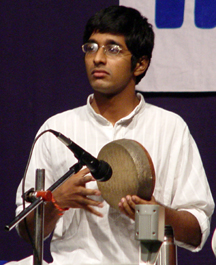
Abhishek
Raghuram (2005)
Primarily a singer who was
coached in kanjira by G. Harishankar. Grandson
of mridangam master Palghat R. Raghu. Located
in Chennai.
|
|
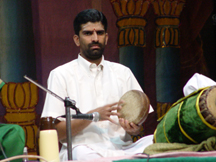
Alathur
T. Rajaganesh (2005)
A mridangam player who also
performs on kanjira. Learned kanjira from
B. Harikumar & V. Nagarajan. Located in
Trichy.
|
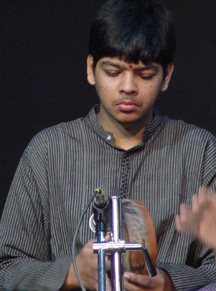
V. Anirudh Athreya (2005)
Youngest Carnatic performer
on kanjira (17 years old). Learned kanjira
from his relative V. Nagarajan and now studies
with T.K. Murthy. Located in Chennai.
|
|
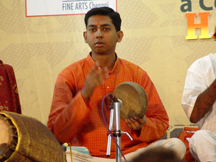
B.S.
Purushotham (2005)
One of the busiest Carnatic
kanjira players in Tamil Nadu. Learned kanjira
from T.K. Murthy. Originally from Bangalore,
now located in Chennai. YouTube
Video 1.
|
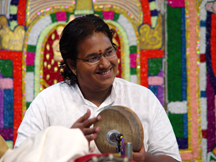
B. Shreesundarkumar (2005)
The most advanced Carnatic
kanjira player in Tamil Nadu. Performs regularly
with all of the top Carnatic vocalists and
instrumentalists and fusion artists. Top mridangam
student (A grade) of Karaikudi R. Mani. Grew
up around G. Harishankar and learned his playing
style on kanjira by observation. His power,
speed, rhythmic complexity, and beauty in
phrasing are that of a senior artist despite
his age being only 24. Located in Chennai.
|
|
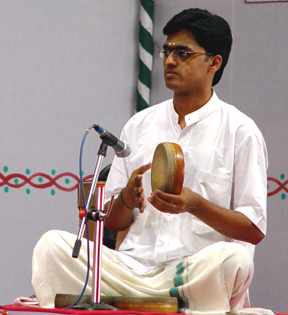
N.
Amrit (2005)
The most advanced Carnatic
kanjira player in Karnataka and most advanced
student of G. Harishankar who has mastered
many aspects of his playing style in terms
of power, speed, rhythmic complexity, and
beauty in phrasing. Performs often with all
of the top Carnatic vocalists and instrumentalists
and fusion artists and plays for marathon
bhajan performances (up to 6 hours). Highly
experienced teacher. A grade kanjira artist
and also a great mridangam player who learned
from Sri M. Vasudeava Rao and Sri A.V. Anand.
Located in Bangalore.
|
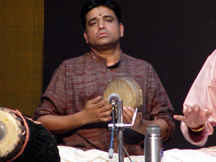
C.P. Vyasa Vittala (2005)
Former student of G. Harishankar
and K.N. Krishna Murthy. Located in Bangalore.
|
|
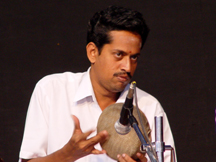
C.S. Venkatramanan (2005)
Son of the late kanjira artist
C.K. Shyam Sundar. Learned kanjira and mridangam
from his father. Originally from Chittoor,
now located in Chennai.
|
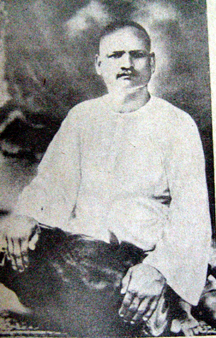
Dakshinamurthy Pillai (1935)
Mridangam and kanjira master
in the early 1930s. Responsible for furthering
the fingering from Pudukottai Manpoondia Pillai
by applying more complicated mridangam fingerings
to kanjira. His playing is said to have raised
the level of kanjira playing. He learned kanjira
from Pudukottai Manpoondia Pillai in the late
1800s.
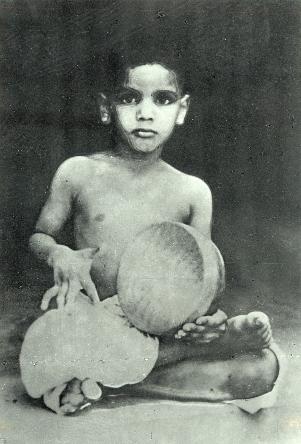
Umayalpuram K. Sivaraman
(1938)
At age 5 with kanjira. See
his mridangam entry below for bio.
|
|
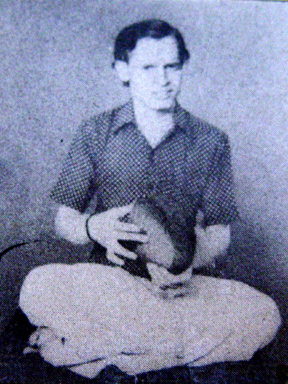
Govinda Harishankar (1979)
The greatest Carnatic kanjira
player who ever lived. Still to this day,
musicians are in awe of what G. Harishankar
was capable of with one hand. His was born
on June 10, 1958 and died on February 11,
2002. G. Harishankar started on kanjira at
a very young age with his father Govinda Rao,
started formal mridangam training with the
legend Palghat T.S. Mani Iyer and then later
with C.S. Murugaboopathy. He also studied
with Ramanathapuram Sri C.S. Sankarasivam.
He plays kanjira right handed but mridangam
left handed (it is said that he did so to
prove that playing mridangam was not as hard
as kanjira so he switched to playing mridangam
left handed). G. Harishankar is responsible
for furthering the complexity of modern kanjira
playing in terms of advanced techniques for
speed, power, rhythmic complexity and beauty
in phrasing (left hand bending of the skin).
It is said in India by many of the senior
percussionists that performed with him or
witnessed him play that he could top any mridangam
player he was matched with in a concert during
the percussion solos (thani avarthanam). G.
Harishankar on several occasions even topped
tabla player Zakir Hussain when they shared
the stage in Malaysia and Europe. He had only
a few students that carried on his secrets
and techniques. Some of his best recorded
playing was as a member of Sruthi Laya with
Karaikudi R. Mani on mridangam, T.V. Vasan
on ghatam, and Srirangam S. Kannan on morsing
in the 1980s-1990s. To many in India, his
death was proof that he was in fact human
and not a god. YouTube
Video 1. YouTube
Video 2. YouTube
Video 3.
|
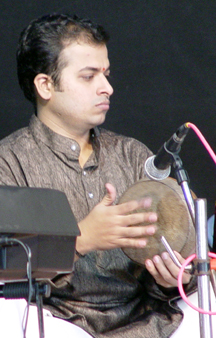
Guru Raghavendra (2005)
Plays fusion with vina player
Rajesh Vaidhya.
|
|
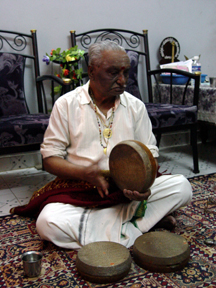
H.P. Ramachar (2005)
Sadly, Ramachar recently
died on June 23, 2006. He was the oldest kanjira
player in India at 82 years old. Responsible
for introducing a new level of speed in the
1970s. Researched the history, construction
of, and tuning of kanjira more than any other
musician in India. His first concert on kanjira
was in 1931 accompanying with mridangam master
Palghat T.A.S. Mani Iyer. He learned mridangam
from H. Puttachar and taught himself kanjira.
|
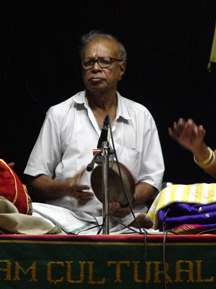
K.S.
Rangachari (2005)
One of the older kanjira
players still performing at 71 years old.
Father of Mambalam Sisters, who he exclusively
accompanies now. Began performing on kanjira
in 1950. Learned mridangam and kanjira from
T.R. Harihara Sharma (father of T.H. "Vikku"
Vinayakram & T.H. Subash Chandran). Originally
from Kanjipuram, now located in Chennai.
|
|
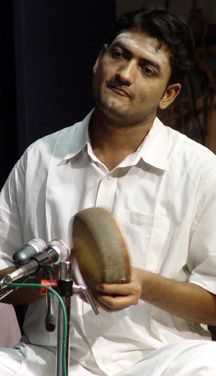
K.V.
Gopalakrishnan (2005)
Son of K.V.R.S. Mani. Learned
from his father and T.K. Murthy. Mainly a
mridangam player who also performs on kanjira.
Located in Chennai.
|
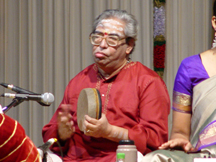
K.V.R.S. Mani (2005)
Originally from Madurai,
now located in Chennai.
|
|
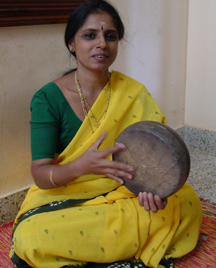
Latha Ramachar (2006)
India's only performing female
Carnatic kanjira player. She learned kanjira
from her father H.P. Ramachar and also U.K.
Sivaraman but has also had some training on
mridangam. She is a member of the all female
ensemble of percussion and saxophone called
Karnataka Mahila Laya Madhuri and has performed
all over India, Europe, and the USA with many
of India's top artists. Located in Bangalore.
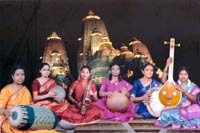
Karnataka Mahila Laya
Madhuri
|
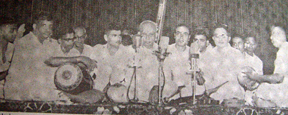
Palghat T.S. Mani Iyer (mridangam
on left) and Palani Subramania Pillai (left
hand kanjira on right, c.
1950s]
Palghat T.A.S. Mani Iyer
Palghat Mani Iyer, one of
two of the greatest mridangam players ever,
was born in 1912 in Palghat, Kerala and died
in 1981. He was named Ramaswamy during Namakaranam
(naming ceremony) but when introduced to the
music world as a mridangam accompanist at
the age of ten, he acquired the name "Mani."
He first studied with Palghat
Subba Iyer and Kalpathy Viswanatha Iyer. Later
with Thanjavur Vaidanatha Iyer. Mani came
into prominence after accompanying Chembai
Vaidanatha Bagavathar in a music concert at
Madras.
He was unusually talented
in rhythm and quickly mastered the technique
of the art of playing mridangam from his gurus
and predecessors such as Azhaganambi Pillai,
Dakshinamurthy Pillai and even studied the
temple drumming of Kerala (panchavadhyam,
chenda, edakka, among others).
Before Mani Iyer’s
arrival in the music scene, the two mridangists
Alaganambi Pillai and Dakshinamurthy Pillai
(also a kanjirist), dominated the art of percussion
playing. The innovations of Mani changed the
style of mridangam playing as Y.G. Doraisamy
points out: "It was Mani Iyer who started
the now prevalent trend of the mridangam,
not just keeping the time with tekkas and
moras, but actively accompanying the musical
phrasing, so as to be a rhythmic running commentary,
reproducing on the drum all the subtleties
and rhythmic complexities of the musical composition."
Palghat Raghu, a disciple
of Mani Iyer, describes his guru as a genius
in that he showed music followers the manner
of blending with the music of the main artist
in handling the kritis of every conceivable
mood and tempo. By his consistent excellence
he could raise the concert to thrilling heights.
It was Palghat T.S. Mani Iyer who outplayed
kanjira player Dakshinamurthy Pillai and reclaimed
the front seat on the stage for mridangam
players. Mani Iyer also occasionally performed
on kanjira.
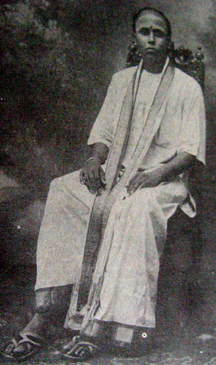
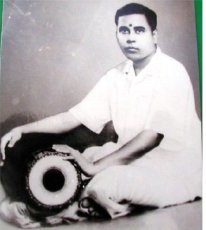
Palani Subramania
Pillai (c. 1940s)
Born in 1908 and died in
1962, never recognized formally with awards
for his innovations in the art of mridangam
and kanjira (most likely because of prejudice
that he was not Brahmin). Palani Subramania
Pillai was a contemporary of Palghat T. S.
Mani Iyer. Equally skilled at mridangam and
kanjira, he was a left handed player.
His technique on mridangam
is said to have been the first to introduce
the gumki or bending of the bass head by sliding
and pressing the hand into the skin. His technique
is said to have featured more rhythmic complexity
while Mani Iyer featured more beauty in the
phrases that he played and how they fit the
music he was accompanying. Both players had
extremely advanced rhythmic and accompanying
skill, and there really is no comparing the
two with regards to which was a better performer.
P. Subramania Pillai was
a student of his father Pazhani Muthiah Pillai
and later Dakshinamurthy Pillai. In concert,
Iyer and Palani were each other's favorite
to accompany with as Mani played mridangam
while Subramania played kanjira. One story
goes that during one of their concerts in
the percussion solos they traded phrases for
an entire hour each not being able to top
the other.
|
|
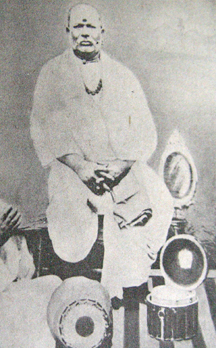
Pudukottai Manpoondia Pillai
Born in 1859 and died in
1922, Manpoondia Pillai is considered to be
the father of the Pudukottai school of percussion.
He is also said to have invented the kanjira,
which is not really true as the instrument
and players existed before his time. What
he is responsible for is introducing the kanjira
to Carantic instrumental and vocal music beyond
bhajans. His life story of a lantern bearer
at the Pudukottai palace who rose to become
a high ranking artist is one of triumph of
the human spirit.
In his palace job in the
mid-1800s he was exposed to dholak and thavil
players and became fascinated with thavil.
Having first learned a frame drum local to
the area (known then as daff), he soon became
a student of thavil (he was left handed) and
learned from Tirugokarnam Mariyappan.
Manpoondia (he was also known
as Mamundi) displayed an unusual skill in
that he could play all of the patterns he
was shown that required 2 hands with 1 hand.
He also redesigned the kanjira
of his time by reducing the number of jingles
from 3 pairs to a single pair and replaced
the ghungroo pellet bells that were common
as jingles at that time with coins as the
pellet bells made too much sound that distracted
singers and other musicians. He also may have
been the first to use Bengal monitor lizard
skin (Varanus bengalensis bengalensis)
in place of goat skin on kanjira making the
instrument more suitable for Carnatic music.
It was Manpoondia Pillai
that introduced a more complex laya into Carnatic
music with his kanjira in the form of korvais
and moras. He began accompanying bhajans and
gained attention with his skill of being able
with 1 hand to repeat anything a mridangam
player could do with 2 hands at that time.
Manpoondia Pillai is also said to have been
influenced after hearing the mridangam playing
of Narayanaswami Appa. Supposedly, after hearing
Appa's playing, Pillai realized the tonal
possibilities of melody oriented intricacies.
This may have been how the bending technique
on kanjira began to develop.
He began traveling around
southern India to music centers introducing
the kanjira and his skill at bhajan performances.
Upon reaching Madras (now Chennai), Pillai
was asked to accompany the singer Tiruvayyaru
Subramaniya Iyer (also known as Patnam Subramaniya
Iyer). Before the concert, Subramaniya Iyer
challenged him and wanted to know what he
was prepared to give up if he could not play
what was sung at the concert. Pillai said
that if he failed to play what was sung he
was prepared to throw his kanjira into the
sea and give it up completely. Subramaniya
Iyer then said that if Pillai did play what
was sung he would give up his place in the
center of the stage to him and stop singing.
Subramaniya Iyer had prepared
an intricate pallavi and sang it at the concert.
Manpoondia Pillai heard it and played it back
and started elaborating on it using his imagination.
Subramaniya Iyer accepted defeat and decided
to concede his place to Pillai. Manpoondia
Pillai humbly declared that it was not his
place, and that it was his desire to continue
to accompany Subramaniya Iyer's music wherever
he sang. The two went on to give numerous
performances all over Madras and other places
and this established the kanjira as a prominent
instrument suited for accompanying in Carnatic
music concerts. This is also how the kanjira
player began sitting in front of the mridangam
player because his skill level was higher
than that of the typical mridangist at that
time.
Manpoondia Pillai is also
responsible for training the first Carnatic
singer in his refined rhythmic concepts (Konerirajapuram
Vaidyanatha Iyer) as well as training percussionists
Dakshinamurthy Pillai, Pazhani Muthiah Pillai,
and Seithur Zamindar in his rhythmic style
on kanjira and mridangam. This brought a much
higher level of performance to the stage in
such trio concerts with the singer, mridangam
player and kanjira player all trained in this
more refined rhythmic style.
In his last years, he renounced
worldly life, becoming a sanyasi under the
name of Murugananda Swamigal.
|
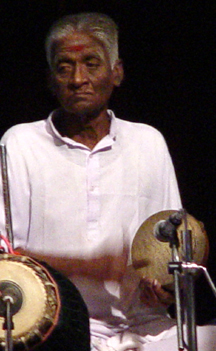
Mayavaram Somusundaram (2005)
One of the older performers
of kanjira still playing at 78 years old.
He began performing Carnatic concerts in 1947
and learned mridangam and kanjira from Boobadhiveli.
Originally from Mayavaram, located now in
Chennai. He recently passed away in 2012.
|
|
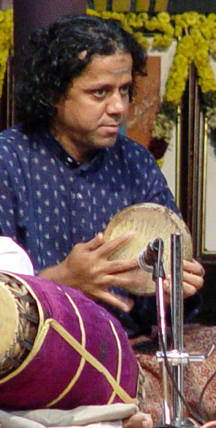
N. Ganeshkumar
(2005)
Born in 1964, Ganesh is a
kanjira player specializing in fusion and
has released the first instructional DVD for
kanjira in the USA. He learned from T.H. Subash
Chandran. Located in Chennai. Website.
|
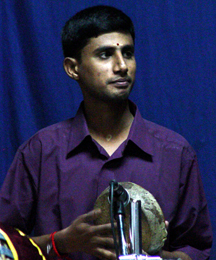
Nerkunam
S. Sankar (2005)
Former student of G. Harishankar.
One of the few kanjira players that has learned
only kanjira and has never studied mridangam.
Originally from Nerkunam, now located in Chennai.
Additional e-mail.
|
|
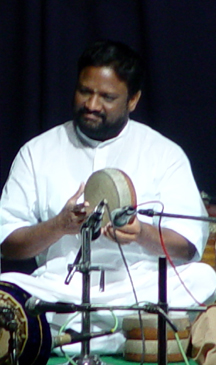
Neyveli
B. Venkatesh (2005)
One of the few mridangam
players that still performs on kanjira. Neyveli
travels most of the year for performances
in Europe with top artists from India. He
is a highly experienced teacher of both mridangam
and kanjira and has trained students all over
Europe. He learned mridangam from A. S. Balaraman
and kanjira from M.N. Kandaswami Pillai. Originally
from Neyveli, now located in Chennai. YouTube
Video 1.
|
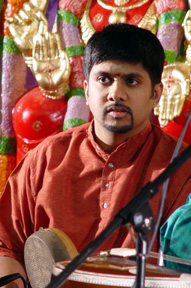
Karthik
Venkataraman (2007)
Kanjira player who studies
with Raja Rao, located in Toronto.
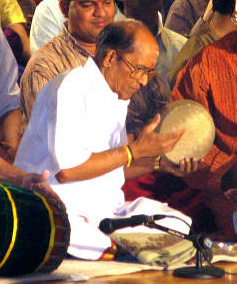
Guruvayur
Dorai (2005)
Located in Chennai. Mainly
a mridangam artist but occassionally performs
on kanjira. Born on July 2, 1935, Dorai started
to play the mridangam at a very early age.
His gurus were Sri Palghat Subba Iyer and
Sri Palani Subramania Pillai. Guruvayur Dorai
has played in almost all the prestigious music
meetings in India and has traveled extensively
all over the world. Carnatic music lovers
in the US are familiar with his style since
his first tour in 1974. Dorai is the recipient
of numerous awards including the Kalaimamani
- a title conferred in 1990 by the Tamil Nadu
government, Asthana Vidwan of Kanchi Kamakoti
Peetam in 1991, and Sangeet Natak Akademi
Award in 1997.
|
|
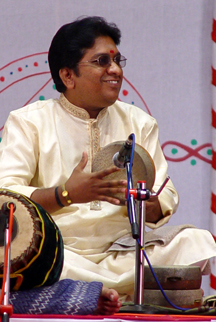
Papanasam S. Sethuraman (2005)
Learned kanjira with Kalaimamani
and Mayavaram Somusundaram and is self taught
on mridangam. Performs regularly in Carnatic
music and fusion, especially with Ghatam S.
Karthick's Heart Beat. Originally from Thirunellveli,
now located in Chennai. YouTube
Video 1.
|
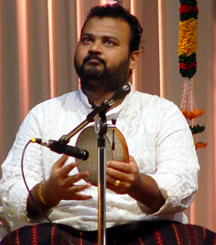
T.
Vinayakram Selvaganesh (2005)
Born in 1972, Selvaganesh
(also known as Chella S. Ganesh) is primarily
a kanjira player specializing in fusion and
perhaps is the best known kanjira artist outside
of India having worked with Remember Shakti,
Jonas Hellborg, Zakir Hussain, Free ~ Winds,
Andrew Lum, and Rikhy Ray. He is also the
first kanjira artist to have a CD released
under his own name. In India, he works mainly
in fusion and session work for film soundtracks
and composes his own music via computer. His
playing technique is unusual in that his touch
is light and he often plays the open tone
(dum) with an upstroke with his three fingers
as opposed to the traditional classical technique
that all other kanjira artists learned, which
is to play the open tone with a down stroke
of the index finger. Learned kanjira, ghatam,
mridangam, and konnakol with his father T.
H. "Vikku" Vinayakram but primarily
with T. H. Subash Chandran. In 2007, he released
the introductory DVD with John McLaughlin
on basic solkattu called The Gateway to
Rhythm. Located in Chennai. Alternate
e-mail.
YouTube
Video 1.
|
|
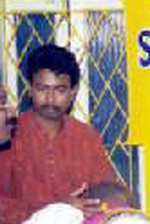
Thanjavur Srinivas (2004)
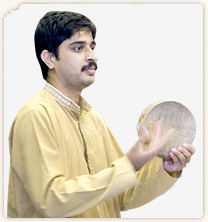
Ghatam
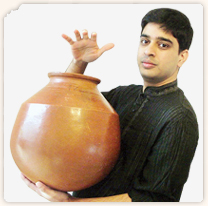
Brother R. N. Prakash (2004)
Originally from Bangalore
but now located in London, the Ghatam Brothers
are R. N. Prakash (pictured above) and R.
N. Prathap. They learned from Bangalore Vidwan
K. N. Krishna Murthy. Both of the Ghatam Brothers
are equally skilled on kanjira, mridangam,
ghatam, and konnakol. Located in London, England,
UK.
|
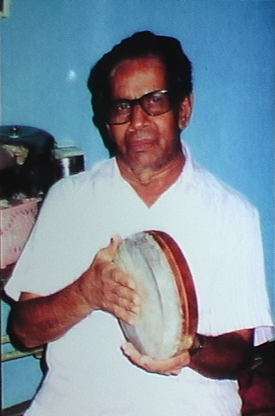
C.K. Shyam Sundar
(1938-2005)
C.K. Shyam Sundar learnt
mridangam and kanjira initially from Thanjavur
Ramadasa Rao and became a kanjira disciple
of Pudhukottai Swaminatha Pillai. He accompanied
Chithoor Subramaniya Pillai, Maharajapuram
Viswanatha Iyer, Ariyakudi Ramanuja Iyengar
and many other stalwarts at a very young age.
He has played kanjira along mridangam legends
such as Palani Subramania Pillai, Kuthalam
Siva Vadivel Pillai, T.K. Murthy, Palghat
Raghu, and Umayalpuram K. Sivaraman. He was
a B-High grade artist for All India Radio
and he worked as a lecturer in mridangam at
the Tamil Nadu Music College, Madurai and
he became a lecturer in kanjira at The Government
Music College, Adyar, Chennai. He was awarded
Kalaimamani in 1986 and received the Guruvayur
Dorai Trust award in December 2004. Originally
from Chittoor, relocated to Chennai during
his career.
|
|
Delhi
Raman Srinivasan
Mridangam player who also
plays kanjira. One of the only Tamil kanjira
players located in New Delhi in North India
(where he was born). He learned mridangam
and kanjira from V. Chandrasekaran, U.K. Sivaraman
& Guruvayur Dorai.
|
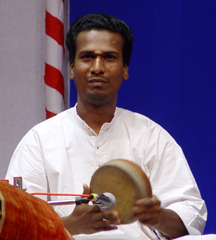
Thenkasi
H. Paramasivam (2005)
Learned mridangam from Thenkasi
K. Hariharan, kanjira from Pudukottai Paranbariyam,
and mridangam, kanjira, and konnakol from
Trichy R. Tayumaravai. Located in Trichy.
|
|
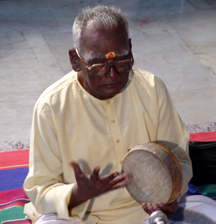
Thirukadaiyur T. K. Dakshinamoorthy
(2005)
Kanjira player mainly for
violinist Kunnakudi Vaidyanathan. Born in
1926, he is one of the older players still
performing today at 80 years of age, and he
sits in front of the mridangam player. His
guru was Kuthaalam Siva Vadivel Pillai. Originally
from Thirukadaiyur, now located in Chennai.
|
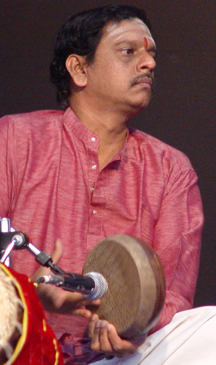
Thiruvayur Saikrishnan (2005)
Learned kanjira and mridangam
from Kumbakonam Rajapa Iyer. Originally from
Thiruvarur, now located in Chennai.
|
|
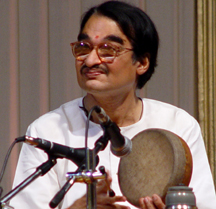
Thrikakkara Y.N. Shantharam (2005)
One of the few kanjira players
from Kerala. Shantharaman learned mridangam
from Serpala Gopalakrishnan and kanjira from
Parashala Ravi. Located in Kerala.
|
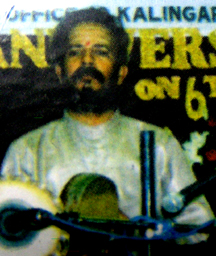
Tirupur G. Sridhar Kumar (2002)
A mridangam player who also
performs on kanjira, often with Smt. Nithyasree
Mahadevan. Located in Chennai.
|
|
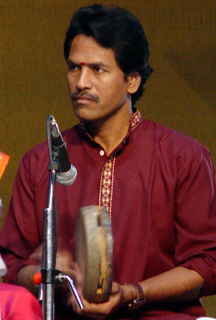
Trichy V.V.S. Manian (2005)
One of the few performers
that accompanies on kanjira and konnakol.
Learned mridangam, kanjira, and konnakol from
Trichy Thayumnavar. Originally from Trichy,
now located in Chennai.
|
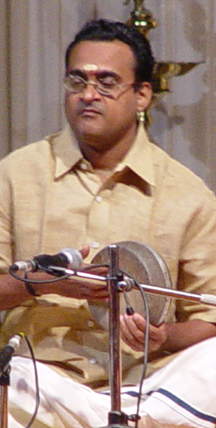
Trivandrum D. Rajagopal (2005)
Mainly a mridangam player
who also performs on kanjira. Learned mridangam
from B. Dorai Swami and mridangam and kanjira
with Sri R. Vaidyanathan. Originally from
Trivandrum in Kerala, now located in Chennai.
|
|
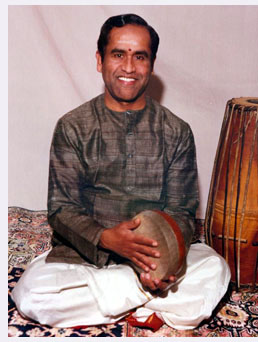
Trichy Sankaran
(2001)
Primarily a mridangam player
of the highest caliber, Trichy also performs
on kanjira in Canada and the USA. Learned
from Palani Subramania Pillai. Originally
from Trichy, now located in Toronto, Canada.
Website.
|
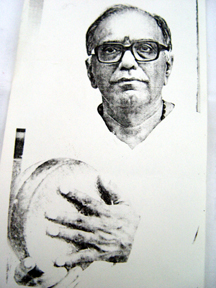
V. Nagarajan (c. 1980)
Born on the July 30, 1930
and died in February 4, 2002. Son of violin
player Sangeetha Kalanidhi Sri. Papa K. S.
Venkatramiah. Nagarajan was a mridangam player
that developed a nerve problem in his right
hand so he switched to playing kanjira left
handed. He learned mridangam from Tanjore
Sri Vaidyanatha Iyer for a few years and then
with Palghat T. S. Mani Iyer for several years
for both mridangam and kanjira. Palghat T.
S. Mani Iyer taught him the traditional methods
and techniques of kanjira. His first concert
was at Trichy with the Alathoor Brothers in
1950. He taught kanjira at Wesleyan University
in Connecticut as a Visiting Professor in
1967 and in 1974 he taught at the University
of Berkeley-California.
|
|
JALATHARANGAM
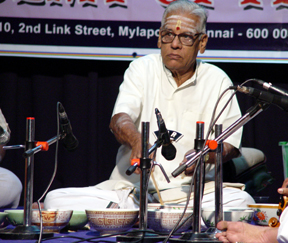
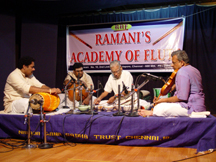
Anayampatti S. Ganesan (2005)
Ganesan is 1 of just 3 jalatharangam
players left still performing in southern
India. He plays a set of 19 antique porcelain
bowls from China that are 100 years old. He
is also a singer and violinist. His was the
only jalatharangam performance for the 2005-2006
concert season in Madras from Nov. - Jan.
some 3000 concerts at 75 locations (and only
because of a cancellation, he was arranged
to play to fill in!). Located in Chennai.
|
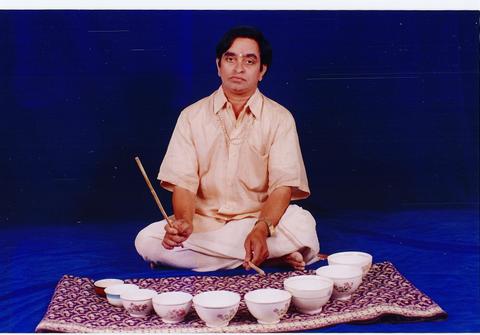
Nemani Somayajulu (2004)
Nemani Somayajulu comes from
a musical family and learned jalatharangam
from Anayampatti Dhandapani. Jalatharangam
consists of several porcelain bowels of different
sizes, arranged in a semicircle before the
performer. They are filled with different
amounts of water in order to tune each bowel
to a specific pitch and each is struck with
a pair of wooden sticks. He also plays mridangam
and ghatam. He is based in North India in
the city of Hyderabad in the state of Andhra
Pradesh and works for All India Radio. Google
Video 1.
|
GHATAM
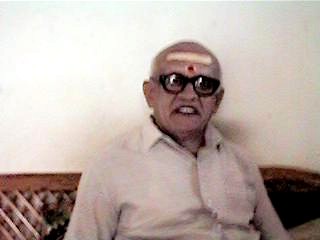
Bangalore K. Venkataram
(2000)
One of the oldest
and most respected ghatam players from Bangalore in
Karnataka, South India (born c. 1934). He began a
Percussive Arts Centre in Bangalore in 1981 to bring
not only Carnatic and Indian percussionists together
in the spirit of learning and respect of the American
Percussive Arts Society but also helped expose Indian
percussionists to other percussion styles outside
of India by organizing concerts and seminars at the
Percussive Arts Centre in Bangalore (and is now run
by his son, mridangam artist V.
Krishna since his death). Between 1994-2002,
he edited and published 7 volumes of the Tala
Vadya Seminar, which featured articles on the
history and style of Indian percussion and percussionists
(similar to the Percussive Notes Research Edition
from the USA).
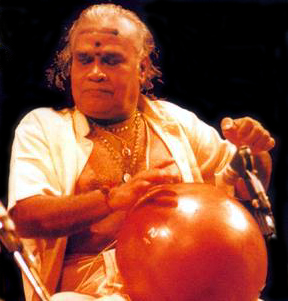
T.H. "Vikku" Vinayakram
(2001)
Born in 1932, Vinayakram
is the most recorded ghatam player in India
and the most well known ghatam player outside
of India. Between the late 1950s and the 1990s,
Vinayakram has performed and recorded with
all of the important male and female vocalists
and instrumentalists in South India. Since
the early 1970s, he has recorded and performed
with many jazz and pop musicians in the West,
such as Shakti, Remember Shakti, Mickey Hart,
and Airto Moreira, among others. He was part
of the first performance of South Indian music
at the United Nations in New York with M.S.
Subbulakshmi in 1966 and he was the first
South Indian musician to win a Grammy Award
for recording with pop musician Mickey Hart
in 1991. He has a school in the Triplicane
area of Chennai in South India called Sri
Jaya Ganesha Thala Vadya Vidyalaya Percussion
School. He learned ghatam, morsing, kanjira,
and konnakol from his father T.R. Harihara
Sharma. In 2008, he reeased the dual instructional
DVD Ultimate Guru: The Language and Technique
of South Indian Percussion Vol. 1. Vikku
prefers the Maana Madurai ghatam. Located
in Chennai. Shakti
YouTube Video 1.
|
|
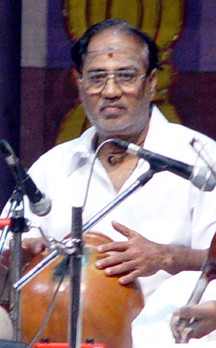
T.H. Subash Chandran (2005)
Younger brother of T.H. "Vikku"
Vinayakram, Subash is a highly experienced
teacher in the West and in India. He has trained
many Western percusisonists in ghatam, kanjira,
konnakol, and other percussion instruments.
He learned from his father T.R. Harihara Sharma.
Subash is not only a respected ghatam player
in India but one of the few remaining high
level artists for konnakol (solkattu performance).
He has a school at the Sankara Apartments
in the West Mambalam area of Chennai. He released
the first instructional DVD for ghatam and
konnakol in 2007 called The Art of Ghatam
and Konnakol. Subash prefers the Maana
Madurai ghatam. Located in Chennai. Website.
YouTube
Video 1.
V. Umashankar (2000)
Son of T.H. "Vikku"
Vinayakram and a specialist in fusion music.
He recorded with his brothers V. Selvaganesh
and V. Mahesh with Jonas Hellborg and Shawn
Lane. Learned from his father and T.H. Subash
Chandran. Umashankar prefers the Maana Madurai
ghatam. Located in Chennai. YouTube
Video 1.
|

T.V. Vasan (2005)
1949-2010
Younger brother of singer
and mridangam master T.V. Gopalakrishnan.
T.V. Vasan was trained in mridangam, pakhawaj,
maddalam, thavil, kanjira, and ghatam and
also taught vocalists. He learned from his
brother and has been an All India Radio A
grade artist for 33 years. As a ghatam artist
he was part of the legendary group Sruthi
Laya with Karaikudi R. Mani on mridangam,
G. Harishankar on kanjira, T.V. Vasan on ghatam,
and Srirangam S. Kannan on morsing. Equally
skilled on mridangam, he was constantly performing
several concerts a day in the 2005-2006 season.
Vasan prefered the Madras ghatam. Originally
from Kerala, relocated in Chennai.
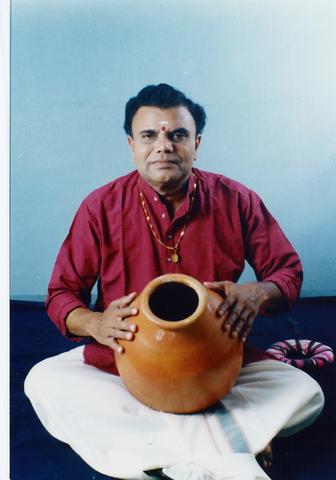
E.M. Subramaniam (2004)
E.M. Subramaniam learned
ghatam from his father and started playing
at the age of 8. He has accompanied almost
all of the senior musicians of South India
including top mridangam players such as Palghat
T.A.S. Mani Iyer, Umayalpuram K. Sivaraman,
and T.K. Murthy, among others, and top tabla
artists of North India such as Allarakha Khan,
Kishen Maharaj, and Zakir Hussain, among others.
He has traveled to many countries including
the USA, Australia, Europe, the Middle East,
and the Far East, among others. He has been
a grade A ghatam artist of All India Radio
for the past 39 years. He was awarded the
title of "Kalaimamani" by the government
of Tamil Nadu in South India in 2000. Subramaniam
prefers the Maana Madurai ghatam. Located
in Chennai. YouTube
Video 1.
|
|
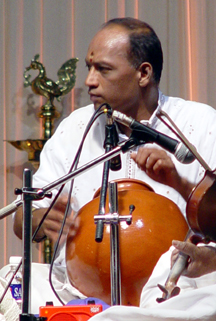
S.V. Ramani (2005)
Born on April 30, 1966, S.V. Ramani learned
from his father Sri P. R. Seshamani and later
became the disciple of Sri Guruvayur Dorai.
He holds an A-Grade in ghatam and B-High in
mridangam. He has been accompanying top Carnatic
artists for the past 32 years in India and
has performed in USA, UK, Germany, Australia,
France, Malaysia, Singapore, Indonesia, United
Arab Emirates, and Sri Lanka. He has served
as teacher and head of the percussion department
in Kala Mandir, Singapore, and he is currently
heading Swaralaya in Chennai since 2000. He
has won many awards. S.V. Ramani plays a Madras
ghatam and is located in Chennai. YouTube
Video 1.
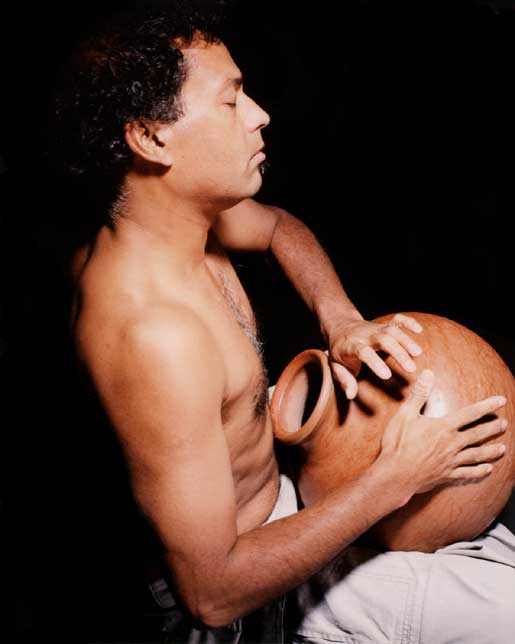
Ganesh Anandan (1990)
Ganesh Anandan is a very
creative musician that plays unique music
on a variety of Indian and non-Indian percussion
instruments including ghatam, kanjira, thavil,
mridangam, and frame drums. He is also a gifted
composer and instrument designer. He was born
and raised in Bangalore, south India, where
he studied Carnatic music for several years
namely the venu with G. Venugopal and the
mridangam with K.K. Parthasarthy. In 1976,
he moved to Canada where he studied music
theory and piano privately. He took part in
a variety of workshops including Cuban bata
rhythms, Brazilian samba, and was a member
of the University of Montreal's Indonesian
gamelan ensemble for a year. Since then, Ganesh
has returned to India on several occasions
to continue Carnatic percussion studies with
T.N. Shashikumar at the renowned Karnataka
College of Percussion in Bangalore studying
the thavil and kanjira. In Canada and the
USA, he had workshops on the bodhran and tar
with Glen Velez (USA) and tammorra and tamburello
with Alessandra Belloni (USA) and Carlo Rizzo
(Italy). Since 1994, Ganesh has been transposing
south Indian rhythmic concepts and drumming
techniques onto tambourines, frame drums,
and alternative surfaces. He has developed
a dynamic personal playing style that combines
the Carnatic method with a variety of personal
finger drumming innovations. Ganesh prefers
the Bangalore ghatam. Originally from Bangalore,
now located in Montreal, Canada.
|
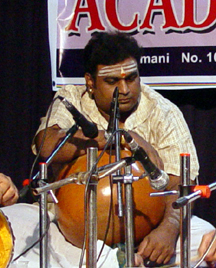
Ghatam
S. Karthick (2006)
Part of the younger generation
of new and highly skilled players, Ghatam
S. Karthick holds several music degrees and
performs with many of the leading Carnatic
artists as well as having his own fusion group
Heartbeat. He learned from T.H. "Vikku"
Vinayakram and T.H. Subash Chandran. He is
an A grade ghatam artist by All India Radio
(AIR) and also sings. Karthick prefers the
Maana Madurai ghatam. Located in Chennai.
Website.
YouTube
Video 1. YouTube
Video 2.
|
|
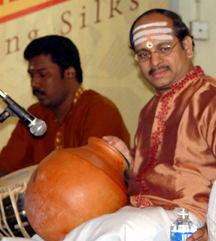
Ghatam
Vaidyanathan Suresh (2006)
Part of the younger generation
of new and highly skilled players, Ghatam
V. Suresh learned from T.V. Gopalakrishnan
and works with the leading Carnatic and fusion
artists as well as some Hindustani and jugal
bandi artists. He is skilled on mridangam,
kanjira, thavil, konnakkol, dholak, ghatam,
and is a vocalist. He is known for a special
technique called double gamaka where he can
produce the bass notes with equal ease with
both the right and left wrists. Suresh prefers
the Maana Madurai ghatam. He occasionally
performs on the ghatam tharangam (a set of
tuned ghatam). Located in Chennai. Website.
|
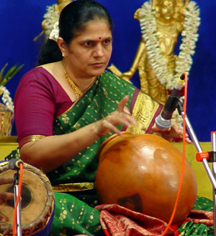
Sukanya Ramgopal
(2005)
One of India's few performing
Carnatic female ghatam artists. Sukanya stared
as a violinist with T.H. Gurumurthy (brother
of T.H. "Vikku" Vinayakram) before
switching to mridangam and ghatam with T.H.
"Vikku" Vinayakram for 20 years.
In 1992, she was the first to perform on the
ghatam tharangam (a set of tuned ghatam).
She has performed with the all-female instrumental
ensembles in India called Sri Taal Tarang
and Karnataka Mahila Laya Madhuri. Sukanya
prefers the Maana Madurai ghatam. Located
in Bangalore.
|
|
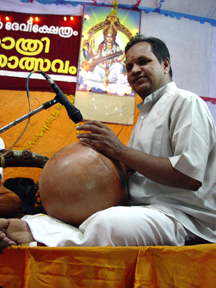
Kottayam Unnikrishnan (2005)
K. Unnikrishnan is a mridangam
player who also performs on ghatam. He learned
from T.V. Vasan. Unnikrishnan prefers the
Madras ghatam. Located in Thiruvananthapuram
in Kerala.
|
.JPG)
Adichanalloor M. Anil Kumar (2006)
Anil Kumar is equally a vocalist
and ghatam player. His technique on ghatam
is amazing in that he has complete control
over the intonation of his instrument and
can produce all of the notes of a given ragam
being performed on the stage on his ghatam
perfectly in tune. Anil prefers the Maana
Madurai ghatam. Located in Kerala.
|
|
M.R. Manjanatha (2005)
Manjanatha is a ghatam player
who also plays tabla, mridangam, kanjira,
and dholak. He prefers the Mysore ghatam.
Located in Mysore.
|
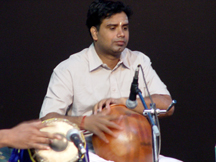
N. Najaram (2006)
Ghatam artist who plays the
Maana Madurai ghatam.
|
|
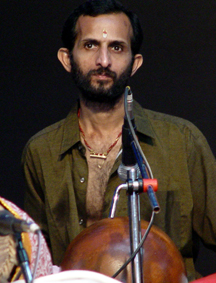
Udupi Balakrishnan (2006)
Mridangam player who also
plays Maana Madurai ghatam.
|
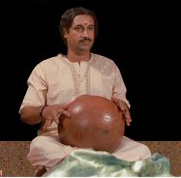
Tripunithura N. Radhakrishnan (2003)
Tripunithura N. Radhakrishnan
was the disciple of the late Shri G. Narayanaswamy
(his father), Shri T. V. Gopalakrishnan (his
cousin), and Shri Parassala Ravi. He started
accompanying artists on the ghatam at the
age of eleven. YouTube
Video 1.
|
|
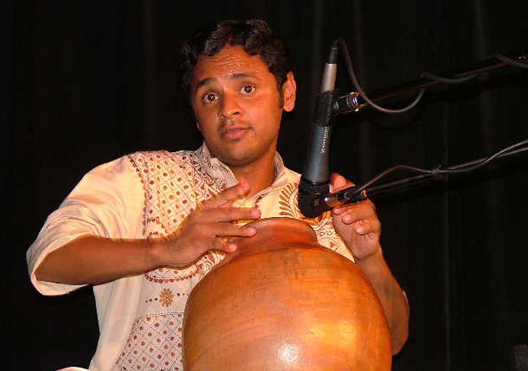
Ghatam
Brother R.N. Prathap (2004)
Originally from Bangalore
but now located in London, the Ghatam Brothers
are R.N. Prathap (pictured above) and R.N.
Prakash. They learned from Bangalore Vidwan
K.N. Krishna Murthy. Both of the Ghatam Brothers
are equally skilled on kanjira, mridangam,
ghatam, and konnakol. The Ghatam Brothers
prefer the Madras ghatam. Located in London,
England, UK.
|
Ghatam
Giridhar Udupa (2004)
Ghatam
Giridhar Udupa is one of the younger generation
of new and amazing percussion artists in Bangalore.
He began learning at age 4 from his father
the mridangist Vidwan Ullur Nagendra Udupa.
He is currently a disciple of Vidushi Ghatam
Sukanya Ramgopal and Vidwan Ghatam V. Suresh.
Udupa performs on the Maana Madurai
ghatam and also performs on mridangam, kanjira,
morsing, and konnakol. Apart from playing
Carnatic music, he has performed in many fusion,
jazz, blues, flamenco, symphonic, Celtic,
world music, and jugal bandi concerts and
has been part of numerous international music
festivals with renowned Indian musicians like
Dr. L. Subramaniam, Pandit Jasraj, and Ganesh
& Kumaresh, among others. Located in Bangalore.
Website.
YouTube
Video 1.
|

Trichy
K. Murali (2004)
K. Murali first studied mridangam
with his mother. Then he learned from Trichy
Thayumanavan who told him to switch to ghatam.
He is an A grade ghatam artist with All India
Radio. Originally from Trichy, now located
in Chennai.

A.S. Murali (2007)
A. S. Murali plays a Madras
ghatam.
|
|
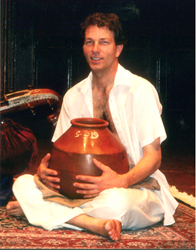
Glenn "Rusty"
Gillette (2000)
One of the few American ghatam
players (another being John Bergamo), "Rusty"
plays a Maana Madurai ghatam and is also a
jazz pianist. He was the instructor of traditional
South Indian music at San Diego State University
in California, USA until 2005. He began his
study of South Indian percussion with T. Ranganathan
at the California Institute of the Arts in
1970 and then studied ghatam in India with
T. H. "Vikku" Vinayakram. He has
performed with noted musicians including T.
Viswanathan, T. Ranganathan, Jon Higgins,
L. Subramaniam, and Trichy Sankaran and also
specializes in mridangam accompaniment for
Bharatha Natyam, a unique form of classical
South Indian dance. A talented teacher &
lecturer, "Rusty" has taught South
Indian rhythmic skills and music for The Center
for World Music, The Balasarasvati School
of Music and Dance, The American Society for
Eastern Arts, The College Music Society, and
University of California, San Diego. Located
in San Diego, California, USA. YouTube
Video 1.
|
MORSING
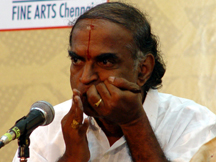
Srirangam
S. Kannan (2005)
Kannan started music at the
age of 33. He became interested in morsing
(started being used in Carnatic music since
1930s-1940s), quit his bank job, and began
studying with a local mridangam player how
to play laya (rhythm). he learned from Pudukottai
Mahadevan and later Karaikudi R. Mani. Within
6 months he was accompanying concerts on morsing
and has been doing so ever since. He came
to prominence as a member of the legendary
group Sruthi Laya which include Karaikudi
R. Mani on mridangam, G. Harishankar on kanjira,
T.V. Vasan on ghatam, and Srirangam S. Kannan
on morsing. Located in Chennai. YouTube
Video 1.
|
|
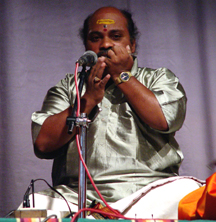
Bangalore
B. Rajasekar (2006)
Rajasekar is one of the prominent
and skilled morsing artists from Bangalore.
He regularly tours outside of India. Located
in Bangalore.
|
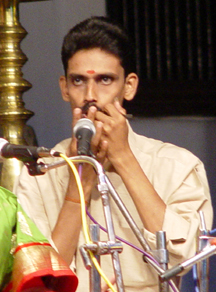
Kottayam S. Muralidharan (2006)
Muralidharan is one of the
most sought after morsing artists in Kerala.
He is uniquely skilled in that he has the
ability to play morsing and recite konnakol
simultaneously during his solos. Amazing player.
Located in Kerala.
|
|
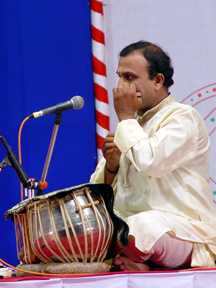
N.
Sundar (2005)
Sundar is equally skilled
as a morsing artist and tabla player specializing
in Carnatic music and fusion. He is a member
of Ghatam S. Karthick's fusion ensemble known
as Heart Beat. Located in Chennai. YouTube
Video 1.
|
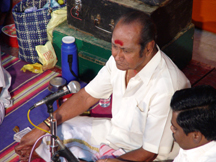
M. Raja Raman (2006)
Raja Raman is one of the
older morsing players still performing. He
has performed and recorded almost exclusively
with violinist Kunnakudi Vaidyanathan since
the 1970s. Located in Chennai.
|
|
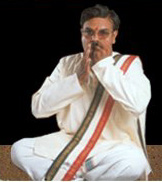
M. Gururaj (2003)
M. Gururaj learned mridangam
and morsing from T.A.S. Mani of Bangalore.
He has been a member of the Drums of India
ensemble of T.A.S. Mani and has traveled widely
abroad in the UK, Germany, Switzerland, USA,
Canada, Scotland, Switzerland, Hong Kong,
and Germany. Gururaj has provided accompaniment
to many stalwarts from South India and has
been a prime morsing accompanist in the concerts
of Flute S. Shashank. He is currently on the
staff of All India Radio, and is located in
Mangalore.
|
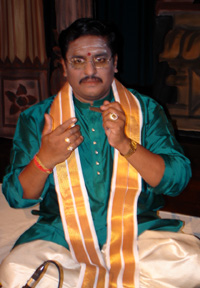
Malaikottai
R.M. Deenadayalu
Malaikottai R.M. Deenadayalu
is a respected morsing artist from Trichy,
Tamil Nadu. He is a disciple of Trichy R.
Thayumanavan and now studies under Sri. B.
Harikumar. He has accompanied many of the
leading Carnatic artists and musicians in
India and abroad. He is an A grade artist
of All India Radio, Trichy and has received
many awards and honorific titles such as Sangunatha
Chakravarthy, Morsing Laya Boopathy, and Asthana
vidwan of Sri Kanchi Kamakoti Peetam.
|
|
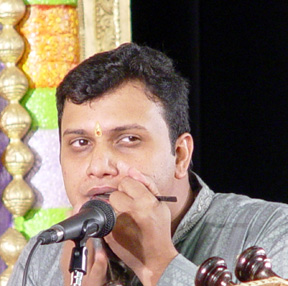
Pramath
Kiran (2007)
Pramath Kiran hails from
a musically inclined family. His father is
a prolific composer and his mother a great
music enthusiast. Being brought up in an atmosphere
of art and culture, Pramath took to Music
early in life. He started with learning Vocal
under Smt.Vijayalakshmi of Bangalore. Discovering
his inherent talent for Rhythm, Pramath was
put under the tutelage of Vidwan Anoor Anathakrishna
Sharma who guided him on the nuances of Laya
and morsing and Shri Uday Raj Karpur for tabla.
Pramath is also a multi-percussionist and
plays a variety of Indian and western percussion
instruments. Located in Bangalore. Website.
|
CARNATIC TABLA
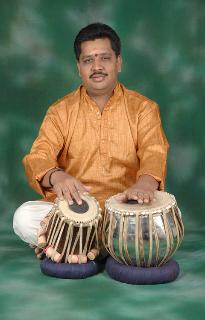
V.B.
Madhusudhanan
V.B. Madhusudhanan is one of the
top Carnatic tabla players in Chennai. Tabla is a
North Indian instrument but it is played all over
India. In the South, tabla players sometimes learn
to play Carnatic style phrases on tabla. V.B. Madhusudhanan
is a top studio player, plays Hindustani music as
well as Carnatic, and is a great fusion percussionist.
His is known for his Carnatic tabla work with the
great ensemble Sruthi Laya led by Karaikudi R. Mani.
Located in Chennai.
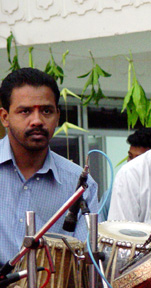
N. Seetharaman
N. Seetharaman is a great Tamil tabla
player located in Chennai. He is equally versed at
Hindustani and Carnatic music and also works as a
studio percussionist. He is familiar with pakawaj
techniques and rhythms as well as dholak, mridangam,
tabla, and tape (Tamil frame drum folk music).
KONNAKOL
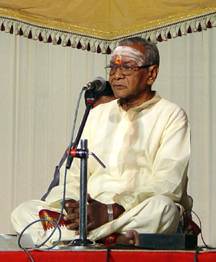
Tiruchi Tayumanovar (2005)
Tiruchi Tayumanovar is the
oldest living konnakol artist in India. Located
in Trichy.
|
|

T.H. Subash Chandran (2005)
Younger brother of T.H. "Vikku"
Vinayakram, Subash is a highly experienced
teacher in the West and in India. He has trained
many Western percussionists in ghatam, kanjira,
konnakol, and other percussion instruments.
He learned from his father T.R. Harihara Sharma.
Subash is not only a respected ghatam player
in India but one of the few remaining high
level artists for konnakol (solkattu performance).
He has a school at the Sankara Apartments
in the West Mambalam area of Chennai. He released
the first instructional DVD for ghatam and
konnakol in 2007. Subash prefers the Maana
Madurai ghatam. Located in Chennai. Website.
YouTube
Video 2
|
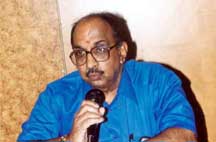
H. Ramakrishnan
Born in 1941 and trained on mridangam
by Palani Subramania Pillai and Karaikudi R. Mani,
Ramakrishnan also plays kanjira and is a Carnatic
vocalist but he is also known as one of the few remaining
konnakol artists. In recognition of his talent, he
has been awarded the Kalaimamani award by the Government
of Tamil Nadu, India for his contributions to the
art of konnakol. Located in Illinois, USA.
THAVIL
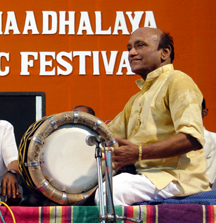
Valayapatti A.R. Subramaniam (2005)
Valayapatti A.R. Subramaniam,
born 1940, is the senior most top thavil artist
in India since the 1960s. He has performed
and recorded for many years with violinist
Kunnakudi Vaidyanathan and is a master of
all the advanced thavil techniques. He learned
from Mannargudi M.N. Rajagopal Pillai. Located
in Madurai.
|
|
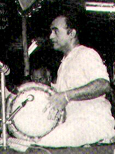
Haridwaramangalam Sri A.K. Palanivel
(2000)
Born in 1948 in Haridwaramangalam
in Thanjavur, A.K. Palanivel received his
training in thavil under his father S. Kumaravel
Pillai and T.G. Muthukumaa Swamy Pillai. He
has performed widely in India and abroad accompanying
senior artists and participating in innovative
ensembles of instrumental music and also dance.
For his outstanding contribution, he has been
variously honoured by Sabhas and institutions,
which include the Kalaimamani Award of the
Government of Tamil Nadu. He was the first
thavil artist to receive the pretigious Padma
Shri award in 2004. Website.
YouTube
Video 1.
|

K. Sekar (2005)
K. Sekar is a thavil artist
who not only plays for nagaswaram wedding
concerts but also accompanies Carnatic instrumental
concerts and performs in fusion. Great player.
Located in Triplicane area of Chennai.
|
|
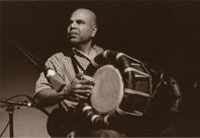
Ramesh
Shotham (1990)
Ramesh Shotham was born in
Madras, South India. He began his musical
career as a self-taught rock drummer with
Human Bondage in 1970. In the mid-1970s, he
learned pakhawaj from Arjun Shejwal in Mumbai
and then returned to Madras (Chennai), to
study thavil with K.P. Ramu. He studied other
South Indian classical percussion instruments
such as ghatam, mridangam, kanjira, and morsing
at the Karnataka College of Percussion with
Professor T.A.S. Mani. In 1980, Ramesh went
to Europe with the Indo-jazz-fusion group
known as Jazz Yatra Septet to perform at various
festivals. The group made a recording titled
Sangam in 1981. Since 1981, Ramesh
Shotham has lived and worked in Europe. During
the last 20 years, he has performed on over
120 recordings and has worked for almost all
the leading TV and radio stations in Germany
and Europe. Originally from Chennai, now located
in Germany. Website.
YouTube
Video 1.
|
Fusion &
Studio Percussionist
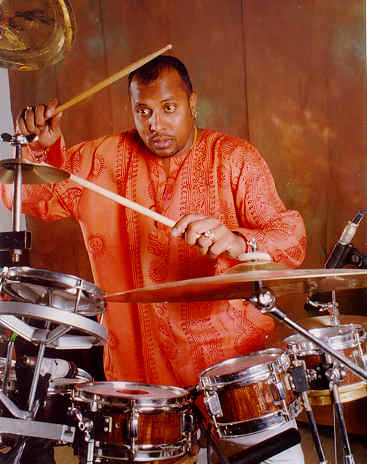
Anandan
Sivamani (2000)
A. Sivamani is a percussionist that
specializes in fusion and studio work. He plays mainly
Western drums but does not use his feet and prefers
to stand up while playing a large set up of instruments.
He has studied the basics of Carnatic music and jazz
and mixes these in his music. He has worked with Egberto
Gismonti, James Asher, Louis Banks, Kunnakudi Vaidyanathan,
Remember Shakti, Zakir Hussain, T.H. "Vikku"
Vinayakram, and A.R. Rahman, among others. Born in
Chennai but located in Mumbai now. YouTube
Video 1.
Percussion
Ensembles of Kerala - Traditional Temple Music
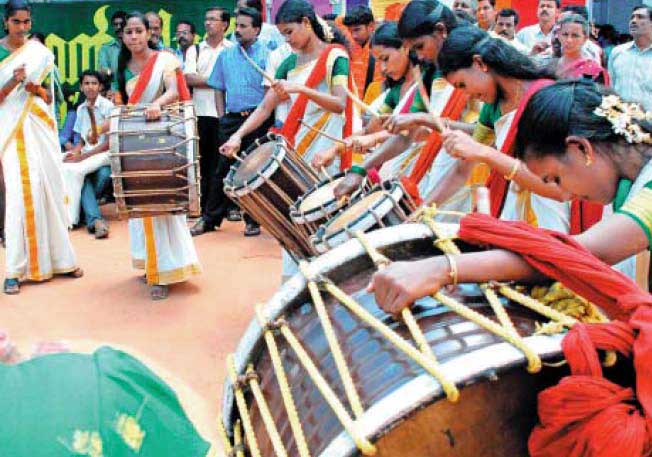
Guru Krupa Kalakendram - Chenda Melam
Ensemble (2007)
Guru Krupa Kalakendram is
12 piece all-female chenda melam ensemble
from Nedumangadu in Kerala. They have performed
all over India including Chennai, Mumbai,
Calcutta, and Kerala. They are the disciples
of Bhanu Asan.
|

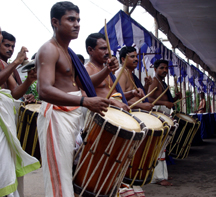
Chenda Melam Ensemble (2005)
This group played chenda
melam music with such instruments as chenda
(stick beaten rope tensioned drums, usually
2 types of tuning low and high) 3 kombu (brass
horns tuned in unison & playing in thirds),
and a line of ilathalam (thick small cymbals)
players. Chenda melam is featured at temple
festivals in Kerala. The second row of chenda
are tuned low and play rhythmic pulsations
outlining the talam while the cymbals in the
back row also play subdivisions outlining
the talam, which shifts from 4 to 6 to 7 beats
before repeating in a cycle. The front line
of Chenda are tuned higher and are played
with a pair of curved sticks in a typically
fast Indian manner. Almost rudimental by Western
standards. The kombu (horns) interject blasts
of sound at certain intervals as a cycle is
climaxing and beginning to repeat. Native
to Kerala, located in Kerala. Contact info:
Mr. Vatta Kadruravi (“Ravi”)
Phone: (001-91) 04923-266583
Cell: (001-91) 9447-675009
YouTube
Video of Other Chenda Melam Event.
|
|
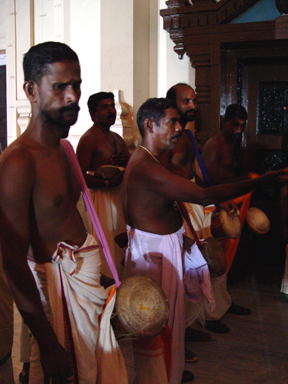
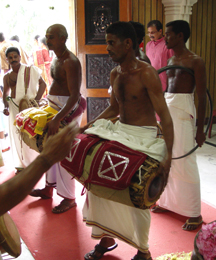
Kshetrakala - Panchavadyam Ensemble
(2005)
This group played panchavadyam
music, which is another type of temple ensemble
from Kerala that uses five musical instruments
being the maddalam (hour glass shaped drum
played with hands on both sides pictured above),
idakka (hour glass shaped drum played with
a stick), thimila (long cone shaped drums
tuned very high and played with the hands
pictured at top), kombu (brass horns), and
ilathalam (thick small cymbals). High degree
of interlocking between the various drums
and shifting of meters is common. Native to
Kerala, located in Chennai. Contact info:
Kshetrakala – Kerala
Temple Programs
No. 2 Bajanai Kovil 3rd Street
Choolaimedu, Chennai 600 094
Tamil Nadu, India
Phone: (011-91) 98414-21124
|
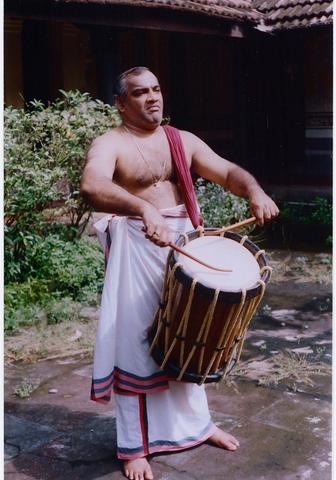
Mattanur Sankaran Kutty on Chenda
(2004)
Mattanur Sankaran Kutty on
chenda, a top percussionist from the state
of Kerala in South India and has traveled
to several countries of the world in traditional
Kerala percussion ensembles and in a special
jugal bandi percussion group with Umayalpuram
K. Sivaraman. Located in Kerala.
The chenda is a hollow cylindrical
drum made of softwood with both ends covered
with cowhide. The tuning of the instrument
is adjusted by moving small bamboo rings to
tension the rope on the shell. The chenda
is played by beating the upper skin with two
slightly curved sticks. This instrument is
traditionally a part of the chenda melam percussion
orchestra of Kerala, which accompanies some
of the temple festivals there.
|
|
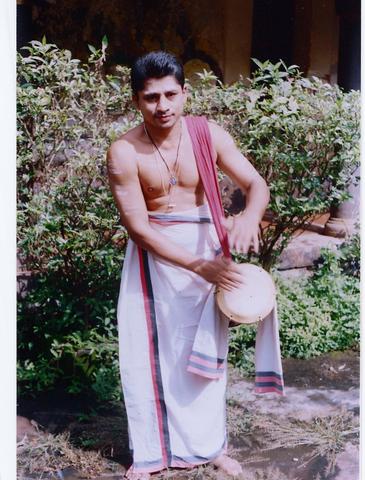
Porur Unnikrishnan on Thimila (2004)
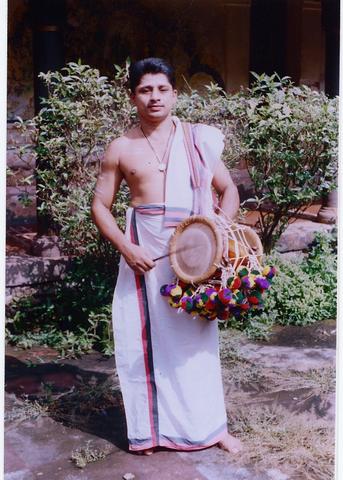
Porur Unnikrishnan on Idakka (2004)
Porur Unnikrishnan on thimila
(top photo) and edakka (bottom photo), a top
multipercussionist from the state of Kerala
in South India and has traveled to several
countries of the world in traditional Kerala
percussion ensembles and in a special jugal
bandi percussion group with Umayalpuram K.
Sivaraman. Located in Kerala.
The thimila is a cone shaped
drum made from polished jackwood. Leather
braces hold the drumheads made of calf hide.
The leather braces are also twined round the
waist of the drum. This arrangement helps
to adjust the tuning, which is very high.
The idakka is an hourglass
shaped drum made of wood. The drumheads are
held in position by interlacing rope. The
playing technique involves simultaneously
beating the drum with one hand with a stick
while manipulating the strings with the other
hand to create pitch changes. These 2 instruments
are traditionally part of the panchavadyam
percussion orchestra of Kerala, which accompanies
some of the temple festivals there.
|
MRIDANGAM
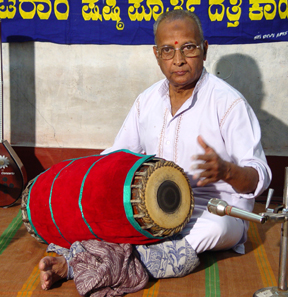
A.V. Anand (2006)
Left-handed mridangam player,
the absolute top in rhythmic complexity on
the instrument in the state of Karnataka.
His calculations are extremely refined. Located
in Bangalore.
|
|
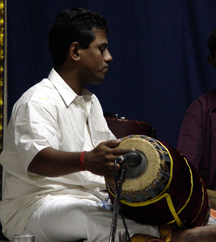
B.
Sivaraman (2006)
Born on June 6, 1972, B.
Sivaraman hails from a family of musicians.
His father Sethalapathy Balsubhramaniam is
a disciple of the great composer Papanasam
Sivan. B. Sivaraman is a mridangam A-grade
artist for All India Radio. He learned from
Kumbakonam Sri Rajappa Iyer for 6 years and
has been a prime disciple of Sangeetha Kalanidhi
Shri T.K. Murthy since 1987. He has won many
awards including the Yuva Kala Bharathi and
Nadha Oli. He has accompanied Ganesh &
Kumaresh and Zakir Hussain, among others.
Located in Chennai.
|
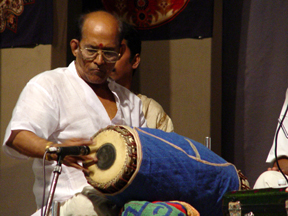
Guruvayur
Dorai (2005)
Located in Chennai. Born
on July 2, 1935, Dorai started to play the
mridangam at a very early age. His gurus were
Sri Palghat Subba Iyer and Sri Palani Subramania
Pillai. Guruvayur Dorai has played in almost
all the prestigious music meetings in India
and has traveled extensively all over the
world. Carnatic music lovers in the US are
familiar with his style since his first tour
in 1974. Dorai is the recipient of numerous
awards including the Kalaimamani - a title
conferred in 1990 by the Tamil Nadu government,
Asthana Vidwan of Kanchi Kamakoti Peetam in
1991, and Sangeet Natak Akademi Award in 1997.
YouTube
Video 1.
|
|
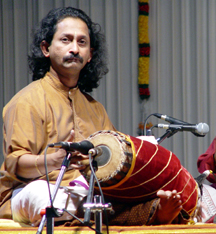
J.
Vaidyanathan (2005)
Located in Chennai. J. Vaidyanathan,
son of the late Sangitha Kalanidhi Sri D.K.
Jayaraman, and had his advanced training from
Sangitha Kalanidhi Dr. T.K. Murthy. He has
won several prizes and awards and has accompanied
Smt. M.S. Subbalakshmi, Smt. D.K. Pattammal,
Smt. M.L. Vasanthakumari, Sri D.K. Jayaraman,
Dr. S. Ramanathan, Sri K.V. Narayanaswamy,
Sri B. Rajam Iyer, Sri T.N. Krishnan, Sri
M.S. Gopalakrishnan. He has given performances
all over India and in the USA, USSR, Singapore,
Muscat, Mauritius, and Australia. YouTube
Video 1.
|
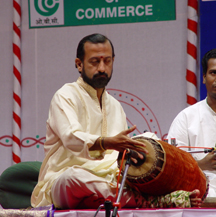
K. V.
Prasad (2005)
Located in Chennai. K. V.
Prasad commenced his mridangam training at
the age of six from the Eranakulam Narayana
Iyer. He had further training from Professor
Parassala Ravi, Principal of the Palakkad
Music College. He received advanced training
from Sangeetha Kalanidhi T. K. Murthy. K.
V. Prasad is a versatile percussionist and
also plays other instruments such as tabla,
Western percussion, and congas. Shri Prasad
has been a long time accompanist to M. S.
Subbulakshmi late in her career. He has also
been a favored accompanist to musicians such
as Yesudos, Unnikrishnan, and A. Kanyakumari,
among others. His mridangam playing is marked
by soft and deft strokes with a clean handling
of the instrument and unobtrusive accompaniment.
He is widely traveled and has played in many
international festivals. He is a staff artist
at All India Radio in Chennai.
|
|
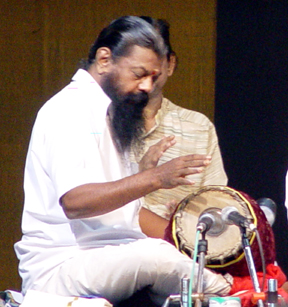
Karaikudi R. Mani
(2005)
Located in Chennai. Mani
was born on September 11, 1945 at Karaikudi
to Sri T. Ramanatha Iyer and Smt. Pattammal.
Mani had his initial training in mridangam
under Karaikudi Sri. Rangu Iyengar and later
under Sri T. R. Harihara Sharma and Sri K.
M. Vaidyanathan. He received his first award
when he was 18 at the National level from
Dr. Radhakrishnan, the President of India.
He is a recipient of the Sangeet Natak Akademi
National Award for 1998. Mani was also responsible
for the formation of the musical orchestration
of cultures called "Melodyssey"
consisting of 40 artists of South Indian,
North Indian, and Western instruments along
with voices. This innovative orchestration
won widespread appreciation. Mani has also
introduced the Laya Ratna percussion duet
concerts, which have been performed in most
of the leading forums in India. He was the
co-founder of the leading group modern Indian
music in the 1980s-1990s called Sruthi Laya
with G. Harishankar, T.V. Vasan, and Srirangan
S. Kannan, and has started a publication called
Layamani Layam. He has founded an
teaching institution named Sruthi Laya Kendra
Natarajaalaya with Smt. Rajeswari Sainath
(a niece of Karaikudi R. Mani). YouTube
Video 1.
|

Kumbakonam
K. Ramakrishnan (2005)
Studied mridangam with Kumbakonam
Shri M. Rajappa Iyer. K. Ramakrishnan is a
B High Grade All India Radio mridangam artist.
Born in Kumbakonam but now located in Chennai.
|
|
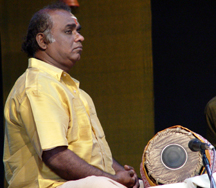
M.R. Sainath (2005)
M.R. Sainath learnrf mridangam
from his father, Sri M.R. Rajappa. He is a
B High grade mridangam artist and a musician
on All India Radio staff since 1984. He was
the recepient of title "Layakalanidhi"
from Bhandoop Fine Arts, an organization in
Mumbai and the Aasthana Vidwan of Sri Ganapathi
Sachchidananda Ashram in Mysore, Karnataka.
|
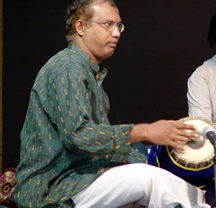
Madipakkam Suresh
(2006)
Madipakkam Suresh had his
initial training on the mridangam under Kumbakonam
Narayanaswamy Iyer. He became a disciple of
Karaikudi Mani in 1988. Suresh became the
instructor of Sruthilaya Seva Trust, a center
for Carnatic percussion arts in Kodambakkam.
He taught there until 1997 and then began
accompanying all of the major Carnatic artists.
He has traveled throughout India with his
guru and has accompanied leading artists.
He has done lecture-demonstrations at universities
in Maryland, Pennsylvania, New York, and Philadelphia
in the USA and has performed at the World
Drums Festival in Toronto, Canada and the
World Tamil Movement Cultural Festival in
2000 in Montreal, Canada. He is an "A"
grade mridangam artist. Located in Chennai.
|
|
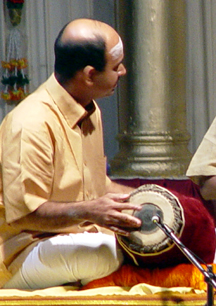
N.
Manoj Shiva (2005)
Born on February 26, 1972,
Manoj had initial training in mridangam under
Kumbakonam Rjappa Iyer and Srirangarajapuram
Jayaraman from age four, and he received advanced
training in mridangam from Palghat R. Raghu
since June 1992. He was awarded a Gold Medal
for mridangam playing by Y.M.C.A.-Chennai
at the age seven and has won the first prize
for mridangam accompaniment in concerts from
institutions like The Music Academy, and Sri
Krishna Gana Sabha, among others. He is an
"A" grade mridangam artist by All
India Radio. Located in Chennai.
|

Karukkurichi N. Mohanaraman (2006)
Karukkurichi N. Mohanaraman
learned from Sri K. M. Vaidhyanathan and Thinniyam
Krishnan. He is an A grade mridangam artist
for All India Radio and has won awards such
as Yuva Kala Bharathi and Nadha Kanal. Located
in Chennai.
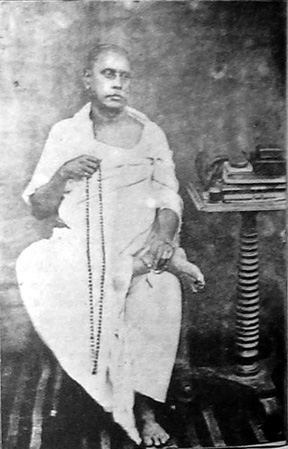
Narayanaswami Appa
(c. 1800s)
Born in Thanjavur, he started
his career as a copyist in state service.
Later, he learned mridangam from Sivaswamy
Appa. His mastery was unparalleled and melodious
and even the very fast and soft patterns carried
a telling clarity and balance. He embellished
concerts in which both the singers and audience
realized the beauty of music from the way
he complimented the songs. It is said that
the left head of his mridangam (bass head)
was tuned to the exact lower octave note of
the right head (treble head). He would play
mridangam for sometime and always check the
tuning of his meettu (nam), chapu and thoppi
(left side) with rava before any concert.
The greatness of his fingers were so that
it is said that his tuning would never go
off. He was never known to have tuned a mridangam
in the concert hall with the stone. He kept
about 8 mridangams ranging from pitches "D"
to "A". Even the artistes tuned
their thambura and violin to his drone note.
He also realized that the tip of the fingers
had a significant role in producing nadham,
and he avoided touching hard materials, for
example the lintel of his cart was covered
with velvet and if he needed to open doors
of a train, he asked somebody to open it for
him. He was also an accomplished singer, composer,
flautist, and jalatharagam player. He accompanied
great masters like Maha Vaidyanatha Iyer (1844--1893),
Patnam Subramanya Iyer (1845–1902),
Sarabha Sasthri, and Veena Seshanna.
|
|
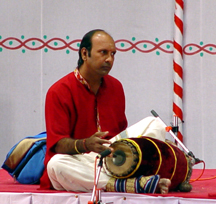
Neyveli
R. Narayanan (2005)
Located in Chennai. Narayanan
learned mridangam from S. K. Ganesa Pillai,
the late Thanjavur Upendran and mridangam
legend Padmashri Umayalpuram Sri K. Sivaraman.
He has accompanied T.N. Seshagopalan, T.V.
Sankaranarayanan, T.R. Subramanian, K.V. Narayanaswamy,
Trichur V. Ramachandran, O.S. Thiagarajan,
Mandolin U. Srinivas, Ravikiran, Flute N.
Ramani, and many others. He has on commercial
recordings released by labels such as Sangeetha,
H.M.V., and A.V.M. Music India, among others.
Narayanan has performed in all the leading
sabhas in India. He has also won acclaim in
other countries such as the USA, Canada, Australia,
Singapore, United Kingdom, Germany, Dubai,
Muscat, Malaysia, Switzerland, New Zealand,
Holland, and Hong Kong (China). He has also
participated in many national and international
festivals such as the Festival of Asia (London),
National Arts Council (Singapore), among others.
He is an 'A' Grade mridangam artist. The Bharat
Kalachar gave him the Yuva Kala Bharathi award
in 1997. Thyaga Brahma Gana Sabha (Vani Mahal)
gave him the Award for Excellence in mridangam
in 1997. He also received the Thanjavur Vaidyanatha
Iyer Award from Raagam Fine Arts in 1999.
YouTube
Video 1.
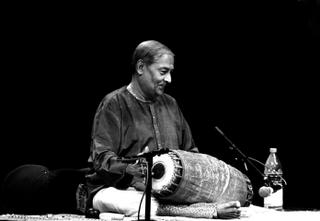
I. Sivakumar (2005)
Sivakumar is an excellent
mridangam accompanist. Sri Sivakumar hails
from a family of famous musicians. He is the
son of Gana Saraswathi Smt. D. K. Pattammal
and son-in-law of mridangam maestro Palghat
Sri Mani Iyer. He is the disciple of Palghat
Kunjumani and later had advanced training
from Palghat Sri Mani Iyer. He has been accompanying
all of the senior Carnatic artists for the
last 50 years. He often accompanies his daughter,
vocalist Nithyasree Mahadevan. YouTube
Video 1.
|
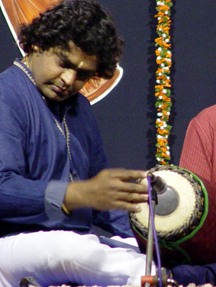
P.
Satish Kumar (2005)
Satish was inspired to learn
mridangam by his mother, Padmavathy, a renowned
violinist. He studied with Sri Ramachandramurthy,
V.A. Swami, and V. Narasimhan in Andhra Pradesh.
He is an A-grade (staff) artist of All India
Radio in Chennai, Tamil Nadu. He has accompanied
leading musicians and won many awards. Located
in Chennai.
|
|
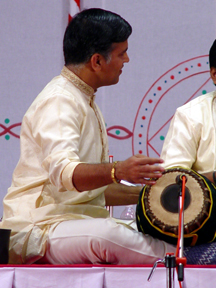
Poongulam
Subramanyam (2005)
Poongulam S. Subramanian
was born in the year 1966. He learned mridangam
from his father Poongulam R. Sabesaiyer and
afterwards with Raja Rao. In 1991, he received
the Best Percussionist Award from YACM. He
has also received awards from the leading
music organizations including Vasantha Priya
(1992) and Krishna Gana Sabha (1993). Other
awards include him being awarded the titles
Yuva Kala Bharathi (Bharat Kalachar), Full
Prince (Muzhu Ilavarasu - Tamil Isai Mandram,Thiruvaiyaru),
and Laya Gana Sudaroli (Kumbakonam). He has
made successful concert tours to Oman, Sri
Lanka, USA, Canada, Australia, New Zealand,
Singapore, Malaysia, Indonesia, and Bahrain,
among others. Located in Chennai. YouTube
Video 1.
|
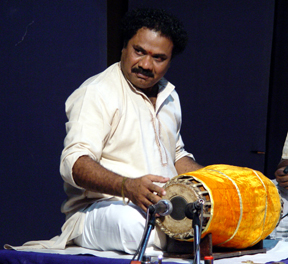
Prapancham
S. Ravindran (2006)
Prapancham S. Ravindran,
a mridangam A-Grade artist for All India Radio,
learned from Thanjavur Sri. Rajam Iyer, and
Balakrishana Naidu. He has accompanied L.
Subramaniam, Dr. M. Balamuralikrishna, N.
Ramani, M.S. Gopalkrihnan, and many others.
He has performed in UK, USA, Europe and elsewhere.
He has maintained a music sabha called "Adhilakshmi
Arts Academy" since 1993. Website.
YouTube
Video 1.
|
|
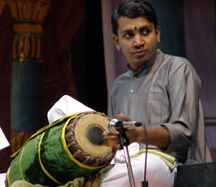
R. Sankaranarayanan (2005)
Located in Chennai. A left-handed
mridangam player and disciple of Srimushnam
Raja Rao. Hails from the family of Papanasam
Sivam, who was a great composer of the recent
past. Sankar also plays mridangam for Sampradaya
(traditional) bhajans.
|
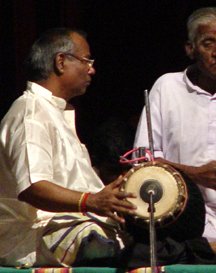
Raja Rao (2005)
Located in Chennai. Sri Raja
Rao got his initial training from his father
vidwan Venkataramana Rao and subsequently
from the well-known Kumbakkonam Rajappa Iyer.
He has captured the hearts of music lovers
in India as well as abroad with his versatile
and masterly performance on the mridangam.
His consistent technical perfection have made
Sri. Raja Rao one of the most famous mridangists
in the Carnatic music scene. Sri Raja Rao
has been conferred with numerous titles and
has won several awards including the Kalaimamani
(from the government of Tamil Nadu), Rasika
Kalaratna (Sydney), Sangeetha Ratnakara (Cleveland
Aradha Committee), and Best Mridangist Award
(Music Academy, Madras). Sri Raja Rao has
performed all over the world including numerous
visits to USA. Raja Rao is also a fine vocalist
and an exponent of the kanjira and morsing.
YouTube
Video 1.
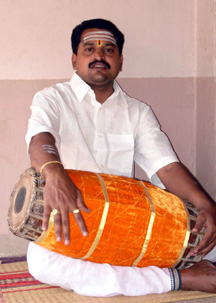
K.P.
Parameswaran
Son of Sri K.S. Padmanabha
Iyer, trained in mridangam with his grandfather
Sri Kodunthirapully Swaminatha Iyer (who was
a student of Sri Thanjavur Vaidyanatha Iyer
and Sri Palakkad Mani Iyer). He now trains
with Dr. T.K. Murthy. He is an All India Radio
‘A’ grade mridangam artist and
has accompanied many of the prominent Carnatic
vocal and instrumental artists in southern
India. Located in Palakkad, Kerala.
|
|
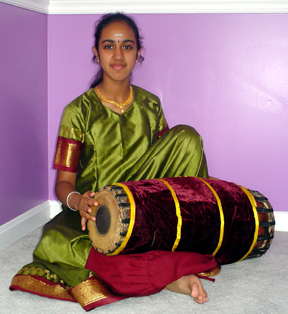
Kumari Rajna Swaminathan
(2005)
One of the few female mridangam
players in the world and also one of the youngest
performing Carnatic concerts at 15 years old.
Rajna learned from her father Dr. P.K. Swaminathan
at age 5 and then at age 8 from U.K. Sivaraman.
She is also a pianist and bharathanatyam dancer.
Located in Burtonsville, Maryland, USA. Website.
YouTube
Video 1.
Rohan
Krishnamurthy
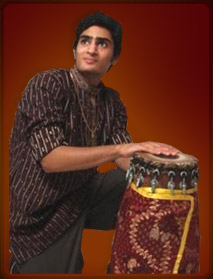
Rohan is one of the younger
generation of mridangam artists located in
the USA at 20 years old. Originally from India,
he began his studies with Damodharan Srinivasan
and then later became a disciple of Guruvayur
Dorai. Rohan has successfully developed a
modern tuning system for the mridangam that
involves metal tuning lugs mounted on the
shell for each head allowing for independent
tuning and head replacement (see his published
article in Percussive Notes, August
2006). Rohan also is proficient on the kanjira
and is also studying Western classical percussion.
He is highly skilled in both Carnatic music
and reading Western music notation, is an
experienced teacher, and has been involved
in the premiere of several mridangam concerti
and chamber music pieces in the USA including
Echoes by Elizabeth Start and Maathras
by Keith Murphy (both concerti in 2006) and
Migration by Elizabeth Start (chamber
piece for mridangam, violin, and piano, 2006).
Located in Kalamazoo, Michigan, USA. Website.
YouTube
Video 1.
|
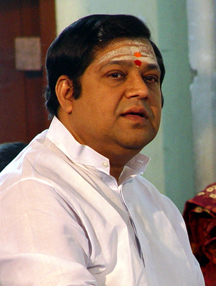
Thiruvarur Bhakthavatsalam (2006)
Located in Chennai. Thiruvarur
Bakthavathsalam has been a well known mridangam
artist for over 30 years. He had his initial
training from his uncle Thiruvarur Krishnamurthy
and later from his mother T.R. Anadavalli.
He has accompanied almost all of the stalwarts
of carnatic music and has participated in
jugal bandis with other artists including
the tabla master Ustad Zakir Hussain. YouTube
Video 1.
|
|

T.K. Murthy (2005)
Born on August 13, 1924,
T.K. Murthy studied mridangam from Thanjavur
Vaidyanatha Iyer. Shri Murthy has more than
70 years of concert experience and has accompanied
almost five generations of Carnatic musicians.
He represents the Thanjavur style of mridangam
playing, which was perfected by his guru Thanjavur
Vaidyanatha Iyer. He has performed internationally
in Scotland, at the United Nations in the
USA, Sri Lanka, and numerous locations throughout
Europe and North America. He has accompanied
all of the major Carnatic recent artists and
played for celebrated musicians of the North
like D.V. Paluskar and Narayana Rao Vyas.
T.K. Murthy's students include K.P. Parameswaran,
J. Vaidyanathan, B. Sivaraman, B.S. Purushotham,
among others. He is a master in konnakkol
and is featured on has released CDs in both
the 35 and 108 varities of talams. He has
received several honors including Sangeet
Natak Academy Award and the prestigous title
Sangeetha Kalanidhi. Located in Chennai. Website.
YouTube
Video 1.
|
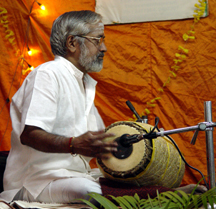
T.V. Vasan (2005)
Younger brother of singer
and mridangam master T.V. Gopalakrishnan.
T.V. Vasan was trained in mridangam, pakhawaj,
maddalam, thavil, kanjira, and ghatam and
also teaches vocalists. He learned from his
brother and has been an All India Radio A
grade artist for 28 years. As a ghatam artist,
he was part of the legendary group Sruthi
Laya with Karaikudi R. Mani on mridangam,
G. Harishankar on kanjira, T.V. Vasan on ghatam,
and Srirangam S. Kannan on morsing. Equally
skilled on mridangam, he was constantly performing
several concerts a day in the 2005-2006 season.
Vasan prefers the Madras ghatam. Originally
from Kerala, now located in Chennai.

B. Ganapathiraman
B. Ganapathiraman (elder
brother of B. Sivaraman) learned initially
from Srimushnam Raja Rao and Nagai Soundararajan
and became the disciple of Kumbakonam Sri
Rajappa Iyer. He is a B-High grade mridangam
artist, and he has accompanied leading musicians
such as Dr. M. Balamuralikrishna and others.
He has won many awards including the Yuva
Kala Bharathi and Nadha Oli. His father Sethalapathy
Balsubhramaniam is a disciple of the great
composer Papanasam Sivan. Located in Chennai.
|
|
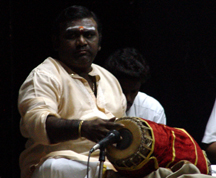
Kumbakonam Saravanan (2005)
Kumbakonam Saravanan was
born on September 25, 1965. He learned mridangam
from Poongaulam Sri Sabesa Iyer, Thanjavur
Srinivasan, and Vazhuvur V. P.Ramadoss. He
is a B-high grade artiste for All India Radio.
He is a lecturer in Govt. Music College. He
has also received the Thanjavur Upendran Award
from Raagam Fine Arts and best player award
from The Music Academy in 1998. Located in
Chennai.
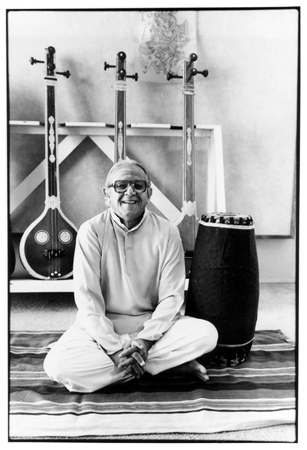
Ramnad V. Raghavan
(c. 1980s)
Great mridangist who played
and recorded with Shakti in the 1975 (he is
on the 1st recording called Shakti with
John McLaughlin). He studied with his
brother Ramnad Easwaran. He taught for many
years at Wesleyan University in CT and now
resides in Chennai. Raghavan also recorded
on the 1st Jamey Haddad LP called Names
in 1984.
|
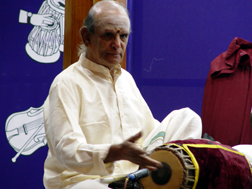
Umayalpuram
K. Sivaraman (2005)
Located in Chennai. Sangeetha
Kalanidhi, Padmabushan Umayalpuram K. Sivaraman,
the topmost mridangam vidwan alive in the
world today was born on December 17, 1935.
The maestro learnt this divine art under four
great and illustrious masters: Sri Arupathi
Natesa Iyer, Sri Tanjavoor Vaidyanatha Iyer,
Sri Palghat Mani Iyer, Sri Kumbakonam Rangu
Iyengar. He has accompanied a galaxy of maestros
of recent past and is a double graduate of
The University of Madras (BA & BL degrees).
He is a trend setter of new techniques, innovations,
and creative ability in accompaniment, solo
renditions, and jugal bandi programs with
his North Indian counterparts, fusion concerts
with celebrated westerners have earned him
a special place in the world of art, for more
than 60 years great merit today, both vocal
and instrumental. Besides his professional
career, this legend has undertaken the very
laudable task of doing original research in
the art of mridangam. This resulted in his
highly acclaimed lecture demonstrations done
in all important centers in India and abroad,
which enabled him to disseminate knowledge
of this divine art to art lovers, music conferences,
music seminars and the like. He is the only
mridangam vidwan who has explored and placed
before the world of art lovers his authentic
information on the techniques and nuances
of mridangam for more than three decades.
He has introduced the fiberglass mridangam
to Carnatic music for the first time, improvised
a mechanical jig to eliminate human error
in the molding of skins for both sides of
the instrument and has done research work
on tanned and untanned skins for the mridangam.
He is the embodiment of effortless playing
with scientific approach regarding fingering
techniques and even complicated phrases. His
innovations include analysis of the ingredients
of the black patch on the treble side of the
mridangam, on the overtones produced from
that head, has synthesized traditional and
modern approaches in playing on the instrument,
evolving new patterns of rhythmic designs
(moras and korvais), and his elegant and bewitching
compositions are being played by numerous
vidwans and aspiring players of today. He
is a poet among other mridangam artistes,
who embellishes classical music with aesthetic
beauties and the sense of when to play and
when to pause, irrespective of any tempo with
clarity and casual elegance. His CDs include
Garland of Rhythm, Drums of India,
Laya Dhara, and the fusion CD Ganesh
with Aka Moon. He is also the Director of
The Thanjavur Vaidhyanatha Iyer School for
Percussion, and a faculty member of The Music
Academy, Chennai and the Rhythmology Program
of the Music Department at The University
of Madras in Chennai. YouTube
Video 1.
|
|
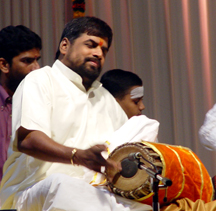
B. Harikumar (2005)
B. Harikumar was born in
Changanasery, Kerala and learnt from Sri Mavelikara
Velukkutty Nair. He graduated in mridangam
from Swati Thirunal Music College and is a
staff artiste at All India Radio in Thiruchy
since 1989. He has conducted Jugal Bandhis
and Tala Vadya programs around the world with
maestros like Sri T.N. Sheshagopalan, Sri
Ajay Chakraborthy, Sri Rashid Khan, Zakir
Hussain, and Sri Tanmoy Bose in USA, Europe,
India, Middle East, Southeast Asia, and Australia.
He has won many prestigious awards. Located
in Tiruchirapalli.
Thanjavur Vaidhyanatha
Iyer (c. 1940)
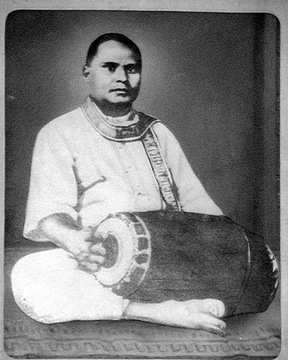
Vaidyanatha Ayyar was born
in Vaiyacheri near Thanjavur in 1897 and died
on April 13, 1947. He learned mridangam from
Thanjavur Doss Swamigal, Kannuswami Nattuvanar,
and K. Ponniah Pillai. He trained disciples
in the "Guru Kula" system. He was
popularly known as "Vaitha Anna,"
("Vaitha" is the short form for
Vaidhyanatha and "Anna" means elder
brother.) Initially, he played for Parameswara
Iyer’s drama troop and traveled to many
places in India. Soon, he accompanied Harikesanallur
Muthaih Bhagavathar, Fiddle Appa Iyer Subharama
Bhagavathar, Kanchipuram Nayana Pillai (from
1916-1926). He also served in the State Broadcasting
Radio Station in Trivandrum. Vaidhyanatha
Iyer served as a "King Maker" in
the field of mridangam with three of his disciples
being the legends Palghat T.A.S. Mani Iyer,
T.K. Murthy, and Umayalpuram K. Sivaraman.
Only after coming under his tutelage, Mani
Iyer started playing the "arai chappu"
stroke (more common in modern mridangam playing).
T.K. Murthy grew up as an adopted son in the
maestro’s house and often played double
mridangam with him in many concerts. Umayalpuram
K. Sivaraman used to play any lesson in 4
speeds immediately after learning the nuances
from Vaitha Anna at the young age of 14. Like
the singing culture of vocalists, T.V. Iyer
imparted a unique pedagogy based on his mridangam
fingering and is today considered to be the
"Father of Mridangam." It is said
that in his playing style, one can identify
whether a pallavi, anupallavi, or charanam
was being performed just by hearing his mridangam
accompaniment. His other disciples include
Mangudi Dorairaja Iyer (who wrote a book for
learning mridangam), ghatam Vilvadhri Iyer,
and Krishnamurthy Rao, among others.
|
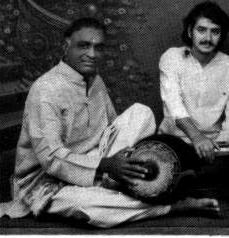
Palghat R. Raghu (c. 1950s)
Located in Chennai. Palghat
R. Raghu was born on January 9, 1928 in Rangoon,
Burma (now Myanmar) but his family comes from
Palghat, Kerala in India. He initially learnt
from Tinniam Venkatarama Iyer and Trichy Raghava
Iyer. Later he learned the art from the legendary
mridangam innovator Palghat T.A.S. Mani Iyer.
He also earned a degree in mathematics. His
thani avartanams with complex and highly mathematical
korvais bear the stamp of innovation, scholarship,
and majestic mastery of this complex instrument.
Complex calculations are a trademark of his
rhythmic style. He has accompanied such vocal
carnatic legends as Sri Papanasam Sivan, Maharajapuram
Viswanatha Iyer, Madurai Mani Iyer, G.N. Balasubramaniam,
Semmangudi Srinivasa Iyer, Alathur Brothers,
Ariyakkudi, M.D. Ramanathan, Chembai Vaidyanatha
Bhagavathar, K.V. Narayanaswami, among others.
He has also accompanied artists such as T.V.
Sankaranarayanan, Trichur Ramachandran, O.S.
Thyagarajan, Doraiswamy Iyengar, Balachander,
Flute Mali, Lalgudi Jayaraman, N. Ramani,
T.N. Krishnan, M.S. Gopalakrishnan, among
others. Palghat Raghu has toured extensively
in Europe, USA, Australia, Malaysia, Singapore,
and elsewhere. He has also been involved in
East-West fusion music. He has been visiting
professor of music at Wesleyan University
in CT, San Diego State University in CA and
University of Berkeley in CA. For his continuing
contribution to carnatic music, Palghat Raghu
has been honored with numerous awards that
include amongst many others: Sangeet Natak
Academy Award, Palghat Mani Iyer Award (first
recipient), Padma Shree, Mridangam Chakravarty
Award, Kalaimamani (Tamil Nadu), Sangeetha
Choodamani, Mridangam Nada Mani (Sankaracharya),
praises from the President of India, Nada
Brahmam - award from Narada Gana Sabha (2000),
and Nada Nidhi (2001).
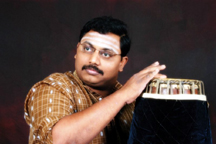
Erode
K.S. Nagaraj (2000)
Karappattu Subrahmanian Nagarajan
first studied mridangam with Palladam Ramachandran
then in 1990 Umayalpuram K. Sivaraman became
his guru. E. Nagaraj is the top student of
Umayalpuram K. Sivaraman. Originally from
Erode, he is now located in Chennai. E. Nagaraj
is an excellent teacher of mridangam and South
Indian rhythmic concepts and theory and is
very highly recommended, particularly for
non-Indian students. E. Nagaraj is also skilled
at singing and is a published poet. He has
been decorated with numerous awards and honors,
is an A grade mridangam artist with All India
Radio, and a teacher at The Music Academy
in Chennai.
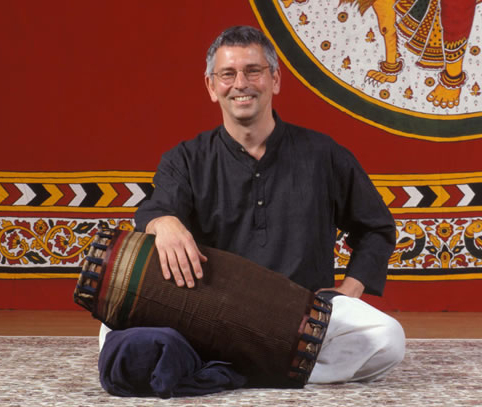
David
Nelson (2004)
Dr. David Nelson, one of
the few American mridangam artists, has been
performing and teaching South Indian drumming
since 1975. From his principal teacher, the
renowned T. Ranganathan, he learned to accompany
a wide range of styles, including Bharata
Natayam, South Indian classical dance. He
has a Ph.D. in Ethnomusicology from Wesleyan
University in CT, where he is Artist in Residence
in South Indian drumming. He has accompanied
well-known artists throughout the United States,
Europe, India, and China. He has also written
extensively on South Indian drumming, including
a major article in the Garland Encyclopedia
of World Music. Located in Connecticut,
USA. Website.
|
|
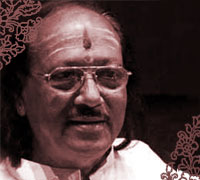
T.V. Gopalakrishnan
(c. 1980s)
T.V. Gopalakrishnan, from
of a musical family, is a master vocalist,
mridangist, percussionist, and violinist.
He is an artist with an unparalleled range,
having mastered concert techniques of the
purely classical and the modern, the Southern
Carnatic and Northern Hindustani. He has brought
a rich crop of disciples to prominence, both
in India and globally. He has given hundreds
of concerts - vocal and instrumental - around
the world. He recorded the first tala vadya
kuttcheri LP called Percussion Through
the Ages in the 1960s. He has also experimented
with mridangam design in developing a seperate
tuning system for each head that involves
metal tuning lugs mounted on the outside of
the shell. A pioneer in music therapy, he
is dedicated to spreading the power of music
through his combination of skill, precision,
and passion. Located in Chennai.
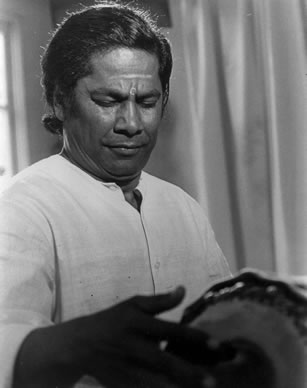
T. Ranganathan (c.
1980s)
T. Ranganathan (born March
13 1925 - died December 22, 1987) came from
a devadasi family of hereditary musicians
and dancers that traces its musical lineage
to all three composers known as the Trinity.
With his brother, flautist and singer T. Viswanathan
(1927-2002), he established Carnatic music
in the United States. Ranganathan learned
from the legendary master Palani M. Subramania
Pillai (1908-1962). A brilliant and sensitive
(if under-rated) mridangam player, Ranganathan
was also a great teacher who dedicated his
career to teaching his non-Indian students
in the USA at Wesleyan University in CT and
CalArts in CA. He forged his own approach
to bharata natayam accompaniment, having been
influenced by Balasaraswati's drummer, M.
Kuppuswami Pillai.
Website.
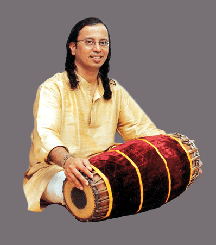
Poovalur
Srinivasan (2000)
Poovalur Srinivasan (also
known as "Sriji") is the most well-known
Indian mridangam players located in the USA.
Originally from Chennai, he studied South
Indian classical music from his father P.
A. Venkataraman. For over three decades Poovalur
has performed with the leading artists from
both South and North Indian classical traditions.
Since his move to the United States, Poovalur
has performed and recorded with artists such
as Sir Yehudi Menuhin, Bela Fleck, Mark O’
Connor, John Bergamo, Glen Velez, and Hands
On'semble. He is the founding member of the
group Brahma. He is currently a faculty member
at the University of North Texas. He has also
taught at CalArts and San Diego State University.
Website.
YouTube
Video 1.
|
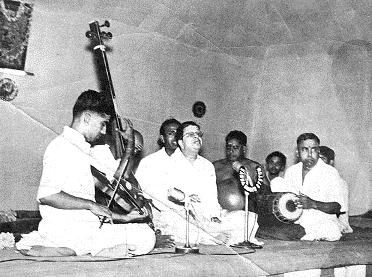
Palani Subramania Pillai
(c. 1950s)
(with Madurai Mani Iyer-vocal & Lalgudi
Jayaraman-violin)
Born 1908 - died 1962. See
entry above in kanjira section for his bio.
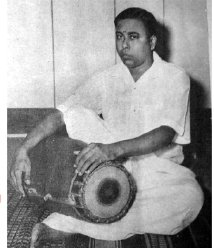
Palani Subramania
Pillai
|
|
|
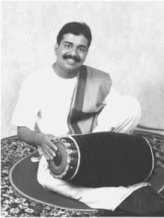
Vinod R. Venkatraman (c. 1970s)
Vinod Venkatraman was born
into a family of rich musical ancestry. He
began performing at a very early age of seven.
Venkataraman had his initial training in mridangam
from Trichy Raghava Iyer, and later from one
of the greatest exponents of the mridangam
Palghat R. Raghu. Venkataraman has performed
extensively all over India, Indonesia, Singapore,
Canada, Europe and the USA. He has to his
credit numerous concerts with legendary greats
like Prof. T.N. Krishnan, L. Subramaniam,
and N. Ravikiran, among others. Venkataraman
has collaborated with legendary jazz artists
like Stephane Grapelli, Larry Coryell, Hubert
Laws, and Alice Coltrane. He is a resident
of Long Beach, California, USA where he is
a professor of mathematics.
|
|
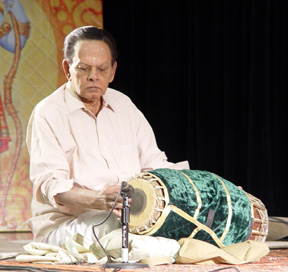
Vellore Ramabadran (2007)
Located in Chennai. Vellore
Ramabhadran learnt from his father Konakkal
Sri Gopalachariar. He enhances a musical recital
without the needless display of technical
exuberance. He has accompanied stalwarts of
the past like Chembai Sri Vaidhyanatha Bhagavadar,
Maharajapuram Sri Viswanatha Iyer, Ariyakudi
Sri Ramanuja Iyer, Madurai Sri Mani Iyer,
Musiri Sri Subramania Iyer, Sri G. N. Balasubramaniam,
Semmangudi Sri Srinivasa Iyer, and Maharajapuram
Sri Santhanam. Ramabhadran is a recepient
of several awards and honors like Sangeetha
Kalanidhi, Kalaimamani, Sri Chowdiah Memorial
Award, Sangeet Natak Akademi Award, among
others. The rotary club of Madras-East presented
to him the Vocational Service Award for the
year 1991 for his excellent contribution in
his vacation. In January 1994 Sankranti Sangeet
Utsav by Murugappa Group paid its tribute
to him as a master of great skill. YouTube
Video 1.
|
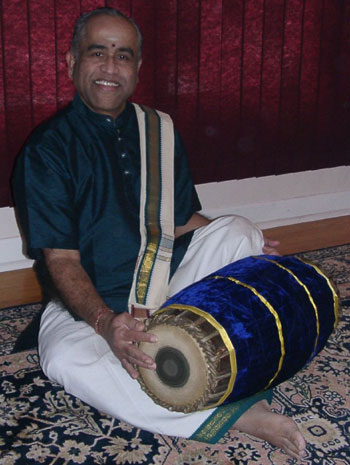
Trichy
Sankaran (2001)
Primarily a mridangam player
of the highest calibre, Trichy also performs
on kanjira in Canada and the USA. Learned
from Palani Subramania Pillai. Originally
from Trichy, now located in Toronto, Canada.
Website.
Trichy Sankaran with Zakir Hussain & G.
Harishankar YouTube
Video 1.
|
|

Neyveli
B. Venkatesh (2005)
One of the few mridangam
players that still performs on kanjira. Neyveli
travels most of the year for performances
in Europe with top artists from India. He
is a highly experienced teacher of both mridangam
and kanjira and has trained students all over
Europe. He learned mridangam from A.S. Balaraman
and kanjira from M.N. Kandaswami Pillai. Originally
from Neyveli, now located in Chennai.
|
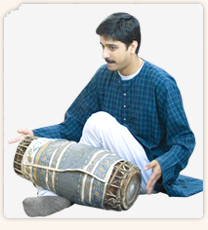
Ghatam Brother R.N. Prakash (2004)
Originally from Bangalore
but now located in London, the Ghatam Brothers
are R.N. Prakash (pictured above) and R.N.
Prathap. They learned from Bangalore Vidwan
K.N. Krishna Murthy. Both of the Ghatam Brothers
are equally skilled on kanjira, mridangam,
ghatam, and konnakol. Located in London, England,
UK.
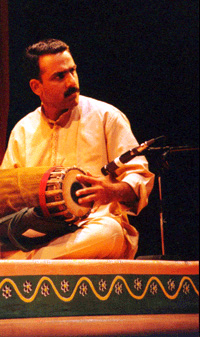
Jayachandra
Rao (2004)
Jayachandra Rao (left handed)
started learning mridangam at the age of 5
with Vidwan Trichur E.P. Narayan Pisharady
and later received advanced training with
Palakkad T.R. Rajamani (the son of Palghat
T.A.S. Mani Iyer). He has also learned bamboo
flute from his father K. Rahavendra Rao. Jayachandra
has accompanied stalwarts from the field of
Carnatic Music including Vidwan T.K. Govind
Rao, Dr. N. Ramani, Bombay Sisters, Rajkumar
Barathi, Kadri Gopalnath, Maharajapuram Ramachandran,
R.K. Srikanthan, Akella Mallikarjuna Sharma,
and Sangita Vidushi Miss Jun Obi (from Japan).
He is a member of the Indian percussion group
Layatharanga. Located in Bangalore. Website.
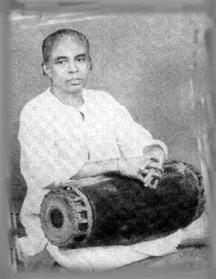
Ramanathapuram C.S.
Murugabhoopathy (c. 1980s)
Murugabhoopathy was born
to Chitsabhai Serrai of Ramanathapuram and
died in the early 2000s in his 70s. He had
his training form his father and his brother
C.S. Sankara Sivam. He was a favorite mridangist
for the flute maestro T.R. Mahalingam. Murugabhoopathy
has been the visiting Principal for Tamil
Isai Sangam Music School, Madurai and has
been a member of the Advisory Committee Government
Music College Madras. He has received numerous
titles including the Kalaimamani, Padmashri,
and the Sangeet Natak Akademi Award. He is
one of the three most celebrated mridangists
including Mani Iyer and Pazhani. In his technique,
the balance and nadha (sound) that he produced
in his thoppi was remarkable. Taught kanjira
legend G. Harishankar.
|
|
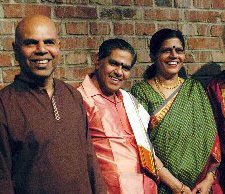
T.A.S.
Mani (Mridangam)
& Karnataka College
of Percussion (1998)
The Karnataka College of Percussion (in photo
are T.N. Ramesh-thavil, T.A.S. Mani-mridangam,
and R.A. Ramamani-vocals, not pictured are
members T.N. Shashikumar-kanjira, R.A. Rajagopal-ghatam,
S. Sudarshan-dholak, and G. Omkar-morsing)
in Bangalore, South India, has been training
young musicians on various percussion instruments
and vocal techniques of South India. This
college has trained a large number of students
in India and from abroad since its inception.
Many of them have obtained distinction in
the Indian government's State Board of Examinations
and became professional musicians. As part
of their curriculum, periodical programs are
arranged to promote art and culture and encourage
talented youngsters. The Karnataka College
of Percussion is world famous for its vibrant
percussion ensemble and vocalist.
T.A.S. Mani is the director of the ensemble
and his wife, Mrs.
R.A. Ramamani, is the lead vocalist
with the Karnataka College of Percussion.
Percussion instruments used in the ensemble
include mridangam, ghatam, kanjira, morsing,
dholak, and thavil. A special feature of this
ensemble is konnakol, a concert performance
of solkattu or vocal percussion syllables.
The Karnataka College of Percussion has performed
in Asia, Australia, Europe, and America, has
participated in many international percussion
festivals as well as the Indian Jazz Yatra
Festival, and made many recordings with such
diverse artists as Okay Temiz, Charlie Mariano,
Ned Rothenberg, Embryo, Dissidenten, Chris
Hinze, Louis Banks, and the WDR Big Band.
T.A.S. Mani, the founder and president of
Karntaka College of Percussion, is an internationally
renowned teacher, mridangam player, and composer.
He is responsible for introducing the Karnataka
College of Percussion to audiences outside
of India since 1975. He has accompanied leading
musicians of Carnatic classical music, and
has composed many pieces employing experimental
rhythms. He also teaches at Bangalore University,
has written books on mridangam, and is a member
of the audition board of All India Radio.
Karnataka College of Percussion is located
in Bangalore in the state of Karnataka.
Address:
Karnataka College Of Percussion
Sri. T. A. S. Mani
93/2, 17th Cross Street, Westpark Road,
Malleswaram,
Bangalore 560055 Karnataka, India
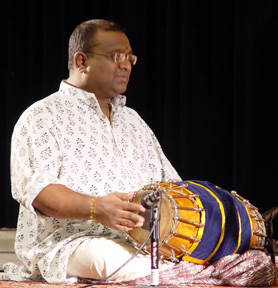
H.S. Sudhindra (2007)
H.S. Sudhindra is a disciple of Sri. M. Vasudeva
Rao & Srimushnam V. Raja Rao. He is an A
grade mridangam artist and is located in Bangalore.
He is the principal of "Suswaralaya College
of Music, located in Bangalore, Karnataka. He
has won many awards and performed across India
and in the US and UK.
|
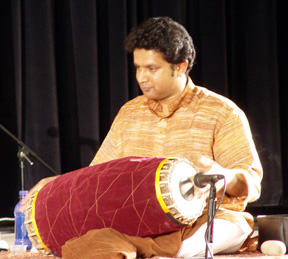
Arjun Kumar (2007)
Arjun Kumar, an A grade mridangam artist,
initially learning mridangam from (his father)
Sri Arjunan and Sri T.A.S. Mani. He was awarded
the Govt. of India scholarship and came under
the tutelage of the mridangam legend, Padmabhushan
Umayalpuram Sri K. Sivaraman. He has accompanied
most of the leading and contemporary Carnatic
musicians and has also perfomed in the Middle
East, Eastern Europe, USA, France, Singapore,
Malaysia, Hong Kong, Australia, and Switzerland.
He is located in Bangalore.
|
|
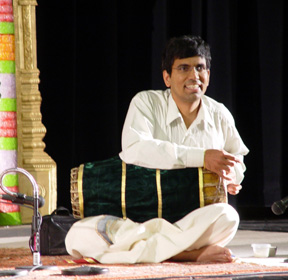
Sri Ramesh (2007)
T.R.
Dhandapany (2002)
Sri T.R. Dhandapany took
his initial training in mridangam from Sikkal
Shri A.S. Natesa Iyer. Later, he studied with
Sri Harihara Sharma, Principal of Jaya Ganesh
Talavadya Vidyalaya of Chennai. Located in
New Delhi, North India.
|
|