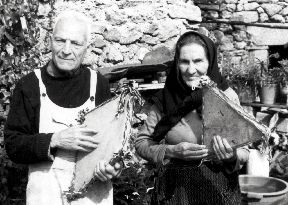
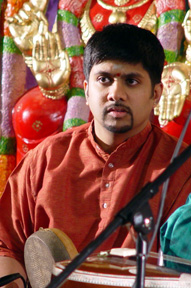
This page
is dedicated to some traditional frame drummers as
well as some of the modern frame drummers in the West.
The musicians on this page are in no particular order.
No bias is meant towards any frame drummers not yet
mentioned on this page. Some of these musicians play
other instruments but are featured here because of
their frame drumming. This page is no longer updated
due to time constraints.
BODHRÁN
- IRELAND
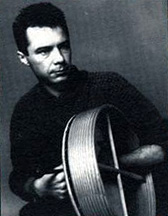
Mel Mercier
Irish bodhrán player
who has performed and collaborated with pianist
and composer Mícheál Ó
Súilleabháin for over twenty-five
years. Throughout the 1980s, he performed
extensively in Europe and the USA with composer
John Cage and the Merce Cunningham Dance Company.
He has also performed and recorded with many
of the leading Irish traditional musicians
of the last thirty years following in the
footsteps of his father, Peadar Mercier,
who was the bodhrán player in The Chieftans
from 1966-1976.
|
|
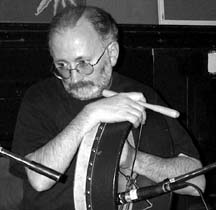
Fergus O'Byrne
Irish bodhrán player
who is now located in Newfoundland, Canada.
Known for his work with the groups The Sons
of Erin, O'Reilly's Men, Sullivan's Gypsy's,
Ryan's Fancy, Tickle Harbour, and now plays
with A Crowd of Bold Sharemen.
|
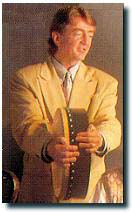
Kevin Conneff
Irish bodhrán player
who played with The Chieftans since 1976.
Conneff was the third bodhrán player
for The Chieftans but he sometimes shared
the duty of playing bodhrán in The
Chieftans with the band's leader Paddy
Moloney.
|
|
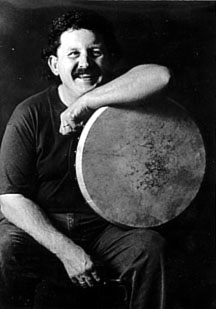
Tommy Hayes
Innovative Irish bodhrán
player who was helped form a progressive band
of All-Ireland championship winning musicians
called Stockton's Wing in 1977 and performed/recorded
with them until 1983. He has several solo
recordings out and was the bodhrán
player in the original run of show Riverdance
and in the film Rob Roy.
|
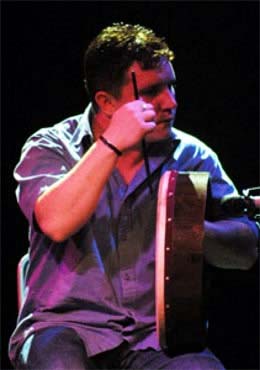
John Joe Kelly
Perhaps the most refined
bodhrán player living today. Plays
with the group Flook.
|
|
%20McDonagh.gif)
Johnny "Ringo" McDonagh
Irish bodhrán player
known for his work with the group Dé
Danann (also spelled as De Dannan) from 1975-1983.
Their 1977 recording Selected Jigs, Reels,
and Songs features a bodhrán solo
by Johnny "Ringo" McDonagh. He is
the first to develop the modern rim shot and
play the bodhrán with a brush.
|
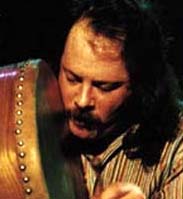
Colm Murphy
Irish bodhrán player
known for his work with the group Dé
Danann (also spelled as De Dannan) from 1983-2002.
Murphy was the second bodhrán player
for the group after Johnny "Ringo"
McDonagh left.
|
|
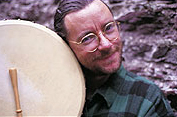
Steáfán
Hannigan
Irish bodhrán player
and multi-instrumentalist who is known for
his work with Lorraine Jordan, Il Divo, Julian
Lloyd Weber, Pete Lockett, Bjork, Depeche
Mode, Gary Barlow, Uriah Heep, Martin Carthy,
Dave Swarbrick, John Kirkpatrick, Broderick,
Luke Daniels, Sin É, Linn Tilla, Anne
Lister, Eileen McGann, Band of Hope, Lammas,
Tim Garland, Brian Willoghby, Lorenna McKennett,
Jeff Martin, James Keelaghan, Art Turner,
The Afro-celts, John O'Connor, and Michael
Flately. Author of The Bodhrán
Book, The Bodhrán Video,
and The Bodhrán DVD.
|
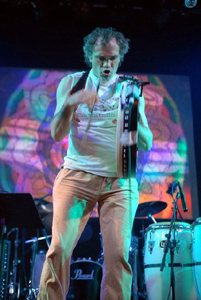
Rónán
Ó Snodaigh
Rónán Ó
Snodaigh is an Irish musician, poet, and vocalist
in the group Kíla. Ó Snodaigh
plays the bodhrán with an unusual technique
he developed that involves the use of a 6-inch
piece of steel pipe that is pressed against
the skin with the left hand for glissandi.
|
|
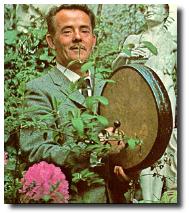
Peadar Mercier
Irish bodhrán player
who played with The Chieftans from 1966-1976
and is the father of Mel Mercier. Paedar Mercier
was the second bodhrán player for The
Chieftans (the first was Dave Fallon
1963-1966). Originally, he first played in
the group Ceoltóirí Cualann
in 1961 with Seán Ó Ríada.
|
|
|
Jesse Winch
American bodhrán player
who is known for his work with the group Celtic
Thunder since 1977.
|
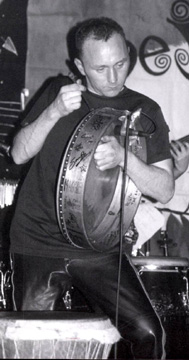
Brian Fleming
Irish bodhrán player
and percussionist who has worked with groups
such as Anuna, Puck Fair, Whirligig, Faolan
and Jack L. and is a founding member of the
Afro-Irish group De Jimbe. He plays with the
Rónán Ó Snodaigh steel
pipe glissandi technique and also uses brushes
for helicopter-like effects.
|
|
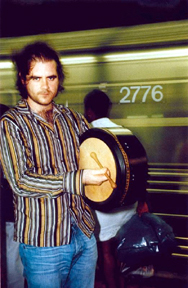
Robbie Harris
Robbie Harris is an Irish
bodhrán player and percussionist from
Dublin. He has performed and recorded with
artists such as Emer Mayock, Eileen Ivers,
Moya Brennan, Stockton's Wing, Bill Whelan,
Brian Kennedy, Daimen Demsey, Finbar Furey,
Mick Moloney, Puck Fair, Grada, Secret Garden,
The Bards, The Fleadh Cowboys, Patrick Mangan,
Kevin O'Connor, Martin Nolan, Zoe Conway,
Peter Browne, Eoin Duignan, Declan Masterson,
Hector Zazou, Sami Moukaddem, Rodrigo y Gabriela,
and Kila. In 2000, he compiled and released
a double CD called Pure Bodhrán
- The Definitive Collection that
features a collection of 19 of the leading
exponents of the drum from all over Ireland.
It features the first ever recording of the
instrument made in 1927. In 2000, he relocated
to New York City to play bodhrán in
the Broadway production of Riverdance.
|
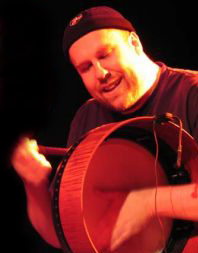
Rolf
Wagels
German bodhrán player
who is recognized as the best player of the
instrument in Europe outside of Ireland. He
is a member of the highly praised Irish traditional
bands DeReelium and Steampacket and played
in Germany with different German and Irish
bands such as Cara, Joe Burke & Anne Conroy,
More Maids, Templehouse Céilí
Band, Ian Smith and Steven Campbell, among
others.
|
|
Svend Kjeldsen
Bodhrán player from
Denmark who plays with the groups Crónán
and Moving Cloud.
|
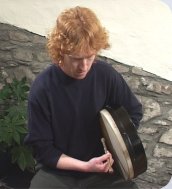
Frank Torpey
Irish bodhrán player
who is a member of the Irish traditional music
group Nomos. He has played with Riverdance,
Michéal Ó Súilleabháin,
Luka Bloom, and The Brendan Power Band. Frank
became the bodhrán tutor at U. C. C.
in 1992 and has since taught on the Masters
Degree in Traditional Music Performance at
the University of Limerick. He is the author
of the Bodhrán CD Rom Tutorial.
|
|
|
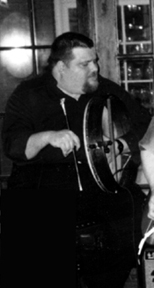
Ken
Larson
American bodhrán player
located in Oregon. Known for his work with
Peter Yeates, Gallowglass, and New Shilling.
|
|
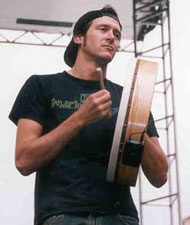
Carter
Gravatt
American guitarist and bodhrán
player with the rock band Carbon Leaf from
Virginia.
|
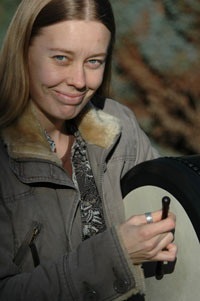
Lucy Randall
Originally a rock drummer,
Lucy was inspired to take up the bodhrán
after seeing the legendary Irish band De Dannan.
Through listening to lots of traditional Irish
music, playing at local sessions, and having
a natural feel for traditional music, she
quickly became a competent player. Soon Lucy
was playing regularly with Broadstairs based
melodeon and guitar maestro Tim Edey, along
with Kent’s leading world music band
Monkey Puzzle with fiddler Laura Targett and
guitarist Peter Gazey. In 2000, Lucy and Laura
won 1st prize in the Wiltshire Young Folk
Awards, Lucy also taking the prize for Best
Instrumentalist. Due to Lucy's respect for
all styles within traditional Irish music
coupled with an interest in many other musical
genres and a technical ability of a very high
standard, Lucy is one of the most versatile
and creative bodhrán players of the
present time. As well as teaching at various
festivals and at Hammersmith Irish Centre
in London, Lucy has recorded and performed
with many excellent musicians including: The
Michael McGoldrick Big Band, James O’Grady
and Alan Prosser (The Oyster Band), Colette
O’Leary (The Bumble Bees), Niel Yates,
Seth Lakeman, and Charlie McCarran (Capercaillie)
plus many others and is now currently working
with Brendan Power, with whom she and Tim
Edey performed on the popular BBC TV music
show Later With Jools Holland. She
is the author of one of the best books on
contemporary bodhrán entitled The
Goat Whackers Guide to Rhythm!
|
|
|
PANDERETA
- SPAIN
Pandereta
- Asturias & Cantabria
Pandeireta
- Galicia
Panderoa
- Basque Country
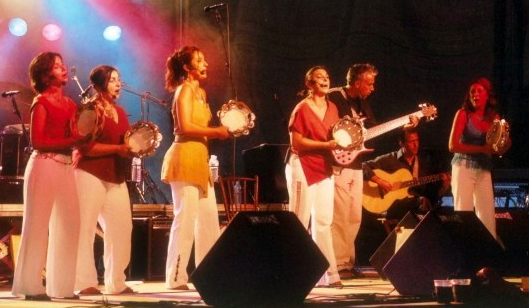
Leilía
Pandereteira ensemble
from Galicia in northwestern Spain whose members include
Felisa Segade Otero, Ana Rodriguez Lareo Gómez,
Mercedes Rodriguez Vazquez, Monserrat Rivera Crespo,
and Patricia Segade Otero. This group performs a blend
of traditional and modern music from Galicia.
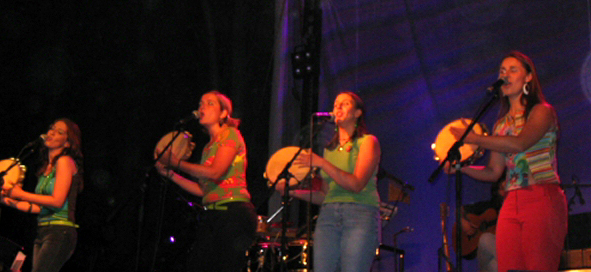
Faltriqueira
Pandereteira ensemble
from Galicia in northwestern Spain whose members include
Ana Leira, Maria López, Carolina Rodriguez,
and Teresa Garcia. This group performs a blend of
traditional and modern music from Galicia.
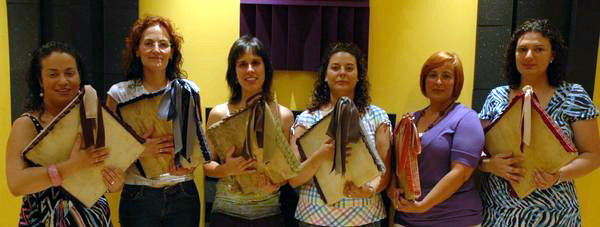
Pandereteres
de Fitoria
Ensemble from Asturias,
Spain featuring pandereta & adufe players Guadalupe,
Lorena, Laura, Silvia, Verónica, and Yolanda
who play a varied repertoire of traditional and modern
music.
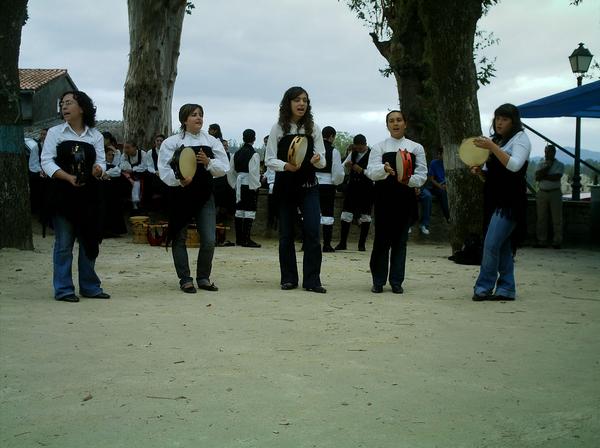
Pandereteiras
do Val da Maía ou Maianas
Ensemble from Ames,
Coruña in Spain.
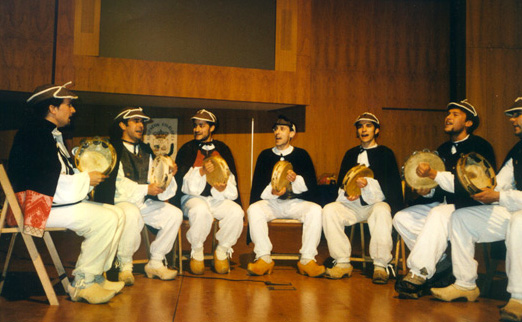
Eiravella
All male ensemble
that specializes in traditional vocal forms with pandeireta
accompaniment from Galicia. Notice both right and
left handed players in the photo above.
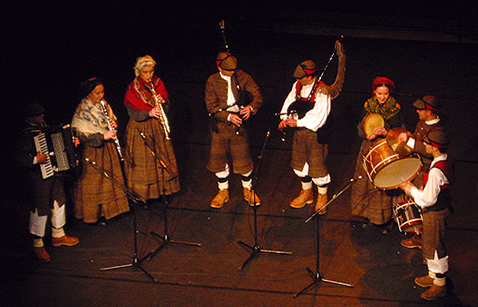
Charanga O Fiadeiro
Ensemble from Galicia specializing
in traditional music from Galicia in northwestern
Spain.
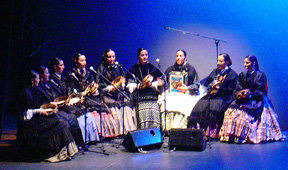
Pandereteiras de O Fiadeiro
All female pandereteira ensemble
from Galicia in northwestern Spain specializing
in traditional music from Galicia.
|
|
|
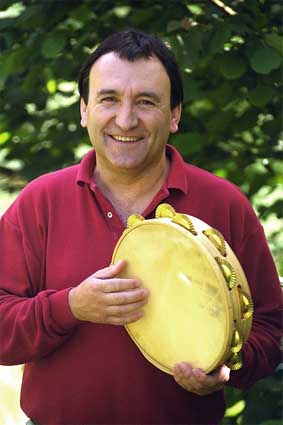
Xabier Berazaluze "Leturia"
Perhaps the most refined
panderoa player from Basque Country in northern
Spain. Plays with Tapia eta Leturia Band.
|
|

Natxo de Felipe
Singer, panderoa player, and
multi-instrumentalist from Basque Country
in northern Spain. Plays with Oskorri.
|
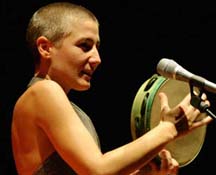
Mercedes
Peón
Pandeireta player, singer, and
multi-instrumentalist from Galicia in northwestern
Spain.
|
|
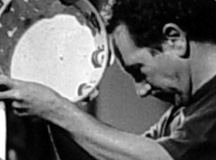
Eliseo Parra
Singer, guitarist, and pandereta
player from Valladolid in Castilla y León,
Spain. His background is diverse as he was
involved in rock and jazz bands but in 1984
began performing a type of Pan-Spanish music
style that incorporated musical instruments
and folk songs from all over Spain with modern
jazz, rock, and funk influences.
|
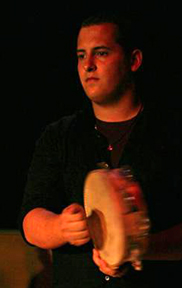
Xavier Sanchez e Iglesias
Player of the Galician pandeireta
with the Belgium group Néboa.
|
|
|
| |
|
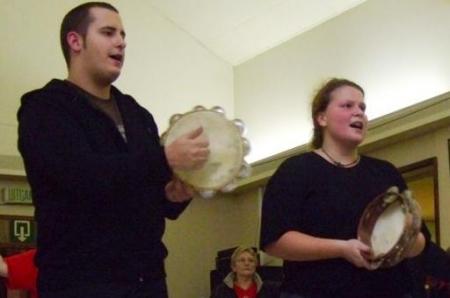
Pandereta
Pandereta is a duo of Galician
pandeireta players & singers located in
Belgium. They are Xavier Sanchez e Iglesias
and Eva Fernandez Palomo.
|
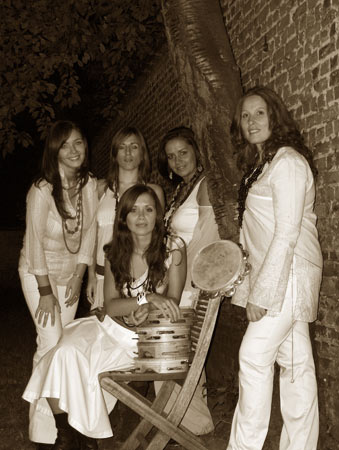
Ialma
Ialma are a Galician group
that play pandeireta and sing, located in
Belgium. Their music is a mix of traditional
Galician and urban popular styles. The band
members are Nuria Aldao, Veronica Codesal,
Natalia Codesal, Magali Menendez, and Marisol
Palomo.
|
|
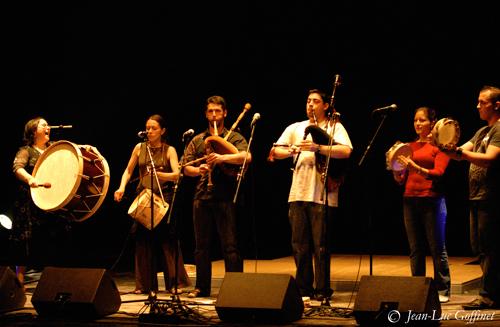
A Contrabanda
A Contrabanda is a group
specializing in traditional Galician music,
located in Belgium. Xavier Sanchez e Iglesias
plays pandeireta with them.
|
TAMBURELLO
& TAMMORRA
- ITALY
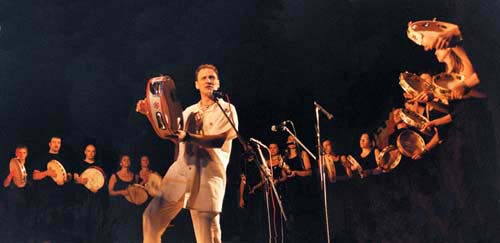
Arnaldo Vacca
One of the top tamburello
and tammorra (pictured above) players in Italy and
a great multi-percussionist and singer. Located in
Rome, Arnaldo is known for his work with the groups
Indaco, Xicrò, and Boom Boom Language, among
others, and leads the group Tamburellando (pictured
above).
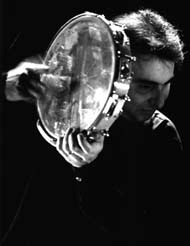
Carlo Rizzo
Most inventive Italian tamburello
player in Europe. Carlo Rizzo was born in
Venice and was originally a painter. After
meeting southern Italian folk musicians, he
developed an interest in tamburello, tammorra,
and traditional songs from southern Italy.
After intense studies, which also included
Persian drumming, he engineered his own poly-timbral
and multi-timbral tambourines (pictured above)
on which he can control the tuning of the
skin, application of snares, and the dampening
of the jingles in real time while performing.
His technique makes his tambourines sound
at times like a snare drum, timpani, and tamburello.
He is also quite skilled and equally inventive
on other frame drums. He is located in France
and performs mostly across Europe.
|
|
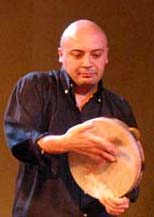
Andrea
Piccioni
Virtuoso Italian tamburello
(pictured above) and tammorra player from
Rome. Equally skilled on other frame drums,
Andrea is part of the newer stylists who have
started using Italian tambourines outside
of their tradition, subsequently expanding
the traditional techniques. He is the author
of the book Il Tamburello Italiano (The
Italian Tamburello).
|
| |
|
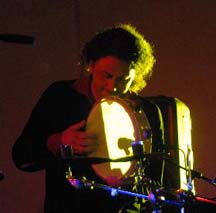
Paolo
Cimmino
Italian tammorra & tamburello
(pictured above) player from Naples who is
also skilled on a variety of frame drums,
percussion, piano, and in singing. Paolo is
part of the newer stylists who have started
using Italian tambourines outside of their
tradition, subsequently expanding the traditional
techniques. Author of the book A New Way
of Playing Tamburello.
|
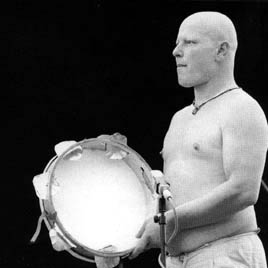
Antonio
O' Lione Matrone
Tammorra (pictured abve)
and tamburello player and singer from Naples
with the group Tammurriata di Scafati (that
also includes the tammorra player Luigi Matrone
and tamburello & tammorra player Piccolo
Corrado Veneruso "Spaghettino").
|
|
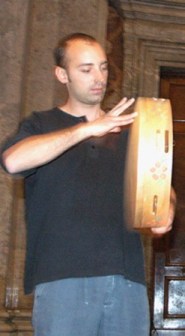
Francesco Manna
Italian tamburello &
tammorra (pictured above) player from Naples.
He studied Italian tambourines with Arnaldo
Vacca and Alfío Antíco
and Persian daf with Mohsen Kassirossafar.
He has performed with Ancia Libera, Taranterrae,
Etnie, Tamburellando di Arnaldo Vacca, Federico
Verdoliva, Caterina Pontrandolfo, Daniele
Sepe, Paolo Cimmino, Zezi teatro, and Giovanni
Coffarelli, among others.
|
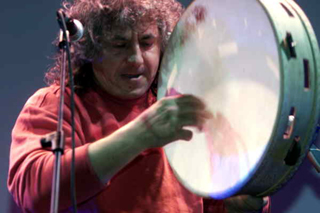
Alfío Antíco
Master Italian tamburello
and tammorra (pictured above) player from
Sicily. He is also a master craftsman and
makes very refined tamburello and tammorra.
He has performed with Musicanova, Edoardo
Bennato, Vincenzo Spampinato, Lucio Dalla,
Fabrizio De Andrè, Vinicio Capossela,
Peppe Barra, Renzo Arbore, Roy Paci, Gianni
Perilli, Piero Ricci, and Nuova Compagnia
di Canto Popolare, among others. His techniques
have spread among the younger generation of
tamburello players including Arnaldo Vacca
and Andrea Piccioni.
|
|
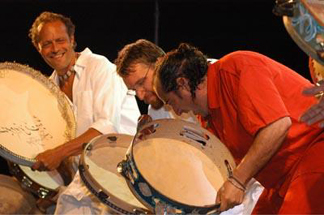
Tamburi del Vesuvio
Ten piece Italian group from
Rome featuring the multi-instrumentalists
& tammorra players (pictured above) Nando
Citarella, Gabriella Aiello, Valerio Perla,
Umberto Vitiello (playing daf above), and
Arabic percussionist Mohammed Abdalla on riqq
and bendir.
|
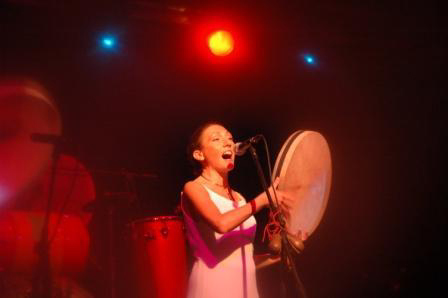
Gabriella Aiello
Gabriella Aiello was born
in Rome, Italy, where she grew up as a singer,
dancer and musician. She started out studying
classic singing techniques with several teachers
and then she got into jazz music. Her main
interest, for many years, has been world music.
Her meeting Giovanna Marini led to the studying
of the traditional Italian musical culture
including its folk songs, musics, and dances.
She has been collaborating as lead-singer
and dancer with several groups performing
southern Italian popular music. She performs
on tammorra with Tamburi del Vesuvio and also
sings with Tarè.
|
|
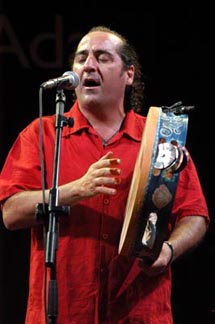
Nando
Citarella
Italian singer, tammorra
player, actor, and musician from Rome who
also works with Tamburi del Vesuvio. He has
worked with Eduardo De Filippo, Dario Fo,
Linsday Kemp, Roberto De Simone, and Ugo Gregoretti.
|
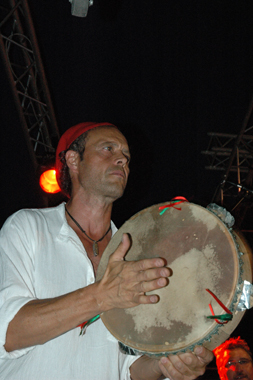
Umberto Vitiello
Italian frame drummer and
percussionist from Rome who plays tammorra,
daf, and other percussion. Works with the
group Tamburi del Vesuvio, among others.
|
|
Valerio Perla
Italian tammorra player and
Afro-Cuban percussionist from Rome who has
worked with Giancarlo Schiaffini & Italian
Instabile Orchestra, Nando Citarella &
Tamburi del Vesuvio, Jovanotti, Mau Mau, Riccardo
Tesi & Banditaliana, James Senese &
Napoli Centrale, Mal Funk, Luca di Volo &
T.E.S.T. Orchestra, among others.
|
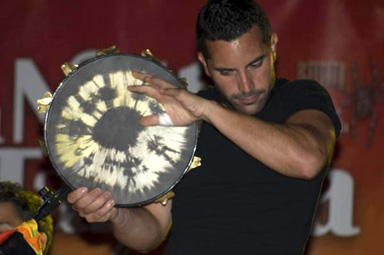
Andrea Stefanizzi
Left-handed Italian tamburello
and frame drummer from Lecce in Salento (southern
Puglia). He has worked with Kumenéi,
among others.
|
|
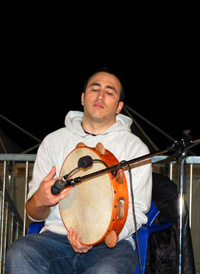
Roberto Chiga
Italian tamburello &
tammorra player and frame drummer from Martignano
in Salento (southern Puglia). He has worked
with Arakne Mediterranea, The Survivers Band,
Ensemble Terra d'Otranto, Skaddia, Giuseppe
Gioia e Apulia Ensemble, and Athanaton.
|
Giorgio
Di Lecce & Arkane Mediterranea
Arakne Mediterranea is an
association of Italian artists, based in Martignano
in Salento (southern Puglia), which for 10
years, together with the co-operation of the
University of Lecce, has been dedicated to
the preservation and diffusion of the traditions
and folk cultures of Salento. The association
has given rise to numerous dance companies
and folk songs, composed by Giorgio Di Lecce
(who is the Director and one of the tamburello
players), Imma Giannuzzi, Gabriella Licciardi,
Graziella Paiano, Pierangelo e Giovanni Colucci,
Francesca Della Monaca, Maria Negro, Gianluca
Milanese, Francesco Del Prete, Francesco Frascella,
Roberto Chiga and Elio Giordano. The photo
below is of an Arakne Mediterranea performance
of la danza del tamburo. This group has many
great CDs and an informative website.
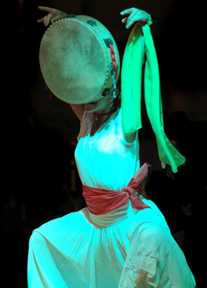
La Danza del Tamburo
|
|
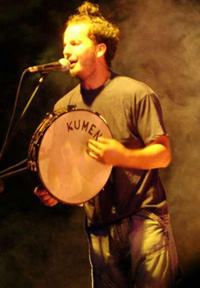
Antonio Melegari
Left-handed Italian tamburello
player from Salento (southern Puglia) who
plays with the group Kumenéi. He has
also worked with the group Mascarimirì.
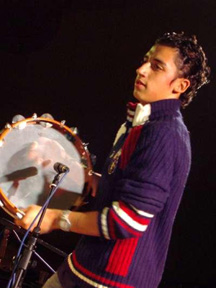
Matteo Manni
Italian tamburello player
from Salento (southern Puglia) who plays with
the group Kumenéi.
|
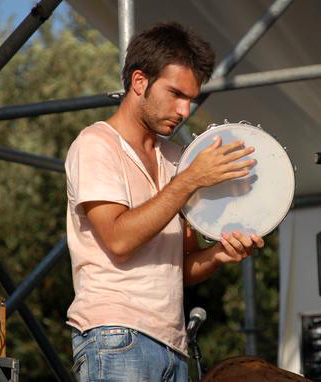
Mauro Durante
Italian tamburello player
and violinist from Lecce in Salento (southern
Puglia). He has worked with Ensemble di Terra
d’Otranto, Cesare Dell’Anna, Nidi
d’Arac, Ambrogio Sparagna, and Piero
Milesi, among others.
|
|
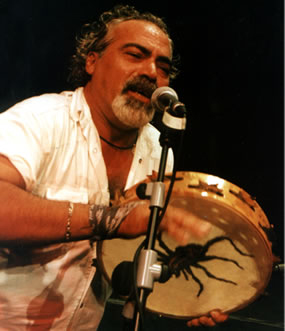
Pino Zimba
Italian tamburello player
and singer from Salento (southern Puglia).
|
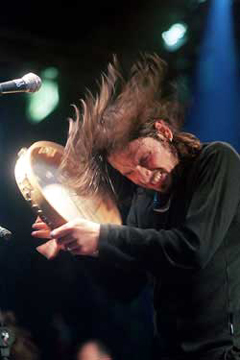
Alessandro Coppola
Italian tamburello player
and multi-instrumentalist from Salento (southern
Puglia) who plays with the group Nidi D'Arac.
|
|
Antonio "Uccio" Aloisi
Italian tamburello/tamburo
player and singer of traditional music from
Salento (southern Puglia). His group is called
Uccio Aloisi Gruppu and features other tamburello
players including Gianluca Cornovaglia
and Domenico Riso. An annual
festival in his memory is held in Cutrofiano,
Salento each October in Italy.
|
| |
|
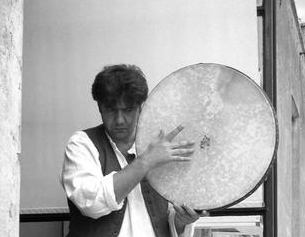
Francesco Salvadore
Italian tamburello player
and percussionist who uses other frame drums
in his work with the Sicilian group Unavantaluna.
|
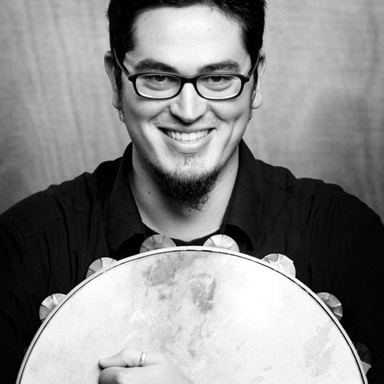
Francesco Turrisi
Italian jazz pianist and
frame drummer who plays great Sicilian style
tamburello. Originally from Turin in northern
Italy, he is now located in Ireland. He has
played with Dave Liebman, Maria Pia de Vito,
Fay Claasen, Gianluigi Trovesi, Lucilla Galeazzi,
John Ruocco, Eric Ineke, Ronan Guilfoyle,
Michael Buckley, Dorothy Murphy, and is the
frame drummer for the early music ensemble
L'Arpeggiata.
|
|
G. Michele Montanaro
Italian tamburello player
from Caserta in Campania. He has studied Italian
tambourines with Arnaldo Vacca, Alfío
Antíco, Nando Citarella, and Andrea
Piccioni. He has performed with Sonia Maurer,
Sara Modigliani, Michela Musolino, Andrea
Piccioni, Pino Pontuali, Arnaldo Vacca, Felice
Zaccheo, and Gianluca Zammarelli, among others,
and is very adept at Brazilian pandeiro style
juggling with the tamburello.
|
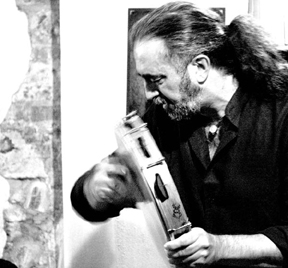
Ninad Massimo Carrano
Italian tamburello player
and frame drummer from Rome. He teaches at
the University of Music, Rome and has worked
with Teresa De Sio, Mimmo Locasciulli, Ornella
Vanoni, Fabrizio de Andrè, Karl Potter,
Massimo Moriconi, Mariapia de Vito, Rita Marcotulli,
Nuova Compagnia di Canto Popolare, Lucilla
Galeazzi, and Tony Esposito, among others.
|
|
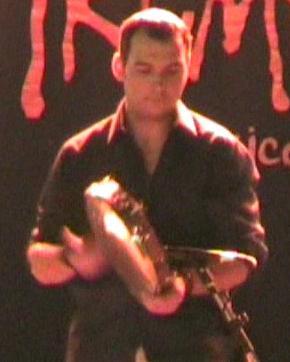
Giulio Varricchio
Great Italian tamburello
& tammorra player with the group Annasulea.
|
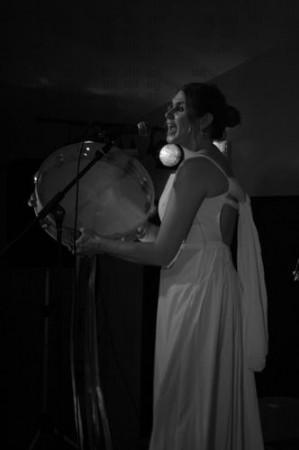
Tiziana Valentini
Italian tamburello &
tammorra from Rome who plays with the amazing
group Ta Travudia who play a blend of various
Italian, French, and Greek styles.
|
|
Valentina De Monte
& Maddalena Pantaleo
Italian tamburello &
tammorra players with the group Lingatere.
Domenico Candellori
Italian tamburello player
and frame drummer from Bologna who has worked
with Gaetano Maria Palumbo, Juredurè,
Claudio Cavallo, Las Migas, Gilles Coullet,
Zohra, Tambours du Mediterranée, Dakkaroudania,
Babylon System Rebels, De Andrè Quintet,
and Fulvio Silvestri, among others.
|
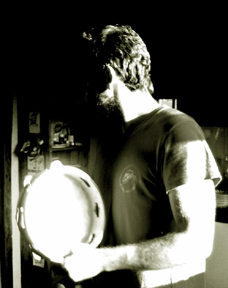
Francesco Semeraro
Italian tamburello player
with Tre Tarantellae.
|
|
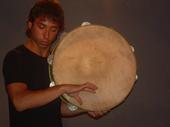
Giovanni Parrinello
Italian tamburello and tammorra
player from Rome.
|
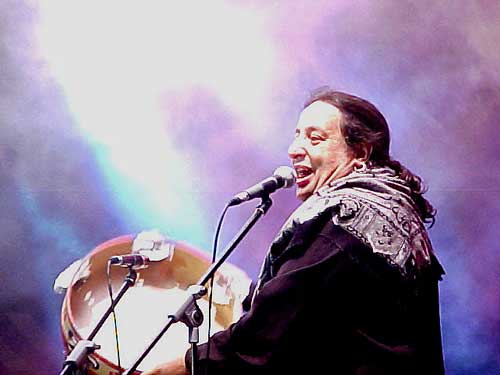
Marcello Colasurdo
Italian tamburello &
tammorra player.
|
|
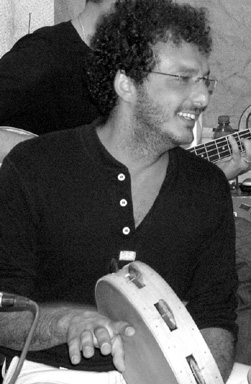
Saverio Paternoster
Italian tamburello player.
|
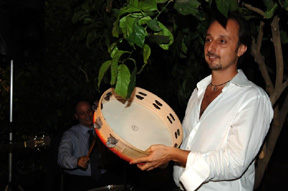
Ciro Raciti
Italian tamburello player
from Naples with the group Gli Antichi Cantori.
|
|
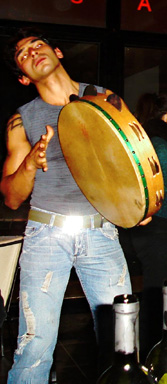
Luca Rossi
Italian tamburello &
tammorra player from Bologna.
|
PANDERO
- MEXICO
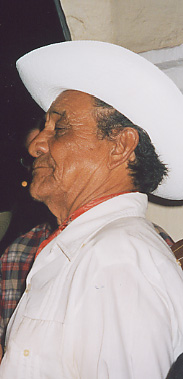
Evaristo Silva "Varo"
(1930-2006)
Legendary pandero
player from Tlacotalpan, Veracruz in eastern Mexico.
Evaristo Silva, known as "Varo" was born
in Tlacotalpan on September 30, 1930 and enjoyed different
things during his life such as fishing, house painting,
and playing baseball, among others, but what really
was trasendental on his life was music and dance.
His first conctact with music was singing "La
Rama" accompained with some cans together in
a wire, after which, someone gave him a pandero, the
instrument that marked his existence. Without any
teacher other than his own intuiton, his musicality
developed quickly and when he was 7 years old he was
able to play at fandangos. While he was still young,
the oportunities came and one was with ensemble Los
Tigres de la Costa. He worked with this group for
one year and travelled all around Mexico, dancing
and playing 6 hours everyday. He also worked with
Andrès Alfonso, a harp player also from Tlacotalpan
who helped Evaristo to master his singing abilities.
In the 1970s, in Tlacotalpan the Casa de la Cultura
Agustìn Lara was established out of which came
the group Conjunto Tlacotalpan that was formed by
Evaristo together with Josè Aguirre "Biscola,"
and Cirilo Promotor. They performed together for more
than 20 years travelling around Mexico and also visited
different countries around the world. "Varo"
also made an important work as a teacher; nuomerous
children, young and adults shared with Evaristo the
process of learning the pandero. Sadly, he died in
2006.
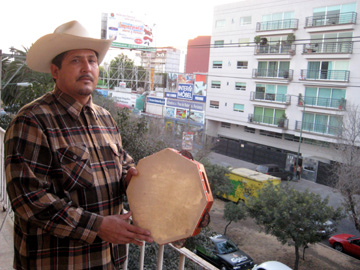
Tereso Vega
Tereso Vega was
born in Comunidad de Boca de San Miguel, Municipio
de Tlacotalpan in Veracruz, Mexico where he lives.
He comes from a family of musicians led by his father
Andres "El Güero" Vega. Tereso plays
the jarana guitar and sings since his early years
and also plays other instruments like guitarra de
son, pandero, and harmonica, among others. He played
with the group Monoblanco and also for 15 years together
with Ramòn Gutierrez in the group Son de Madera.
With these groups, Tereso has played in different
cities in Mexico, Europe, and the United States. Recently
the Vega family recorded a CD as a tribute to Andres
Vega. Check out Tereso Vega on You
Tube.
Andrés
Flores "Laudero"
Another
great pandero player in Mexico is Andrès
Flores who also makes these octogonal
tambourines and other son jarocho musical instruents
for sale. Andrés Flores was born in Alvarado,
Veracruz, Mexico, and as a percussionist he performs
regularly with the group Quemayama. As an instrument
builder, he learned his craft in comunity workshops.
Since 1996, Andrés has his own workshop in
Coatzacoalcos city, Veracruz in Mexico where, together
with his wife Carolina Pitalúa, he builds all
kinds of jarocho musical instruments including jarana,
guitarra de son, leona, and panderos, among others.
After experimenting, making research and exchanging
ideas with other luthiers, Andres has developed his
own building techniques for many of these instruments.
Omar Flores
Durán
Pandero player from
Distrito Federal in Mexico and plays with the group
Kumaltik.
ADUFE
- PORTUGAL & Spain (Galicia)
| |
|
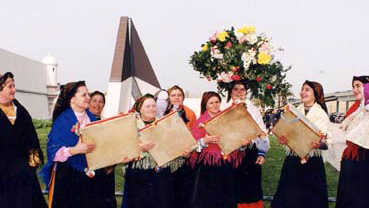
Adufeiras de Monsanto
Portuguese adufe group from
Monsanto led by Amelia Fonseca.
|
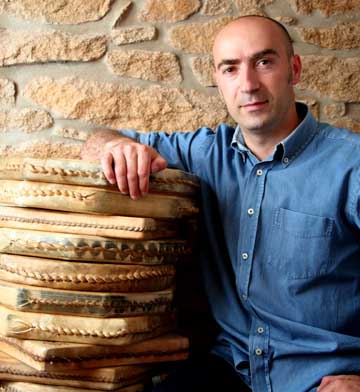
Paulo
Meirinhos
Portuguese maker and player
of adufe (pandeiro quadrado). The making of
these instruments has been in his family for
a few generations. Paulo makes versions with
pneumatic tuning systems in many shapes including
square, triangle, diamond, hexagon, octagon,
and circle. Checkout his website
on how he builds his drums and to order.
|
|
|
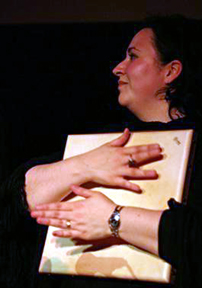
Annabel Araico
Player of the pandeireta
and pandeiro (in photo, also known as adufe)
in the Galician style (northwestern Spain)
and member of the Belgium group Néboa.
|
|
|
KANJIRA
- INDIA
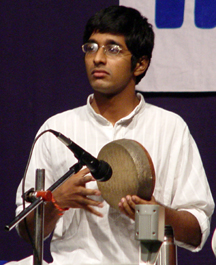
Abhishek
Raghuram
Primarily a singer who was
coached in kanjira by G. Harishankar. Grandson
of mridangam master Palghat R. Raghu. Located
in Chennai.
|
|
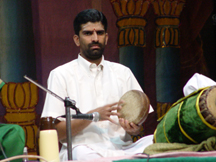
Alathur
T. Rajaganesh
A mridangam player who also
performs on kanjira. Learned kanjira from
B. Harikumar & V. Nagarajan. Located in
Trichy.
|
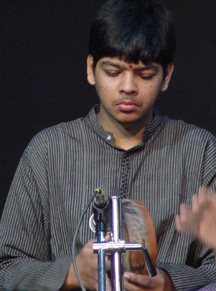
V. Anirudh Athreya
Youngest Carnatic performer
on kanjira (17 years old). Learned kanjira
from his relative V. Nagarajan and now studies
with T.K. Murthy. Located in Chennai.
|
|
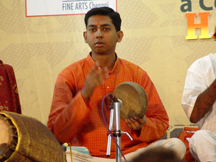
B.S.
Purushotham
One of the busiest Carnatic
kanjira players in Tamil Nadu. Learned kanjira
from T.K. Murthy. Originally from Bangalore,
now located in Chennai. YouTube
Video 1.
|
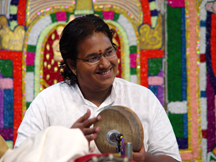
B.
Shreesundarkumar
The most advanced Carnatic
kanjira player in Tamil Nadu. Performs regularly
with all of the top Carnatic vocalists and
instrumentalists and fusion artists. Top mridangam
student (A grade) of Karaikudi R. Mani. Grew
up around G. Harishankar and learned his playing
style on kanjira by observation. His power,
speed, rhythmic complexity, and beauty in
phrasing are that of a senior artist despite
his age being only 24. Located in Chennai.
Website.
|
|
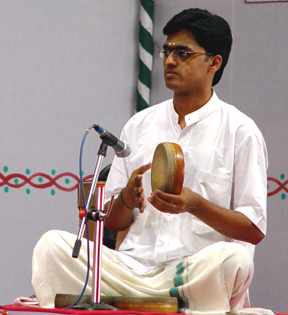
Amrit
Nataraj
The most advanced Carnatic
kanjira player in Karnataka and most advanced
student of G. Harishankar who has mastered
many aspects of his playing style in terms
of power, speed, rhythmic complexity, and
beauty in phrasing. Performs often with all
of the top Carnatic vocalists and instrumentalists
and fusion artists and plays for marathon
bhajan performances (up to 6 hours). Highly
experienced teacher. A grade kanjira artist
and also a great mridangam player who learned
from Sri M. Vasudeava Rao and Sri A.V. Anand.
Located in Bangalore. Website
|
C.P. Vyasa Vittala
Former student of G. Harishankar
and Sri Mushnam V. Raja Rao. One of the few
kanjira players that did not also learn mridangam.
Located in Bangalore.
|
|
C.S.
Venkatramanan
Son of the late kanjira artist
C.K. Shyam Sundar. Learned kanjira and mridangam
from his father. Originally from Chittoor,
now located in Chennai.
|
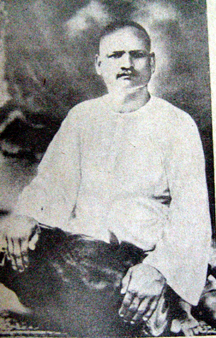
Dakshinamurthy Pillai
Mridangam and kanjira master
in the early 1930s. Responsible for furthering
the fingering from Pudukottai Manpoondia Pillai
by applying more complicated mridangam fingerings
to kanjira. His playing is said to have raised
the level of kanjira playing. He learned kanjira
from Pudukottai Manpoondia Pillai in the late
1800s.
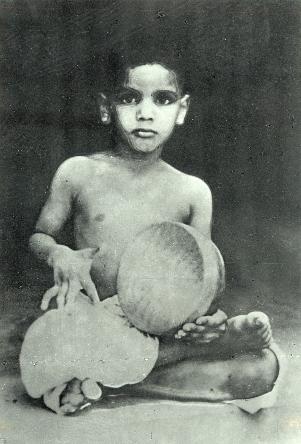
Umayalpuram K. Sivaraman
At age 5 with kanjira. See
his mridangam entry on the South
Indian Percussionists Page for bio.
|
|
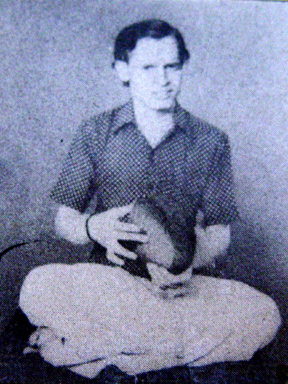
Govinda Harishankar
(1958-2002)
The greatest Carnatic kanjira
player who ever lived. Still to this day,
musicians are in awe of what G. Harishankar
was capable of with one hand. His was born
on June 10, 1958 and died on February 11,
2002. G. Harishankar started on kanjira at
a very young age with his father Govinda Rao,
started formal mridangam training with the
legend Palghat T.A.S. Mani Iyer and then later
with C.S. Murugaboopathy. He also studied
with Ramanathapuram Sri C.S. Sankarasivam.
He plays kanjira right handed but mridangam
left handed (it is said that he did so to
prove that playing mridangam was not as hard
as kanjira so he switched to playing mridangam
left handed). G. Harishankar is responsible
for furthering the complexity of modern kanjira
playing in terms of advanced techniques for
speed, power, rhythmic complexity and beauty
in phrasing (left hand bending of the skin).
It is said in India by many of the senior
percussionists that performed with him or
witnessed him play that he could top any mridangam
player he was matched with in a concert during
the percussion solos (thani avarthanam). G.
Harishankar on several occasions even out-played
tabla player Zakir Hussain when they shared
the stage in Malaysia and Europe. He had only
a few students that carried on his secrets
and techniques. Some of his best recorded
playing was as a member of Sruthi Laya with
Karaikudi R. Mani on mridangam, T.V. Vasan
on ghatam, and Srirangam S. Kannan on morsing
in the 1980s-1990s. To many in India, his
death was proof that he was in fact human
and not a god. YouTube
Video 1. YouTube
Video 2. YouTube
Video 3.
|
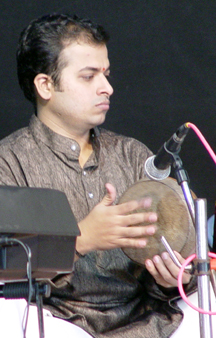
Guru Raghavendra
Plays fusion with vina player
Rajesh Vaidhya.
|
|
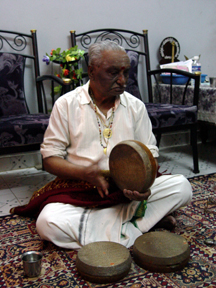
H.P. Ramachar
(1925-2006)
Sadly, Ramachar recently
died on June 23, 2006. He was the oldest kanjira
player in India at 82 years old. Responsible
for introducing a new level of speed in the
1970s. Researched the history, construction
of, and tuning of kanjira more than any other
musician in India. His first concert on kanjira
was in 1931 accompanying with mridangam master
Palghat T.A.S. Mani Iyer. He learned mridangam
from H. Puttachar and taught himself kanjira.
|
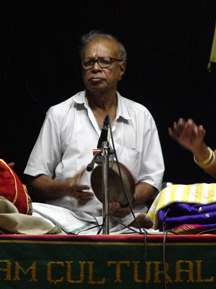
K.S. Rangachari
One of the older kanjira
players still performing at 71 years old.
Father of Mambalam Sisters, who he exclusively
accompanies now. Began performing on kanjira
in 1950. Learned mridangam and kanjira from
T.R. Harihara Sharma (father of T.H. "Vikku"
Vinayakram & T.H. Subashchandran). Originally
from Kanjipuram, now located in Chennai.
|
|
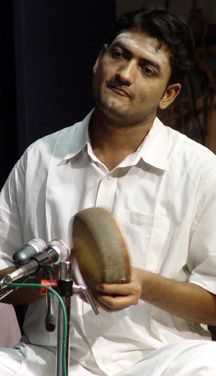
K.V.
Gopalakrishnan
Son of K.V.R.S. Mani. Learned
from his father and T.K. Murthy. Mainly a
mridangam player who also performs on kanjira.
Located in Chennai.
|
K.V.R.S. Mani
Originally from Madurai,
now located in Chennai.
|
|
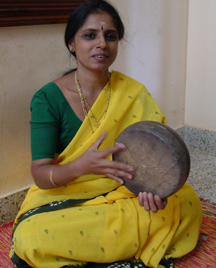
Latha Ramachar
India's only performing female
Carnatic kanjira player. She learned kanjira
from her father H.P. Ramachar and also U.K.
Sivaraman but has also had some training on
mridangam. She is a member of the all female
ensemble of percussion and saxophone called
Karnataka Mahila Laya Madhuri and has performed
all over India, Europe, and the USA with many
of India's top artists. Located in Bangalore.
|
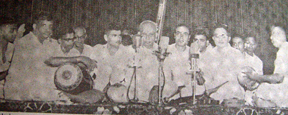
Palghat T. A. S. Mani Iyer (mridangam
on left) and Palani Subramania Pillai (left
hand kanjira on right, c.
1950s]
Palghat T.A.S. Mani Iyer (1912-1981)
Palghat T.A.S. Mani Iyer,
one of two of the greatest mridangam players
ever, was born in 1912 in Palghat, Kerala
and died in 1981. He was named Ramaswamy during
Namakaranam (naming ceremony) but when introduced
to the music world as a mridangam accompanist
at the age of ten, he acquired the name "Mani."
He first studied with Palghat
Subba Iyer and Kalpathy Viswanatha Iyer. Later
with Thanjavur Vaidanatha Iyer. Mani came
into prominence after accompanying Chembai
Vaidanatha Bagavathar in a music concert at
Madras.
He was unusually talented
in rhythm and quickly mastered the technique
of the art of playing mridangam from his gurus
and predecessors such as Azhaganambi Pillai,
Dakshinamurthy Pillai and even studied the
temple drumming of Kerala (maddalam, chenda,
edakka, among others).
Before Mani Iyer’s
arrival in the music scene, the two mridangists
Alaganambi Pillai and Dakshinamurthy Pillai
(also a kanjirist), dominated the art of percussion
playing. The innovations of Mani changed the
style of mridangam playing as Y. G. Doraisamy
points out: "It was Mani Iyer who started
the now prevalent trend of the mridangam,
not just keeping the time with tekkas and
moras, but actively accompanying the musical
phrasing, so as to be a rhythmic running commentary,
reproducing on the drum all the subtleties
and rhythmic complexities of the musical composition."
Palghat Raghu, a disciple
of Mani Iyer, describes his guru as a genius
in that he showed music followers the manner
of blending with the music of the main artist
in handling the kritis of every conceivable
mood and tempo. By his consistent excellence
he could raise the concert to thrilling heights.
It was Palghat T. A. S. Mani Iyer who outplayed
kanjira player Dakshinamurthy Pillai and reclaimed
the front seat on the stage for mridangam
players. Mani Iyer also occasionally performed
on kanjira.
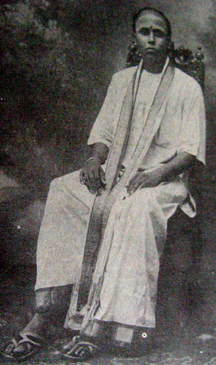
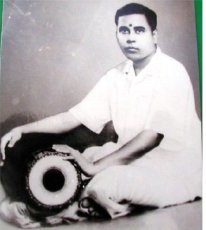
Palani Subramania
Pillai
(1908-1962)
Born in 1908 and died in
1962, never recognized formally with awards
for his innovations in the art of mridangam
and kanjira (most likely because of prejudice
that he was not Brahmin). Palani Subramania
Pillai was a contemporary of Palghat T. A.
S. Mani Iyer. Equally skilled at mridangam
and kanjira, he was a left handed player.
His technique on mridangam
is said to have been the first to introduce
the gumki or bending of the bass head by sliding
and pressing the hand into the skin. His technique
is said to have featured more rhythmic complexity
while Mani Iyer featured more beauty in the
phrases that he played and how they fit the
music he was accompanying. Both players had
extremely advanced rhythmic and accompanying
skill, and there really is no comparing the
two with regards to which was a better performer.
P. Subramania Pillai was
a student of his father Pazhani Muthiah Pillai
and later Dakshinamurthy Pillai. In concert,
Iyer and Palani were each other's favorite
to accompany with as Mani played mridangam
while Subramania played kanjira. One story
goes that during one of their concerts in
the percussion solos they traded phrases for
an entire hour each not being able to top
the other.
|
|
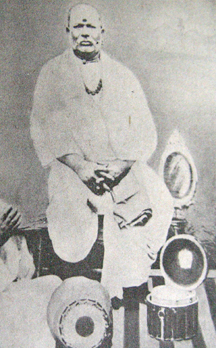
Pudukottai Manpoondia Pillai (1859-1922)
Born in 1859 and died in
1922, Manpoondia Pillai is considered to be
the father of the Pudukottai school of percussion.
He is also said to have invented the kanjira,
which is not really true as the instrument
and players existed before his time. What
he is responsible for is introducing the kanjira
to Carantic instrumental and vocal music beyond
bhajans. His life story as a lantern bearer
at the Pudukottai palace who rose to become
a high ranking artist is one of triumph of
the human spirit.
In his palace job in the
mid-1800s, he was exposed to dholak and thavil
players and became fascinated with thavil.
Having first learned a frame drum local to
the area (known then as daff), he soon became
a student of thavil (he was left handed) and
learned from Tirugokarnam Mariyappan.
Manpoondia (he was also known
as Mamundi) displayed an unusual skill in
that he could play all of the patterns he
was shown that required 2 hands with 1 hand.
He also redesigned the kanjira
of his time by reducing the number of jingles
from 3 pairs to a single pair and replaced
the ghungroo pellet bells that were common
as jingles at that time with coins as the
pellet bells made too much sound that distracted
singers and other musicians. He also may have
been the first to use Bengal monitor lizard
skin (Varanus bengalensis bengalensis)
in place of goat skin on kanjira making the
instrument more suitable for Carnatic music.
It was Manpoondia Pillai
that introduced a more complex laya into Carnatic
music with his kanjira in the form of korvais
and moras. He began accompanying bhajans and
gained attention with his skill of being able
with 1 hand to repeat anything a mridangam
player could do with 2 hands at that time.
Manpoondia Pillai is also said to have been
influenced after hearing the mridangam playing
of Narayanaswami Appa. Supposedly, after hearing
Appa's playing, Pillai realized the tonal
possibilities of melody oriented intricacies.
This may have been how the bending technique
on kanjira began to develop.
He began traveling around
southern India to music centers introducing
the kanjira and his skill at bhajan performances.
Upon reaching Madras (now Chennai), Pillai
was asked to accompany the singer Tiruvayyaru
Subramaniya Iyer (also known as Patnam Subramaniya
Iyer). Before the concert, Subramaniya Iyer
challenged him and wanted to know what he
was prepared to give up if he could not play
what was sung at the concert. Pillai said
that if he failed to play what was sung he
was prepared to throw his kanjira into the
sea and give it up completely. Subramaniya
Iyer then said that if Pillai did play what
was sung he would give up his place in the
center of the stage to him and stop singing.
Subramaniya Iyer had prepared
an intricate pallavi and sang it at the concert.
Manpoondia Pillai heard it and played it back
and started elaborating on it using his imagination.
Subramaniya Iyer accepted defeat and decided
to concede his place to Pillai. Manpoondia
Pillai humbly declared that it was not his
place, and that it was his desire to continue
to accompany Subramaniya Iyer's music wherever
he sang. The two went on to give numerous
performances all over Madras and other places
and this established the kanjira as a prominent
instrument suited for accompanying in Carnatic
music concerts. This is also how the kanjira
player began sitting in front of the mridangam
player because his skill level was higher
than that of the typical mridangist at that
time.
Manpoondia Pillai is also
responsible for training the first Carnatic
singer in his refined rhythmic concepts (Konerirajapuram
Vaidyanatha Iyer) as well as training percussionists
Dakshinamurthy Pillai, Pazhani Muthiah Pillai,
and Seithur Zamindar in his rhythmic style
on kanjira and mridangam. This brought a much
higher level of performance to the stage in
such trio concerts with the singer, mridangam
player and kanjira player all trained in this
more refined rhythmic style.
In his last years, he renounced
worldly life, becoming a sanyasi under the
name of Murugananda Swamigal.
|
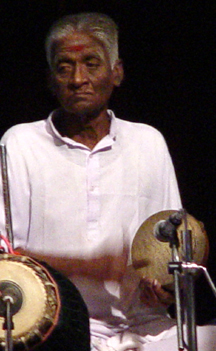
Mayavaram Somusundaram
One of the older performers
of kanjira who was still playing at 79 years
old in 2006 (he died in 2011). He began performing
Carnatic concerts in 1947 and learned mridangam
and kanjira from Boobadhiveli. Originally
from Mayavaram, was located in Chennai at
timeof death.
|
|
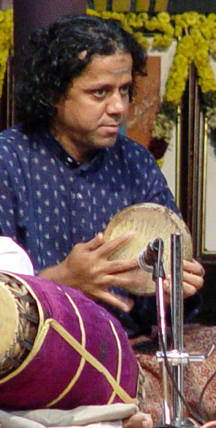
N.
Ganeshkumar
(Nataraj Ganesan)
Born in 1964, Ganesh is a
kanjira player specializing in fusion and
has released the first instructional DVD for
kanjira in the USA. He learned from T.H. Subash
Chandran. Located in Chennai. Website.
|
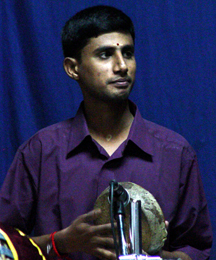
Nerkunam
S. Sankar
Former student of G. Harishankar.
One of the few kanjira players that has learned
only kanjira and has never studied mridangam.
Originally from Nerkunam, now located in Chennai.
Additional e-mail.
|
|
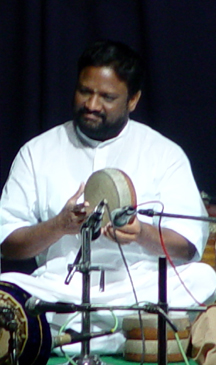
Neyveli
B. Venkatesh
One of the few mridangam
players that still performs on kanjira. Neyveli
travels most of the year for performances
in Europe with top artists from India. He
is a highly experienced teacher of both mridangam
and kanjira and has trained students all over
Europe. He learned mridangam from A.S. Balaraman
and kanjira from M.N. Kandaswami Pillai. Originally
from Neyveli, now located in Chennai. YouTube
Video 1.
|
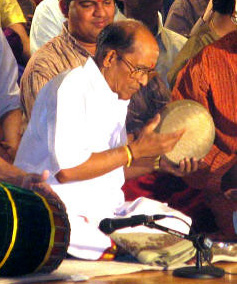
Guruvayur
Dorai
Located in Chennai. Mainly
a mridangam artist but occassionally performs
on kanjira. Born on July 2, 1935, Dorai started
to play the mridangam at a very early age.
His gurus were Sri Palghat Subba Iyer and
Sri Palani Subramania Pillai. Guruvayur Dorai
has played in almost all the prestigious music
meetings in India and has traveled extensively
all over the world. Carnatic music lovers
in the US are familiar with his style since
his first tour in 1974. Dorai is the recipient
of numerous awards including the Kalaimamani
- a title conferred in 1990 by the Tamil Nadu
government, Asthana Vidwan of Kanchi Kamakoti
Peetam in 1991, and Sangeet Natak Akademi
Award in 1997.
|
|
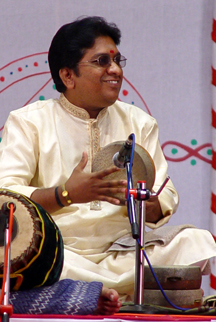
Papanasam S. Sethuraman
Learned kanjira with Kalaimamani
and Mayavaram Somusundaram and is self taught
on mridangam. Performs regularly in Carnatic
music and fusion, especially with Ghatam S.
Karthick's Heart Beat. Originally from Thirunellveli,
now located in Chennai.
|
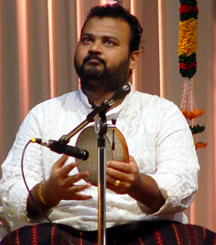
T.
Vinayakram Selvaganesh
Born in 1972, Selvaganesh
(also known as Chella S. Ganesh) is primarily
a kanjira player specializing in fusion and
perhaps is the best known kanjira artist outside
of India having worked with Remember Shakti,
Jonas Hellborg, Zakir Hussain, Free ~ Winds,
Andrew Lum, and Rikhy Ray. He is also the
first kanjira artist to have a CD released
under his own name. In India, he works mainly
in fusion and session work for film soundtracks
and composes his own music via computer. His
playing technique is unusual in that his touch
is light and he often plays the open tone
(dum) with an upstroke with his three fingers
as opposed to the traditional classical technique
that all other kanjira artists learned, which
is to play the open tone with a down stroke
of the index finger. Learned kanjira, ghatam,
mridangam, and konnakol with his father T.H.
"Vikku" Vinayakram but primarily
with T.H. Subash Chandran. Located in Chennai.
Alternate e-mail.
YouTube
Video 1.
|
|
Thanjavur Srinivas
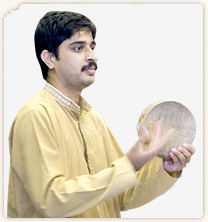
Ghatam
Brother R.N. Prakash
Originally from Bangalore
but now located in London, the Ghatam Brothers
are R.N. Prakash (pictured above) and R.N.
Prathap. They learned from Bangalore Vidwan
K.N. Krishna Murthy. Both of the Ghatam Brothers
are equally skilled on kanjira, mridangam,
ghatam, and konnakol. Located in London, England,
UK.
|
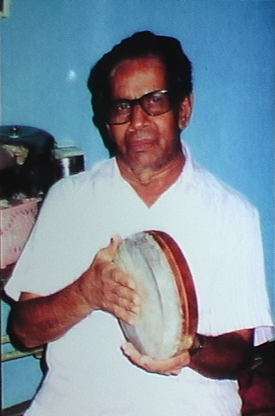
C.K. Shyam Sundar
(1938-2005)
C.K. Shyam Sundar learnt mridangam and kanjira
initially from Thanjavur Ramadasa Rao and
became a kanjira disciple of Pudhukottai Swaminatha
Pillai. He accompanied Chithoor Subramaniya
Pillai, Maharajapuram Viswanatha Iyer, Ariyakudi
Ramanuja Iyengar and many other stalwarts
at a very young age. He has played kanjira
along mridangam legends such as Palani Subramania
Pillai, Kuthalam Siva Vadivel Pillai, T.K.
Murthy, Palghat Raghu, and Umayalpuram K.
Sivaraman. He was a B-High grade artist for
All India Radio and he worked as a lecturer
in mridangam at the Tamil Nadu Music College,
Madurai and he became a lecturer in kanjira
at The Government Music College, Adyar, Chennai.
He was awarded Kalaimamani in 1986 and received
the Guruvayur Dorai Trust award in December
2004. Originally from Chittoor, relocated
to Chennai during his career.
|
|
Delhi
Raman Srinivasan
Mridangam player who also
plays kanjira. One of the only Tamil kanjira
players located in New Delhi in North India
(where he was born). He learned mridangam
and kanjira from V. Chandrasekaran, U.K. Sivaraman
& Guruvayur Dorai.
|
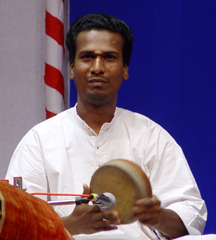
Thenkasi
H. Paramasivam
Learned mridangam from Thenkasi
K. Hariharan, kanjira from Pudukottai Paranbariyam,
and mridangam, kanjira, and konnakol from
Trichy R. Tayumaravai. Located in Trichy.
|
|
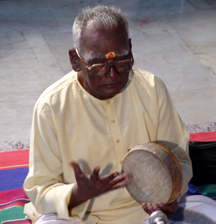
Thirukadaiyur T.K. Dakshinamoorthy
Kanjira player mainly for
violinist Kunnakudi Vaidyanathan. Born in
1926, he is one of the older players still
performing today at 81 years of age, and he
sits in front of the mridangam player. His
guru was Kuthaalam Siva Vadivel Pillai. Originally
from Thirukadaiyur, now located in Chennai.
|
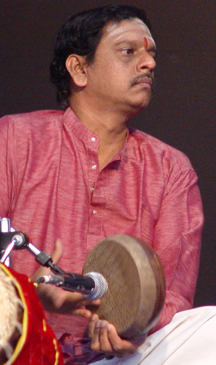
Thiruvayur Saikrishnan
Learned kanjira and mridangam
from Kumbakonam Rajapa Iyer. Originally from
Thiruvarur, now located in Chennai.
|
|
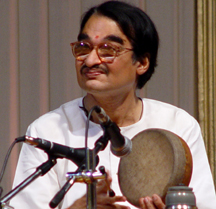
Thrikakkara Y.N. Shantharam
One of the few kanjira players
from Kerala. Shantharaman learned mridangam
from Serpala Gopalakrishnan and kanjira from
Parashala Ravi. Located in Kerala.
|
Tirupur G. Sridhar Kumar
A mridangam player who also
performs on kanjira, often with Smt. Nithyasree
Mahadevan. Located in Chennai.
|
|
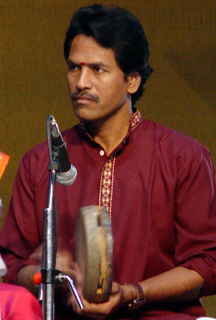
Trichy V.V.S. Manian
One of the few performers
that accompanies on kanjira and konnakol.
Learned mridangam, kanjira, and konnakol from
Trichy Thayumnavar. Originally from Trichy,
now located in Chennai.
|
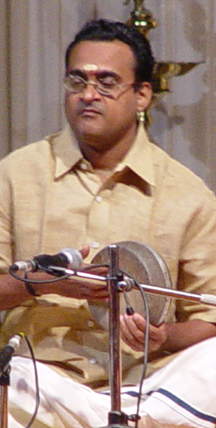
Trivandrum
D. Rajagopal
Mainly a mridangam player
who also performs on kanjira. Learned mridangam
from B. Dorai Swami and mridangam and kanjira
with Sri R. Vaidyanathan. Originally from
Trivandrum in Kerala, now located in Chennai.
|
|
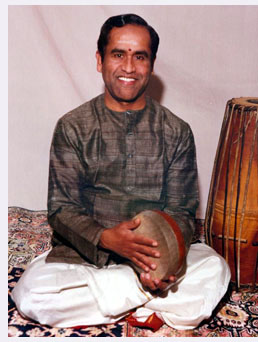
Trichy
Sankaran
Primarily a mridangam player
of the highest caliber, Trichy also performs
on kanjira in Canada and the USA. Learned
from Palani Subramania Pillai. Originally
from Trichy, now located in Toronto, Canada.
Website.
|
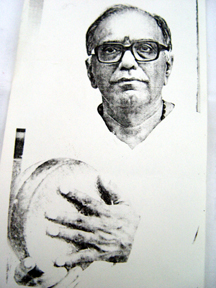
V. Nagarajan
(1930-2002)
Born on the July 30, 1930
and died in February 4, 2002. Son of violin
player Sangeetha Kalanidhi Sri Papa K. S.
Venkatramiah. Nagarajan was a mridangam player
that developed a nerve problem in his right
hand so he switched to playing kanjira left
handed. He learned mridangam from Tanjore
Sri Vaidyanatha Iyer for a few years and then
with Palghat T. A. S. Mani Iyer for several
years for both mridangam and kanjira. Palghat
T. A. S. Mani Iyer taught him the traditional
methods and techniques of kanjira. His first
concert was at Trichy with the Alathoor Brothers
in 1950. He taught kanjira at Wesleyan University
in Connecticut as a Visiting Professor in
1967 and in 1974 he taught at the University
of Berkeley-California.
|
|
|
|
PANDEIRO
- BRAZIL
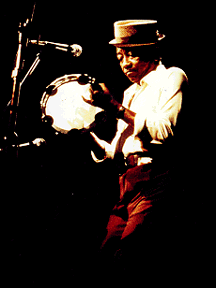
Jackson do Pandeiro (José
Gomes Filho)
(1919-1982)
Jackson do Pandeiro, alias, Jackson
the Tambourine player, first wanted to play the accordion.
But as his parents could not afford one, Jackson was
given a pandeiro instead. His mother was a coco singer
and played percussion instruments like zabumba and
ganzá. When he was 13, Jackson moved with his
family to Campina Grande, in Paraíba, where
he had the opportunity of watching coco singers and
guitar players performing at local markets. That’s
where his first artistic name, Jack, came up, influenced
by American western films. In the 1940s, he moved
to João Pessoa, performing in cabarets and
on the radio. Later, he moved to Recife, in the state
of Pernambuco (NE), where he adopted the name Jackson
do Pandeiro. In 1953, Jackson recorded his first hits:
"Sebastiana" (by Rosil Cavalcanti) and "Forró
em Limoeiro" (by Edgar Ferreira). Three years
later, he married Almira, and the two started performing
together. In the same year, they moved to Rio de Janeiro,
where Jackson was hired by Rádio Naçional,
and became an overnight sensation among the audience
and the critics due to his unique way of singing popular
Brazilian rhythms, such as baiões, cocos, rojões,
sambas, and marchinhas de carnaval. Jackson’s
music legacy can be found in new recordings of his
work, such as "O Canto da Ema" recorded
by Lenine, "Na Base da Chinela" recorded
by Elba Ramalho, "Lágrima" recorded
by Chico Buarque, or "Um a Um" recorded
by the pop band Paralamas do Sucesso. A great composer
and talented musician, Jackson recorded Brazilian
Northeastern classics which became great hits among
the general public, such as "Chiclete com Banana"
(by Gordurinha & Almira Castilho), "Xote
de Copacabana" (by José Gomes), "17
na Corrente" (by Edgar Ferreira & Manoel
Firmino Alves), "Como Tem Zé na Paraíba"
(by Manezinho Araújo & Catulo de Paula),
"Cantiga do Sapo," "A Mulher do Aníbal,"
"Ele Disse" (by Edgar Ferreira), and "Forró
em Caruaru" (by Zé Dantas). A biography
about his life is Casaca de Couro: Uma Biografia
de Jackson do Pandeiro - o Rei do Ritmo.
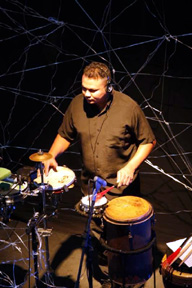
Márcio
Jardim
Márcio Jardim
is perhaps Brazil's most refined pandeiro
player and plays with the group Trio Manari
from Northern Brazil. Trio Manari consists
of percussionists Nazaco Gomes, Márcio
Jardim, and “Paturi” Kleber Benigno.
The group specializes in Amazonian music traditions
and has revitalized the use of traditional
percussion in contemporary Amazonian music.
Trio Manari has arranged percussion music
for many shows and recordings featuring the
most prominent artists of the Amazon and has
performed at PASIC in 2004 and 2007. The group
has also recently performed at the Cayenne
Jazz Festival and the 2007 PercPan Festival
in São Paulo, Brazil. In 2007, the
ensemble released the DVD Dançando
no Rio with Brazilian singer Fafá
de Belém.
|
|
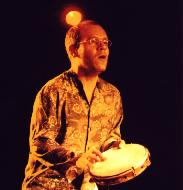
Marcos Suzano
The Brazilian pandeiro player
from Rio de Janeiro who is most widely known
for helping to develop a newer technique and
popularizing the playing of funk on pandeiro.
He was influenced by the playing styles of
Jorginho do Pandeiro and Celsinho Silva. Suzano
made use of a new left hand technique where
the pandeiro is turned/shaken in continuous
16th notes while the right hand strikes the
skin. Influenced from his brief studies on
tabla, he also changed the right hand technique
in that the tips of the fingers as well as
the thumb can be used for the low open tone
while the plam is used for slapping. With
this technique, a player can alternatively
play open and slap sounds on downbeats or
in syncopations while keeping the continuous
turning/shaking. He also popularized the use
of a thicker and much lower tuned skin. His
newer style was most evident first on the
recordings of the group Aquarela Carioca in
1993. He has had such an impact in and outside
of Brazil that nearly all of the younger pandeiro
players are now emulating his technique.
|
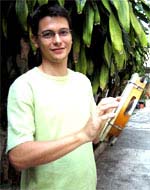
Bernardo Aguiar
Brazilian pandeiro player
from Rio de Janeiro who has worked with the
samba school Unidos do Santa Marta and the
pandeiro orchestra Pandemonium. He has studied
with Marcos Suzano and has performed with
Rodrigo Lessa, Eduardo Neves, Fernando Moura,
Alceu Maia, O Rappa, Kátia B., and
Pife Muderno, among others.
|
|
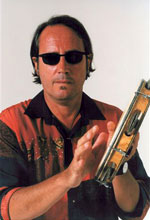
Beto Cazes
Great Brazilian choro pandeiro
player who has worked since 1976 with artists
such as Coisas Nossas, Camerata Carioca, Radamés
Gnattali, Joel Nascimento, Elizeth Cardoso,
Nara Leão, Maria Lúcia Godóy,
Nó em Pingo D'Água, Orquestra
de Cordas Brasileiras, Baticun, Wagner Tiso,
Orquestra de Câmera de Curitiba, Caetano
Veloso, Martinho da Vila, Chico Buarque, Paulinho
da Viola, Gal Costa, Maria Bethânia,
Elba Ramalho, Nadinho da Ilha, Marco Pereira,
Trio Madeira Brasil, Rabo de Lagartixa, Olívia
Bington, Zé Paulo Becker, and Henrique
Cazes, among others.
|
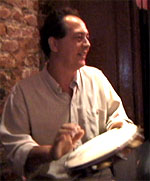
Celsinho Silva
Brazilian pandeiro player
and son of pandeiro master Jorginho do Pandeiro.
Equally skilled at choro and samba playing,
he has worked with Nó Em Pingo D'Agua,
Paulinho da Viola, Nara Leão, Dominguinhos,
Joel Nascimento, Radamés Gnattali,
Turíbio Santos, Elizeth Cardoso, Elba
Ramalho, Francis Hime, Olívia Hime,
Cristina Buarque, Moraes Moreira, Elton Medeiros,
Nelson Cavaquinho, Roberto Ribeiro, Mariza
Monte, Ademilde Fonseca, Zezé Gonzaga,
D. Ivone Lara, Conjunto Época de Ouro,
Rildo Hora, Guinga, Chico Buarque, Nelson
Sargento, Geraldo Azevedo, Leila Pinheiro,
Beth Carvalho, Gilberto Gil, and Ivan Lins,
among others.
|
|
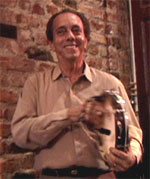
Jorginho do Pandeiro
Brazilian pandeiro player
who began performing and recording in 1944.
Father of expert pandeiro player Celsinho
Silva. Known for his work with Conjunto Época
de Ouro, he has also worked with Carlola,
Jacob do Bandolim, Paulo Moura, Raphael Rabello
& Dino 7 Cordas, and Arranca Toco, among
others.
|
Paulinho do Pandeiro
Brazilian pandeiro and tamborim
player who worked with Patrick Moraz in 1978
and also with Teresa Cristina & Grupo
Semente 57, among many others.
|
|
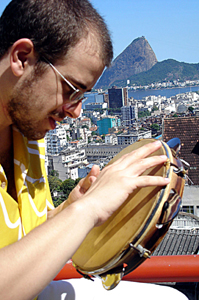
Sergio Krakowski
Brazilian expert pandeiro
player. Known for his work with the group
Tira Poeira and Maria Bethânia, Lenine,
Zélia Duncan, Olivia Hime, Francis
Hime, Bnegão, and Beth Carvalho. He
also experiments with electronics on pandeiro.
|
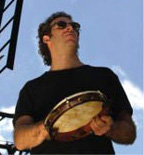
Scott Feiner
American pandeiro player
and jazz guitarist living in Brazil.
|
|
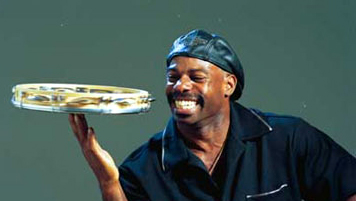
Ron Powell
American pandeiro player
and studio percussionist in California.
|
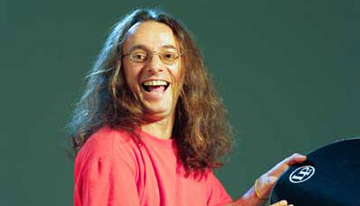
Mario Monaco
American pandeiro player
and percussionist now in Canada. Plays in
a more modern version of a largely urban playing
style in which the pandeiro is kept mostly
flat (largely unturned or unraised) in the
left hand while the right hand moves around
the skin.
|
|
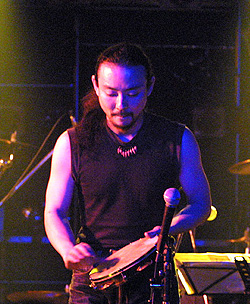
Keijiro Nagaoka
Japanese pandeiro player
and percussionist in Tokyo.
|
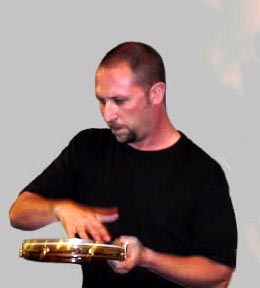
Randy
Gloss
American pandeiro player
and percussionist extrodinaire in California.
|
|
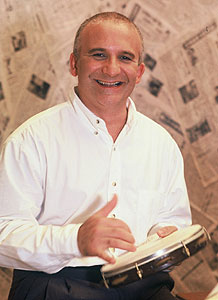
Luiz Carlos Xavier Guello
Master Brazilian pandeiro
player and percussionist. Known for his expressive
choro pandeiro playing with the group Modern
Traditions Ensemble, Guello has also worked
with Duoello, Orquestra Popular de Câmara,
Trio Bonsai, Zizi Possi, Paulo Moura, Mônica
Salmaso, Joyce, Marco Pereira, Toninho Carrasqueira,
and Toninho Ferragutti, among others.
|
Paulinho Silva
Brazilian pandeiro player
who has studied with Marcos Suzano and has
subsequently released instructional material
of his technique on both CD-ROM, 3 DVDs, and
a website.
|
|
Gilson de Assis
Brazilian pandeiro player
now loacted in Germany. Plays with the group
Tamburo Mundi.
|
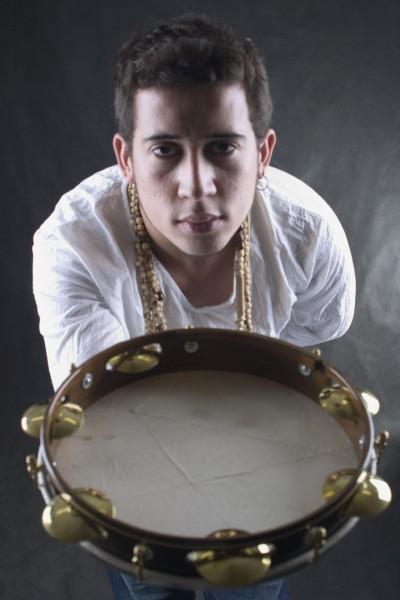
Emerson Taquari
Emerson Taquari is one of
the leading performers of the more modern
pandeiro technique and has performed at leading
percussion festival such as PercPan in Brazil,
among others. He has performed with Ivete
Sangalo, Gilbert Gil, and Daniela Mercury,
among others. His CD is Pandeirotico.
|
|
Amoy Ribas
Amoy Ribas was born in Brasília
and from a young age had a good musical ear
and rhythmic aptitude. Along with his parents,
he enjoyed music from around the world - jazz,
Indian music (tabla), Arabic music (dumbek),
Brazilian folkloric music, choro, samba, baião,
maracatu, frevo, as well as rhythms from the
south of Brazil. He has lived in India and
Germany. He started on drumset, but soon after
was specializing in percussion, receiving
praise from Hermeto Pascoal, as well being
invited to perform and record on the CD Mundo
Verde Esperança. He has also performed
on several occasions at the Clube de Choro
in Brasília with Ginga, Paulo Sergio
Santos, and Arismar do Espírito Santo.
Located in Rio de Janeiro, Brazil.
|
Carlinhos Pandeiro de Ouro
(Carlinhos
de Oliveira)
Carlinhos Pandeiro de Ouro
(Carlos de Oliveira) is one of the world's
leading performers on the pandeiro. Over the
last 50 years he has recorded and toured with
Herbie Mann, Ed Thigpen, Martinho da Vila,
Beth Carvalho, Maria Bethania, and Sergio
Mendes. He appeared regularly on Globo TV
and Radio Naçional during the late
'60s and '70s on programs such as Alerta
Geral with Alcione and Brasil Pandiero
with Betty Faria, as well as with Carlos Machada,
Ataulfo Alves de Sousa, Emilinha Borba, and
Jackson do Pandeiro. Carlinhos’s original
songs have been featured in the 1978 movie
Samba da Criação do Mundo
and on several albums of the Swedish pop icon,
Sylvia Vrethammar, with whom he toured for
many years. He is the dancing pandeiro player
in the 1959 film Orfeu Negro. He
is located in Los Angelos, California, USA.
|
|
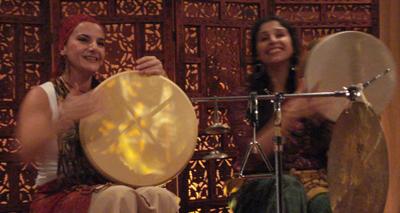
Fogueira das Rosas
Fogueira das Rosas are Angélica
Leutwiller and Valéria Zeidan. They are a duo
of great singers and frame drummers who play many
styles of frame drums and are located in São
Paulo, Brazil. |
| |
|
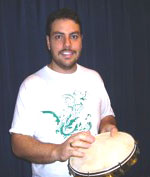
Netinho Albuquerque
Netinho Albuquerque was born
in Duque de Caxias, Rio de Janeiro in Brazil
and is the nephew of the master, Jorginho
do Pandeiro, who was also his teacher. He
began playing pandeiro at 13 years old and
has played with an impressive list of Brazilian
musicians, such as Dona Ivone Lara, Luiz Melodia,
Guilherme de Brito, Ademilde Fonseca, Violeta
Cavalcante, Beth Carvalho, Conjunto Época
de Ouro, Nó em pingo D’água,
Délcio Carvalho, Elton Medeiros, Flávia
Bittencourt, and Marcos Sacramento. He has
performed in important venues such as Canecão,
Rival e Teatro Municipal de Niterói,
and has participated in the musical Chico
Viola (Teatro Gláucio Gil) and
with Clara Nunes (Teatro de Arena).
|
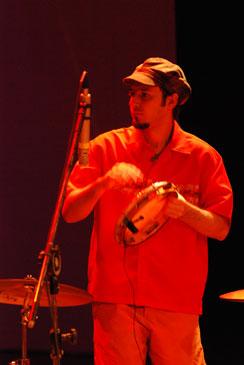
Claudinho Santana
Claudio Santana is self-taught
and from Recife, and started his career through
the mix of influences from his local music
such as maracatu, coco, ciranda, afoxé,
baião, cavalo, marinho, candomblé,
and foreign music as well. He is influenced
by Marcos Suzano, Maestro Spok, Jorginho do
Pandeiro, and Sergio Krakowisk. His primary
instrument is pandeiro but he also plays djembe,
congas, and cajon. Recently, Santana has utilized
his talents to incorporate the sounds of percussion
with drumset. Claudio Santana has played in
the Maracatu Estrela Brilhante from Alto José
do Pinho for ten years, playing alfaia, a
large bass drum, snare and shekere. Santana
has played with international names like the
New Orleans trombonist Rick Trolsen, Scottish
groups called The Wha, Bloco Vomit, and MacUmba.
Nationally, Santana has accompanied singers
Gonzaga Leal, Kelly Rosa, Neneu Liberalquino,
Mônica Feijó, Adryanna BB, Gina
Solo, Geraldo Maia. He was also invited to
accompany the pianist and founder of the piano
department at UFPE, Elyanna Caldas. Santana
was an instructor of the group “Corpos
Percussivos” and the Irish group called
MaSamba in Dublin, Samba ya Bamba in Glasgow,
the Manchester Samba School in Manchester,
the Edinburgh Samba School in Edinburgh, A
Banda in Denmark, among others. He’s
sponsored by Contemporânea and is now
located in West Virginia.
|
|
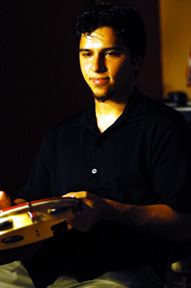
Rafael Pereíra
Rafael Pereíra grew up in São
Paulo, Brazil. Inspired by the contagious
sounds of street rhythms, parades, and outdoor
concerts, he began studying drums and percussion
at the age of 12. In Brazil, he had the opportunity
to attend workshops with acclaimed percussionists
such as Airto Moreira, Naná Vasconcelos,
Luiz Guello, Marcos Suzano, and Alex Acuña,
among others. His music is a fusion of traditional
styles of samba, choro, frevo, maracatu, baião,
and various styles of contemporary music.
As a teenager, he co-founded and directed
a samba ensemble, composing music and booking
performances. After graduating from high school
in 2002, he relocated to Atlanta, Georgia
and began widening his studies in world music.
Since then he has performed with several local
artists, including Brazilian/Latin jazz guitarist
Sasha Lisnichuk. In 2004, he co-produced two
of Sasha’s CDs in which he has also
performed. He was featured in other CDs playing
with different musicians from the Atlanta
area. Endorsed by Pearl Percussion since 2005
and Cooperman since 2007, Rafael was invited
to lead a workshop on Brazilian percussion
at the 2007 Percussive Arts Society International
Convention (PASIC) in Columbus, Ohio, one
of the most prestigious percussion conventions
in the world. He was also invited to perform
and give a workshop in pandeiro at the North
American Frame Drum Association, Inc. Frame
Drum Fest 2008 in New Jersey. He has also
organized a Brazilian “Batucada”
group at Georgia State University and directed
them at the Rialto Center of Performing Arts,
in Atlanta, Georgia where he is now located.
He currently plays with RUA 6 Band, voted
the best Latin Band in the Atlanta area by
USA Today. In 2007, he was invited
again to host a workshop on samba and batucada
at PASIC as well as teach at two regional
percussion events; the Sonny Emory Summer
Camp and the Jason Currin Festival. He is
also busy organizing his batucada group called
Bratuque, playing in the Sonny Emory State
of the Art Band, recording his own solo CD,
and producing instructional percussion videos.
|
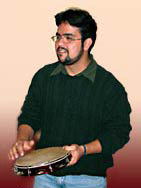
Gilberto Campello
Gilberto Campello was born in Recife,
Brazil and performs on all types of percussion playing.
In 2003, he studied at the world-famous Instituto
Superior de Artes in Havana, Cuba with a grant from
the Aschberg Foundation/UNESCO to research the common
roots between Cuban and Northeastern Brazilian music.
In the USA, he studied modern techniques for frame
drums with N. Scott Robinson and Glen Velez. An accomplished
artist, he has received two honorary mentions from
the Pernambuco State Arts Council (2003, 2005). Gilberto
studied drumset and percussion at the Conservatorio
Pernambucano de Musica with M. Chiappetta and A. Barreto.
He performed in many folkloric music groups. As a
member of the Brazilian ensemble Sa Grama, he recorded
five CDs as well as several movies, documentaries,
television specials and theater soundtracks. He also
appears on releases of the new Northeast Brazilian
Rock and folklore fusion bands. He has performed in
concert halls such as Auditorio Che Guevara in Casa
de las Americas (Havana, Cuba), Sala Funarte (Rio
de Janeiro, Brazil), Millennium Stage at the Kennedy
Center for the Performing Arts in Washington, DC,
and the Brazilian Embassy. In Washington, DC, he taught
Brazilian percussion at the Latin American Folk Institute
and the House of Musical Traditions and was a resident
artist of The Washington Performing Arts Society Artist
Residencies from 2004 to 2007. He was also a guest
lecturer at the Brazilian American Cultural Institute
and the University of Maryland. He currently teaches
percussion at Maracatu Brasil in Rio de Janeiro, Brazil,
where he performs with Trio Barrilete, Os 3 Batutas,
Guto Goffi, G.R.E.S. Caprichosos de Pilares, and in
a special trio fusing choro and flamenco.
DOYRA
- UZBEKISTAN & TAJIKISTAN
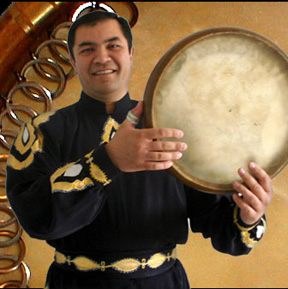
Abbos Kosimov
Perhaps Uzbekistan's most
widely known and most refined doyra player.
Resides in both Uzbekistan and California.
|
|
Rakhimahon Mazokhidova
One of the oldest and most
respected singers and doyra players still
living in Uzbekistan.
|
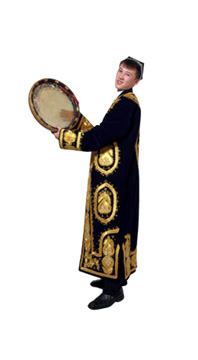
Axror Islomov
Doyra player from Uzbekistan.
Plays with the Tashkent Group.
|
|
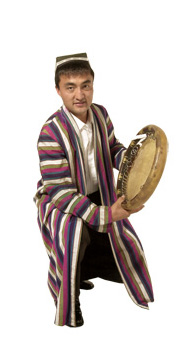
Azmiddin Asxonov
Doyra player from Uzbekistan.
Plays with the Tashkent Group.
|
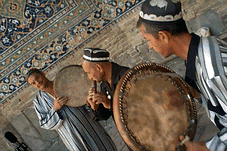
Shir Dor Madrassah Ensemble
An Uzbek ensemble from Samarkand
that features several doyra players.
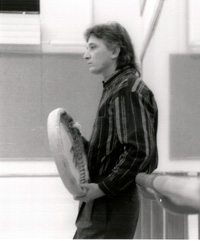
Tolkin Isakov
Tolkin Isakov, doyra player
& percussionist from Tashkent, Uzbekistan,
is currently residing in St. Louis, Missouri.
He has been a percussionist with the National
Symphonic Orchestra of the Republic of Uzbekistan
and was the senior teacher of percussion and
the Dean of the orchestral faculty at Tashkent
State Conservatory in Uzbekistan. He has been
a solo percussion performer for international
concerts and festivals, an ensemble soloist
for international concerts and competitions,
and a teacher of music clinics and workshops
at universities and colleges throughout the
United Arab Emirates, Bahrain, Turkey, Russia,
Turkmenistan, Azerbaijan, Kazakhstan, Kyrgyzstan,
Uzbekistan, Tajikistan, Austria, France Germany,
Switzerland, Greece, and the United States.
He has recently collaborated with Remo on
a synthetic Uzbek doyra and published a methods
book for Uzbek doyra called Modern Methods
of Doyra Playing.
|
|
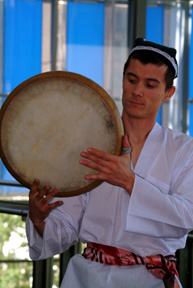
Salokhiddin Fakhriev
Salokhiddin Fakhriev was
born in 1976 in Samarkand, Uzbekistan. Growing
up in a family of musicians, he was interested
in percussion from an early age and began
to study the doyra (Uzbeki frame drum) when
he was six years old. Over the next several
years, he traveled with his teacher to perform
in summer music festivals in Moscow, Gorkiy,
and Sverdlovsk. While attending the Mukhtor
Ashrafi Conservatory of Tashkent, Salokhiddin
taught percussion classes and continued to
perform at weddings and festivals throughout
the Soviet Union. After graduating in 1999,
he also taught percussion in local elementary
and secondary schools. In 2002, Salokhiddin
immigrated to the United States, first to
Connecticut where he was able to perform in
nearby New York City, and then to California.
In 2006, he performed at the PASIC festival
in Texas with Abbos Kosimov. Salokhiddin currently
resides in Oakland, California, where he continues
to teach and perform on the doyra and darabuka
and perform with the fusion group A Meeting
at the Crossroads. He has a DVD for doyra
called Doyra & Davul.
|
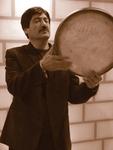
Sattor
Fozilov
Sattor Fozilov was born in
Chodschent in Tajikistan in a musical family
and learned the Central Asian doyra at the
early age of five. As a professional musician,
he was committed to different state ensembles
and went on concert tours worldwide. In 1999,
he recieved the award "Deserved Artist
of the Republic of Tajikistan." Sattor
Fozilov is a master on his instrument in all
styles of the traditional Tajiki music. His
repertoire comprises not only of countless
compositions for frame drums, solos, and group-dances,
but he also accompanies instrumental and vocal-pieces
from the classic Tajiki art-music makom as
well as swift dance-music for Tajiki weddings.
Among the musicians of this region, Sattor
Fozilov is especially known for his outstanding
technique and his virtuoso performances.
|
|
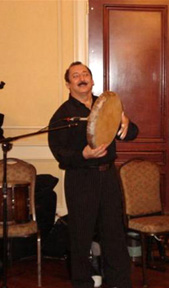
Yasha Barayev
One of the top Bukharan Jewish
doyra players whose virtuosso playing style
rivals that of the great Abbos Kosimov. He
is now located in the USA. Alternate spellings
of his name include Yasha Baraev & Yasha
Barajev. Another great Bukharan doyra player
is Ilusha
Barayev (on right in video).
|
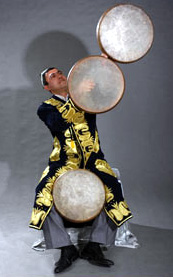
Ravshan Asadullaev
Ravshan Asadullaev became
an apprentice of Ashrafhodajaev Toshpolathuja
at the age of 9 for doyra. At the same time
he also went to music school. He learned the
theory of music there and the way of execution
for the forms known as "Tajikcha-Bukharacha,"
"Hosil," and "Doyra Sairaidi,"
among others. Later Ravshan studied at technical
school of culture and Tashkent State University
of Culture. He is a master of Uzbek doyra
and also plays tabla, kongi, and davul. He
performs with the group Shodlik
and is located in Tashkent, Uzbekistan.
|
|
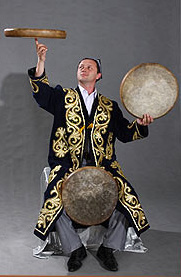
Davronbek
Ravshanbekovich Akbarbekov
A master of the Uzbek national
percussion instruments doyra and nog'ora and
a leading member of the Uzbekistan State Ensemble
of Song and Dance for the Ministry of Culture
in Uzbekistan. Davron was born in 1972 in
the city of Tashkent in Uzbekistan. His father
is the master of doyra Ravshan Ortikovich
Akbarbekov who has devoted his life
to the development of skill to play on doyra
and has started to teach young Davronbek when
he was three years old. His father
worked for many years in the Bahor state ensemble
of a song and dance called Mukarama Turgunbaeva.
His father is credited with a large contribution
to development of the Uzbek dance and new
Uzbek rhythms. Davronbek performs with the
group Shodlik
and islocated in Tashkent, Uzbekistan.
|
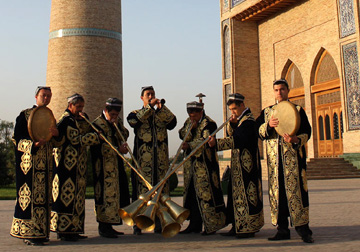
Shodlik
Uzbek ensemble located in Tashkent
featuring doyra players Ravshan Asadullaev & Davronbek
Ravshanbekovich Akbarbekov.
DAF & DAYEREH
- IRAN
&
GHAVAL - AZERBAIJAN
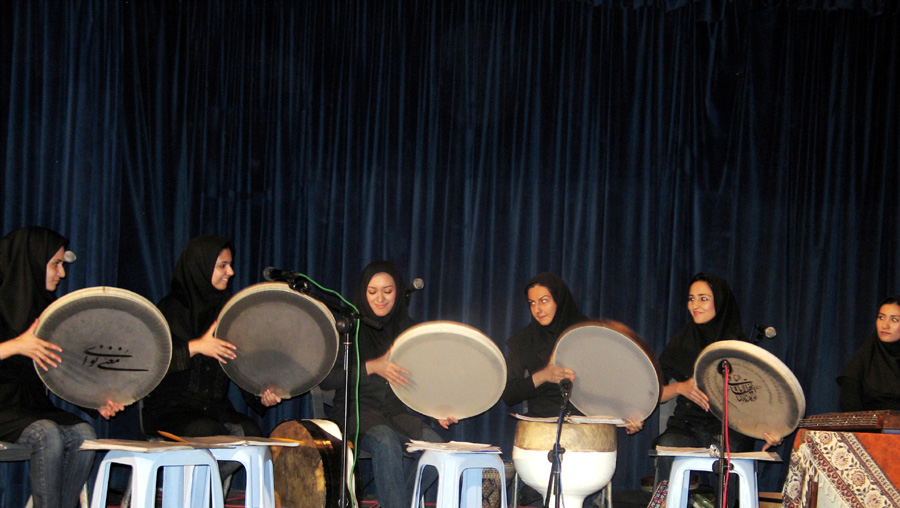
Safahan
All female Persian daf ensemble that
performed at Tamburi Mundi Iran in May 2008.
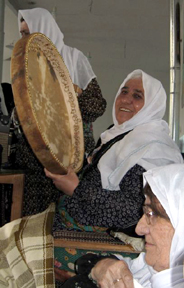
Khalifeh Rahmeh
Throughout Kurdistan in Northwestern
Iran, there are many spiritual groups whose practices
have revolved around the daf since ancient times.
Women and men are segregated in their ceremonies,
and in most cases the women's groups use the same
spaces as the men at different times. Khalifeh Rahmeh
is the women's spiritual leader in Baneh, Kurdistan,
Iran, and is the only woman within a large geographic
area to construct her own khanegah, or meeting place,
exclusively for the use of the women's community.
Madjid
Khaladj
Persian daf and tombak player
now living in France. Born in Ghazvin, Iran
in 1962, Madjid Khaladj began studying the
tombak at age seven. Highly active internationally,
he has perfomed in festivals, concerts, and
conferences around the world. In 1984, he
was invited to teach Iranian percussions at
the Center for Middle Eastern Music Studies
at the Institute of Musicology of Paris-Sorbonne.
In 1996, he founded the Ecole de Tombak in
Paris (Center for Iranian Percussion Study).
Since 1998, he has also been teaching at the
State Academy of Music in Basel, Switzerland
(Musik Akademie der Stadt Basel in Switzerland).
|
|
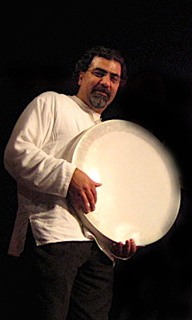
Houman Pourmehdi
Persian daf and tombak player
with Liän Ensemble. Now located in California.
|
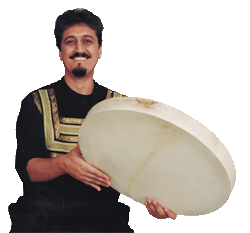
Behnam Samani
Persian daf player with Ensemble
Samani and Zarbang (in which Reza
Samani also plays daf). Located in
Germany.
|
|
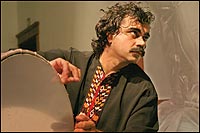
Pejman Hadadi
Persian daf player with the
groups Zarbang, Dastan Ensemble, and Namah
Ensemble. Now located in California.
|
Mehrdad Arabi Fard
Persian daf player with the
groups Zarbang, Namaad Ensemble, and Namah
Ensemble. Located in California.
|
|
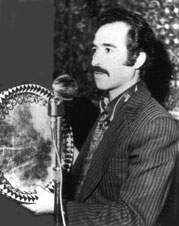
Latif Tahmasebi-zadeh
Pioneering Azerbaijani ghaval
player who was the first to introduce soloing
on the ghaval.
|
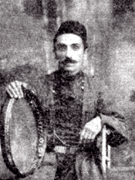
Dzhabbar Kariagdiev
Azerbaijani ghaval player.
|
|
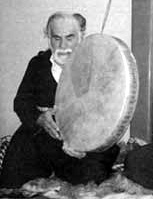
Haj Khalifeh Karim Safvati
(1920-2007)
Master daf player and singer
of Sufi music from Kurdistan in Iran. He was
born in 1920 and passed away in July 2007.
|
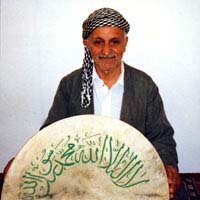
Khalifeh Mirza Agha Ghosi
(1928-2007)
Daf player and master singer
of Sufi music of the Qadderi Order from Sanandaj,
Kurdistan in Iran. He was born in 1928 and
passed away in 2007.
|
|
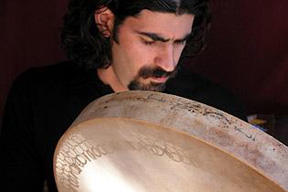
Kourosh Moradi
Born in Guran, Kermanshah,
Iran, and now located in California. Kourosh
Moradi began studying tanbur at the early
age of three with his father, legendary tanbur
master, Ali Akbar Moradi. He also studied
daf with the Sufi masters of the Yarsan Order
and tombak with Ostad Hamid Moghadam. He has
toured the world as percussionist with his
father and other Kurdish and Persian master
musicians, such as Hossein Omoumi, Madjid
Derakhshani, and Pejman Hadadi.
|
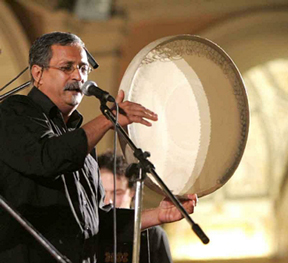
Mohssen Kasirossafar
Persian daf and tombak player
who is located in Rome, Italy. He has performed
with K. Kalhor, M.R. Lotfi, H. Alizadeh, B.
Kamkar, M. Aayan, Ennio Morricone, Giancarlo
Schiaffini, Giorgio Battistelli, Angelo Branduardi,
Mauro Pagani, Paolo Vivaldi, Giuliano Taviani,
Andrea Morricone, Rita Marcotulli, Daniele
Sepe, Andrea Parodi, and Antonello Salis &
Alessandro Satta Duo, among others.
|
|
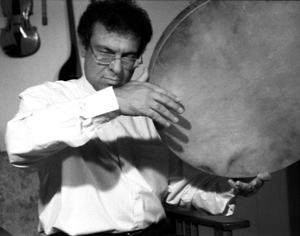
Bijan Kamkar
Bijan Kamkar is Kurdish and
is a member of the group The Kamkars and plays
tar (lute), rebab, tombak, sings, and daf,
which he has introduced into the classical
Iranian repertoire.
|
.jpg)
Mahmud Salah
The top Azerbaijani ghaval
player living today. He performs with the
Ghadim Sharq Ensemble. He has performed with
respected Azerbaijani traditional musicians
such as Alim Qasimov, Janali Akperov, Sakine
Ismailova, professors and assistant professors
of Azerbaijan National Conservatoire, tar
performers Ramiz Quliyev, Mohlat Muslimov,
Malik Mansurov, and kamancha performers Shafiga
Eyvazova, Fahraddin Dadashev, among others.
|
|
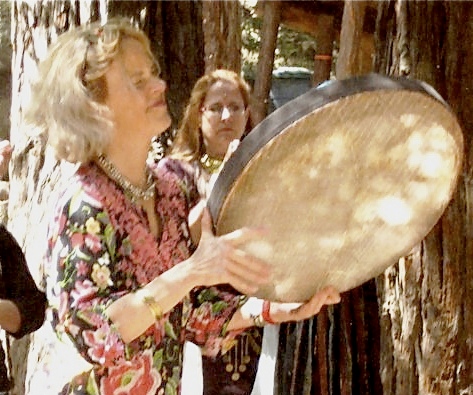
Rowan
Storm
Rowan Storm is an American
player of daf and other frame drums. Since
1977, Rowan Storm has been singing, studying
and performing a wide variety of traditional
hand drums with some of the greatest masters
of Middle Eastern and Mediterranean music
throughout the Americas, Europe, and the Middle
East. Rowan became enchanted with the frame
drum through a performance of Kurdish daf
in the mid-1980s, initiating her search to
understand its meaning and history. In 2006,
Rowan was invited to play daf within the circles
of women dervishes in their ceremonies in
Kurdistan, Iran. An intrepid musical, cultural,
and linguistic explorer, Rowan has been living
primarily in Greece since 1993, with Los Angeles
as her western base. Rowan is building bridges
throughout the world with her performances
and unique Essential Frame Drum Method Workshops,
which promote musical and rhythmic language
development, and technique within a context
that encourages integration of the two brain
hemispheres. For details on her Iran travels,
please see her web
blog.
|
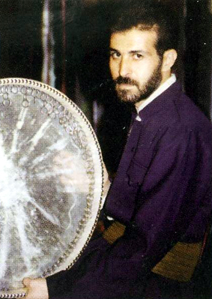
Seyed Ataollah Salamieh
Persian daf player who recorded
the CDs Daf Maqams and Faryad-e
Daf.
Vughar Musayev Gesang
Azerbaijani musician who
plays tar (lute) and ghaval with the group
Ghadim Sharq Ensemble.
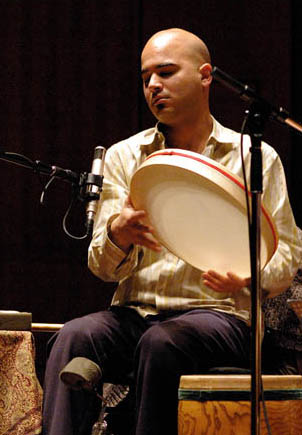
Ziya
Tabassian
Persian daf, dayerah and
tonbak player located in Canada. He plays
in several early, contemporary, and world
music ensembles and is an active and a co-founding
member of both Constantinople (Middle Age
and Renaissance music) and Duo Prémices
(soprano & percussion). Ziya has performed
in several concerts in Canada, Mexico, Germany,
USA, Greece, and Tunisia, notably with Hossein
Omoumi, Keyhan Kalhor, Liu Fang, Kronos Quartet,
En Chordais, and Studio de musique ancienne
de Montréal and Caprice, among others.
|
|
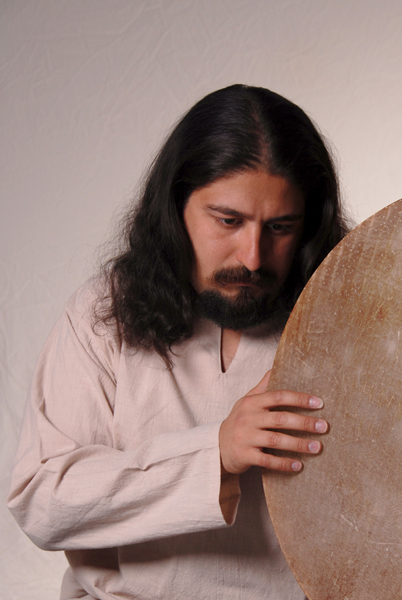
Pezhham
Akhavass
Persian daf, tonbak, oud,
and setar player who now lives in San Francisco,
California. Pezhham Akhavass was born in Iran
in 1980 and graduated with bachelor's degree
in music from University of Tehran. Pezhham
began studying the tonbak at 5 years of age
with the guidance of Naser Farhanghfar. He
continued learning the tonbak with Saeid Roudbary
from 1989 to 1991. He started the daf when
he was 9 years old, and in college he studied
the setar and oud. From 2001, Pezhham began
working professionally with the renowned vocalist
Shahram Nazeri. He has performed in many notable
music festivals world-wide and toured extensively
in Iran, France, Morocco, Sweden, Austria,
Italy, Australia, Finland, and USA. Akhavass
has also performed with master Persian musicians
Hossein Alizadeh, Aliakbar Moradi, Saeid Farajpouri,
Majid Derakhshani, Hosein Yousefzamani, Masoud
Shoari, and Shahram Nazeri. Pezhham has studied
other percussion instruments including Indian
tabla, kanjira, and ghatam.
|
RIQQ, MAZHAR,
TAR & BENDIR
- TURKEY, WESTERN
ASIA & NORTH AFRICA
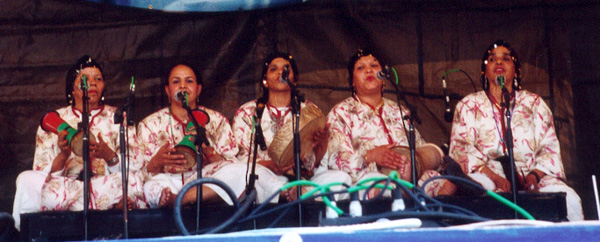
B'Nèt
Houariyat
Moroccan group of female singers, dancers,
bendir, ta'arija (riqq), and percussion players whose
name means "The Daughters of the Houara."
Members include Zahra Bani (on ta'arija), Khadija
Haliba (on bendir and ta'arija), Malika Rahmi, Saîda
Madrani, and Halima Zeiter.
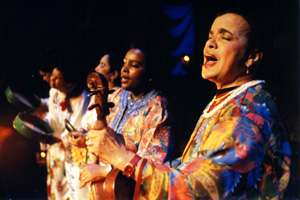
B'Nèt
Marrakech
Spin off group from B'Nèt
Houariyat of Moroccan female singers, dancers,
bendir and percussion players whose name means "The
Daughters of Marrakech." This group also performs
on violin, ta'arija (riqq), and gembri (lute). Members
include Malika Mahjoubi, Malika Ait-zouin "Aziza,"
Fatima Bakkou (bendir), Halima Chamkhi (ta'arija),
and Fatima Malih (bendir).
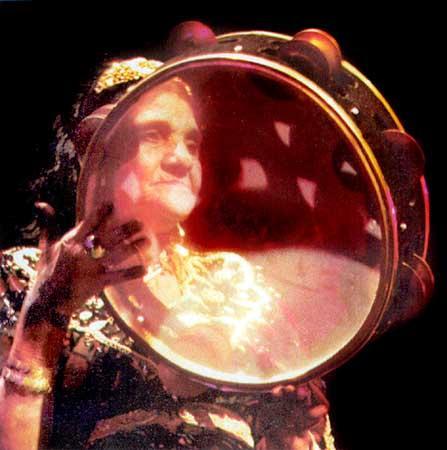
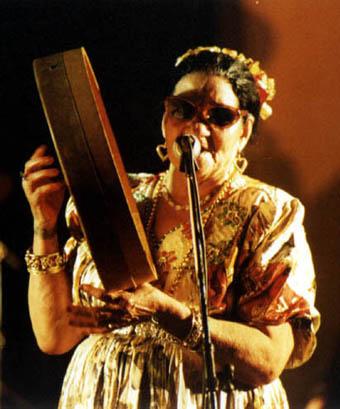
Cheikha Rimitti
Great player of mazhar, bendir, and
riqq and a great singer. She is from Algeria and has
many recordings.
Hamza El Din
(1929-2006)
Nubian singer and player
of oud and the frame drum tar (Nubia is southern
Egypt & northern Sudan). He lived from
1929-2006.
|
|
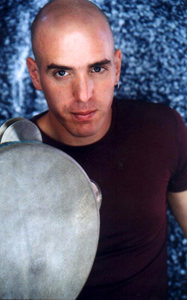
Zohar Fresco
Great Israeli riqq player
and frame drummer born and living in Israel.
Plays with the singer Noa and Ziryab Trio.
|
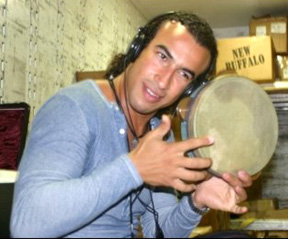
Rhani
Krija
Bendir and riqq player from
Morocco, now living in Germany.
|
|
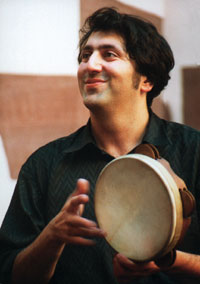
Murat Coskun
Riqq player and frame drummer
from Turkey. Director of the annual European
frame drum festival Tamburi Mundi and Tamburi
Mundi Iran.
|
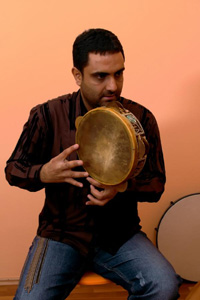
Mehmet Akatay
Amazing Roma riqq player
from Turkey. Plays with his brother Hamdi
Akatay in Akatay Project.
|
|
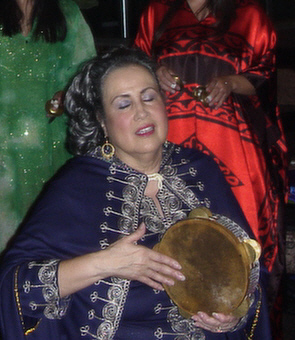
Zuhela Yamir
Famous Egyptian belly dancer
who also plays riqq (duf). Now located in
Florida.
|
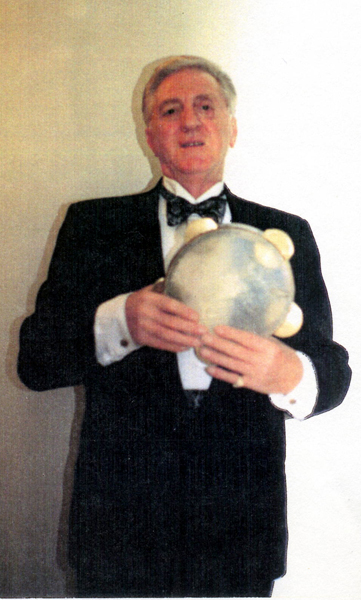
Hanna Mirhige
(1933-2000)
Lebanese riqq and tabla (dumbeck)
player who was the first to teach Glen Velez
riqq. His name at birth was "Hanna Merhej
Baklouk" but upon settling in the USA
it became "Hanna Mirhige." He is
the younger brother of the great Arabic riqq
player Michel Merhej Baklouk.
Hanna was a virtuoso riqq
and dumbeck player. He was Lebanese but born
in Jerusalem and attended the Conservatory
of Music in Beirut, Lebanon. In the 1905s,
Hanna was a featured performer at the Baalbek
Festivals and the Casino du Liban in Beirut
where he accompanied Arabic dancers such as
Nadia Gamal, Naima Akef, and Samia Gamal,
and the famous singers Fairuz and Sabah. Hanna
first came to the USA in 1965 and performed
with Simon Shaheen and Dr. Ali Jihad Racy.
He moved to New York in 1968 to be the drummer
for Ibrahim Farrah for whom he became Musical
Director in his Near East Dance Group. He
is known for playing riqq and percussion on
many of the latter 1970s recordings of belly
dance music by percussionist Eddie "The
Sheik" Kochak and Armenian-American oud
player George Mgrdichian. Although he was
not the first riqq player in the USA, Hanna
Mirhige helped to establish the riqq in the
USA by teaching it and performing in major
concert halls across the USA including New
England Life Hall in Boston, Kennedy Center
in Washington, DC, Shrine Auditorium in Los
Angeles, and in New York at Madison Square
Garden, Riverside Dance Festivals, Carnegie
Hall, Avery Fisher Hall, and Lincoln Center.
As the main teacher of Arabic riqq for Glen
Velez in the 1980s, Hanna Mirhige is an important
part of the history of the frame drum and
it's establishment in the USA.
|
|
Michel
Merhej Baklouk
Lebanese riqq player (born
in Jerusalem in 1928) and musical arranger
who now lives in New York. He is the older
brother of Hanna Mirhige. He has performed
with some of the most important Arabic artists
including belly dancers Tahiyya Karyoka, Samia
Jamal, and Naima Akef, the singer Fairuz,
and The Rahbani Brothers, Halim al-Rumi, Tawfiq
al-Basha, Zaki Nasif, Filimon Wahbi, and Simon
Shaheen, among others. He started performing
with the Near East Radio Ensemble in Israel
and Cyprus in the late 1940s and then in Lebanon
in the early 1950s. He was one of the few
musicians in Lebanon who could read Western
notation and developed a method for teaching
riqq, which spread across many of the Arabic
countries. The book Eastern Percussion
Methods by Elie al-Faqih (a former student
of Michel Merhej Baklouk) is in fact the method
of Michel Merhej Baklouk. His name is also
often listed as "Michel Baklouk."
|
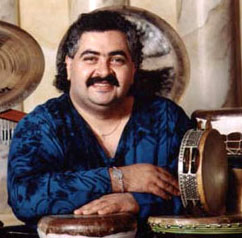
Hossam
Ramzy
Egyptian percussionist who
sometimes plays the riqq. Started off as a
jazz drumset player and eventually returned
to playing Arabic percussion with Latin and
African percussion. He also builds custom
riqqs with several options including gold-plated
jingles.
|
|
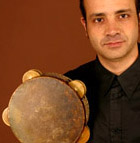
Karim Nagi-Mohammed
Egyptian percussionist and
dancer who plays riqq and Egyptian tabla.
Performs with the group Sharq and is author
of the DVD Riqq: Arab Tambourine, Complete
Instruction - Technique, Rhythms, Accompaniment.
Located in Massachusetts.
|
Yinon Muallem
Arabic percussionist who
plays oud, riqq, tar, darabuka, bendir, and
other percussion. Born in Israel but of Iraqi
origin. Yinon has performed with Ross Daly,
Yair Dalal, Omer Faruk Tekbilek, Suleyman
Erguner, Alim Gasimov, Zhubin Kalhor, Piris
Eliyahu, Eyal Sela, Muhammed Alnuma, Sheldon
Sands, and dancer Berrak Yedek. Author of
the DVD Arabic Percussion. Currently
located in Turkey.
|
|
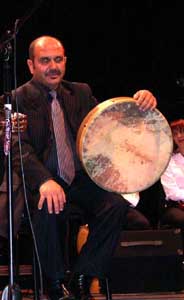
Souhail
Kasper
Born in Lebanon and trained
at Nadi al-Fonun al-Arabia (Conservatory of
Traditional Arabic Music) in Aleppo, Syria.
He excelled in both classical and ethnic rhythmic
patterns and techniques, and received a Degree
in Classical Arabic Performance. Now located
in California.
|
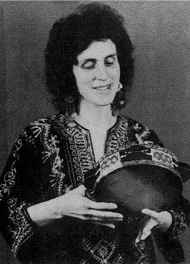
Mary Ellen Donald
American riqq, tar, mazhar,
zils, and tabla (dumbeck) player located in
California. Author of one of the first books
in the USA on Arabic frame drums in 1985 called
Arabic Tambourine.
|
|
Ben
Harms
American classical percussionist
who also specializes in Arabic riqq and early
music percussion. Located in Massachusetts.
|
NATIVE AMERICAN
& AFRICAN AMERICAN
- NORTH AMERICA
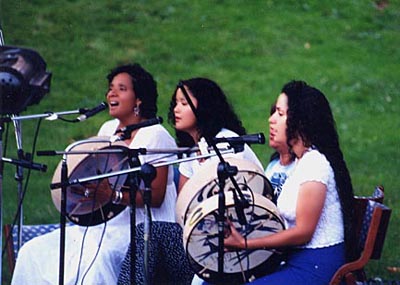
Ulali
Native American frame drummers
and singers from California, USA. The group
features Soni Moreno (Mayan, Apache, and Yaqui),
Pura Fé (Tuscarora), and Jennifer Kreisberg
(Tuscarora). This group blends all types of
singing with Native American chants and drumming
to form a unique contemporary Native American
sound.
|
|
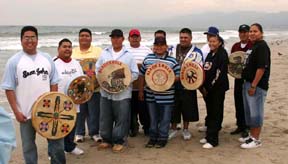
Black Eagle
Black Eagle is a group of
young Native American frame drummers and singers
who perform in a contemporary style by creating
new songs in their traditional Towa language.
They are from the Pueblo of Jemez in New Mexico
and feature Kendrick Casiquito, Terrence Casiquito,
David Yepa, Jr., Emmett Yepa, Malcolm Yepa,
and Glendon Toya, among others.
|
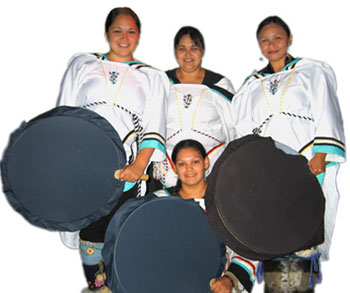
Siqiniup Qilauta -
Sunsdrum
Ensemble from Ottawa, Canada
who specialize in traditional performances
of Cooper Inuit kattajjaq (throat singing),
drum dances & songs (with the qilaut in
photo), and other traditional performances.
Members include Emily Qattu Paniga Karpik,
Tracy Aasivak Brown, Emily Arnainnuk Kotierk,
Lynda Qaqasirija Brown, Kendra Tagoona, and
David Joanasie.
|
|
Jack Ashford
American tambourine and vibes
player from Michigan, USA, who played with
with The Funk Brothers. Played a common tambourine
on numerous Motown hit records between 1963-1972.
|
Rosalie "Lady Tambourine"
Washington
African American tambourinist
from New Orleans, Louisiana, USA, who plays
for gospel and New Orleans music events. Her
rhythmic styles rivals that of a pandeiro
player in that her tchnique achieves all kinds
of rhythmic and timbral variations.
|
|
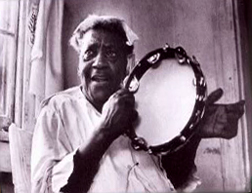
Sister Gertrude Morgan
(1900-1980)
African American tambourinist
from New Orleans, Louisiana, USA, who played
in an older African American gospel tambourine
style in which she achieves all sorts of rhythmic
and timbral variations.
|
ORCHESTRAL
TAMBOURINE - EUROPE & USA
Neil
Grover
American orchestral percussionist
with the Boston Symphony Orchestra in Massachusetts.
He makes one of the most popular orchestral
tambourines with orchestra percussionists
and is the co-author of the book The Art
Of Tambourine And Triangle Playing.
|
|
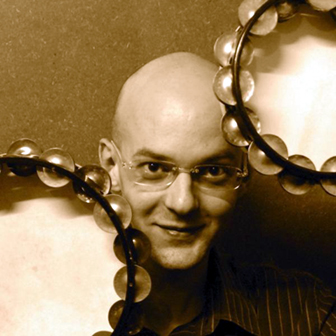
Cristiano Pirola
Italian orchestral percussionist
from Milan who plays great orchestral tambourine.
Cristiano has incorporated Spanish pandereta
techniques to play some orchestral excerpts
on tambourine.
|
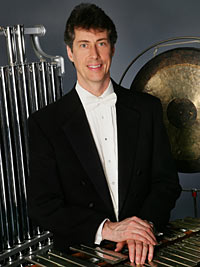
Chris Lamb
Hailed as a dynamic and versatile
performer, Chris Lamb joined the New York Philharmonic
as Principal Percussionist in 1985. He subsequently
made his solo debut with the Philharmonic in the world
premiere of Joseph Schwantner’s Percussion
Concerto, one of several commissions celebrating
the Philharmonic’s 150th Anniversary, and has
since performed the work to critical acclaim with
orchestras throughout the United States. Mr. Lamb
also gave the world premiere of Tan Dun’s Concerto
for Water Percussion. In 1999, Mr. Lamb was the
recipient of a prestigious Fulbright Scholar Award
to lecture and conduct research in Australia. On the
faculty of the Manhattan School of Music since 1989,
Mr. Lamb has given clinics and master classes throughout
the United States and on nearly every continent. Mr.
Lamb has recorded chamber works on the New World,
Cala, and CRI labels. A former member of The Metropolitan
Opera Orchestra and Buffalo Philharmonic, he is a
graduate of the Eastman School of Music in Rochester,
New York. His technical skills on orchestral tambourine
remain unparalleled. His technique is such that he
is able to perform modern etudes for the snare drum
on tambourine expertly executing all rolls, grace
notes, and other intricate notation.
KOMPANG - MALAYSIA,
BRUNEI & SINGAPORE
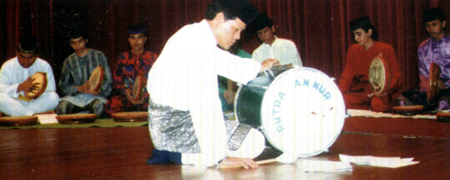
Singapore Hadrah and Kompang
Association
A group from Singapore that specializes
in both traditional and newly composed works for kompang
and hadrah.
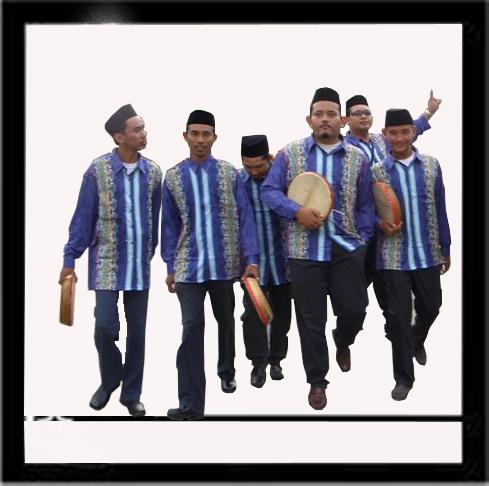
Azman
Malaysian kompang group.
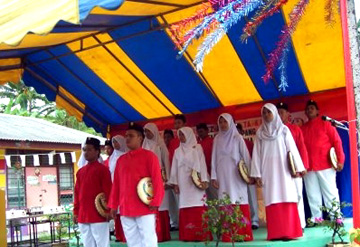
Kompang Ezhar
Kompang Ezhar is the top
Malaysian group for kompang performance (frame
drum ensemble & song). They also play
for pentjak silat (martial art) and perform
traditional Malaysian dances.
|
|
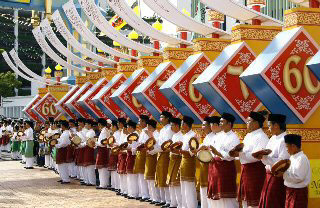
Hadrah groups from Brunei
Similar to kompang ensembles,
hadrah ensembles are common in Malaysia, Brunei,
and also in Singapore. The Brunei ensembles
play a small tambourine called tar (kompang
are used in Malaysia & Singapore). Most
elementary schools through the university
level in Malaysia, Singapore, and Brunei have
kompang or hadrah ensembles. The photo above
is of several hadrah groups in Brunei playing
the tar for the 60th birthday celebration
of the Sultan of Brunei. The hadrah differs
from the kompang ensemble in Malaysia in that
hadrah perform a different set of rhytms in
accompaniment to Islamic religious praise
singing. The kompang traditionally play interlocking
rhythmic patterns in accompaniment to wedding
ceremonies and other religious or celebratory
functions.
|
FRAME DRUMMERS
- USA, CANADA & EUROPE
Glen Velez
American master frame drummer,
percussionist, and composer who is responsible
for the world wide resurgence of the frame
drum since the late 1970s. His style involved
blending technical aspects of unrelated frame
drumming traditions to form a unique style
employed on many types of frame drums including
bodhran, tar, bendir, riqq, tamburello, kanjira,
pandeiro, and others. His teachings have spread
world wide to the point that nearly all modern
frame drummers can be traced back to the teachings
of Glen
Velez. Author of several books and DVDs
on frame drums.
|
|
Layne
Redmond (1952-2013)
American frame drummer who
was one of the first proficient students of
Glen Velez and who accompanied him on many
of his earliest recordings of his compositions.
Beyond her work with Glen Velez, Layne Redmond
has gone on to leave a substantial body of
work including award winning CDs, videos,
and the book When The Drummers Were Women.
In Salvador, Brazil, she has set up an institute
of percussion based on the frame drum where
one can study both Bahian percussion and a
variety of frame drumming styles. Last located in North Carolina, ensembles Layne
had directed included the Mob of Angels in
USA, Kyprogenea
in Cyprus, and Sundaryalahari
in Brazil.
|
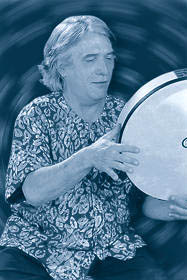
John Bergamo (1940-2013)
American percussionist, composer,
and frame drummer who is known for his innovative
approaches to percussion, composition, and
outstanding percussion ensembles such as Repercussion
Unit and Hands On'semble.
|
|
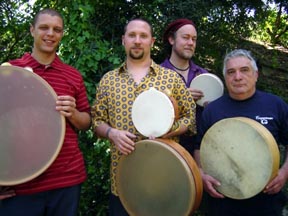
Hands
On'semble
Andrew Grueschow, Randy
Gloss, Austin
Wrinkle, and John Bergamo. One of the
most outstanding world percussion ensembles
in the USA. Its members are known for highly
refined playing on a wide variety of world
percussion including many frame drums such
as daf, riqq, pandeiro, kanjira, and others.
|
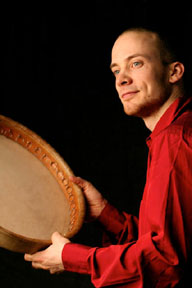
David
Kuckhermann
Higly skilled German frame drummer
and multi-percussionist. Skilled in a variety
of frame drum styles, he is the author of
the DVDs World Percussion 1: Frame Drums
and World Percussion 2: Riq and Darbuka.
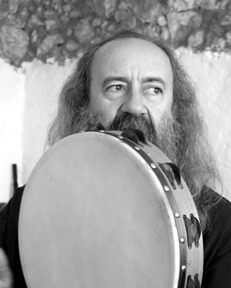
Pedro Estevan
Frame drummer from Spain.
|
|
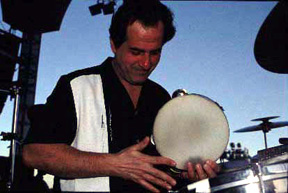
Jamey Haddad
American jazz drummer and
frame drummer. Originator of the Cooperman
hadjira tambourine. Lives in Ohio, teaches
at Berklee College of Music, and plays with
Paul Simon and Dave Liebman, among others.
Steve Amedée
American tambourine player
with the New Orleans groups, The Subdudes
and The Dudes. Known for playing a common
tambourine with a Blastick achieving the full
rhythmic support of a drumset.
|
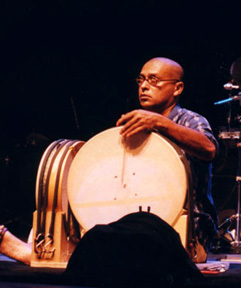
Ganesh
Anandan
Originally from Bangalore, India.
Now located in Canada. Inventive frame drummer
and composer.
|
|
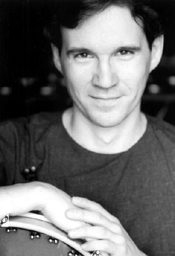
Patrick
Graham
Canadian frame drummer and multi-percussionist.
Performs with GaPa with Ganesh Anandan.
|
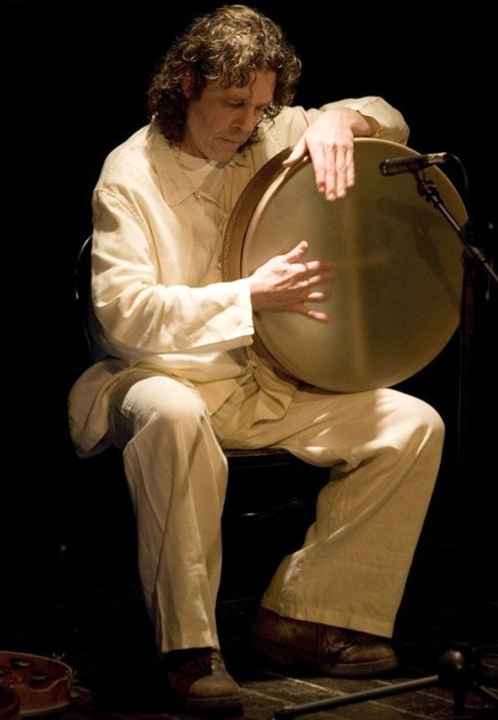
Gianluca Baldo
(1961-2008)
Italian frame drummer who
lived in Spain. Gianluca was also an accomplished
visual artist and was one of those that organized
the first frame drum festivals in Europe known
as European Frame Drummers Meeting with his
organization and website Frame Drums Europe.
Pete
Lockett
English percussionist proficient
on frame drums, particularly the kanjira as
well as a wide range of other percussion.
He can be heard on many blockbuster film soundtracks
and recordings and is the author of the book
Indian Rhythms for Drumset.
|
|
B.
Michael Williams
B. Michael Williams is Professor
of Music and Director of Percussion Studies
at Winthrop University in Rock Hill, South
Carolina. He holds the B.M. degree from Furman
University, M.M. from Northwestern University,
and Ph.D. from Michigan State University.
Active as a performer and clinician in both
symphonic and world music, Williams has performed
with the Charlotte (NC) Symphony, Lansing
(MI) Symphony, Brevard Music Center Festival
Orchestra, and the Civic Orchestra of Chicago,
and has appeared at several Percussive Arts
Society International Conventions. He has
written articles for Accent Magazine,
South Carolina Musician, and Percussive
Notes, and has made scholarly presentations
on the music of John Cage and on African music
at meetings of the College Music Society and
Percussive Arts Society. In 2004, Dr. Williams
received the Winthrop University Distinguished
Professor Award, the highest honor given to
a Winthrop faculty member.
Dr. Williams is Associate
Editor (of world percussion) for Percussive
Notes magazine. He is one of the first
published composers of music for frame drums.
His pieces include innovative works for frame
drums and percussion including his "Four
Solos for Frame Drums," which was the
first published composition for frame drums.
Additional works to his credit include "Three
Shona Songs" and "Shona Celebration”
for marimba ensemble, “Recital Suite
for Djembe," "Tiriba Kan" for
solo djembe, "Bodhran Dance," and
"Another New Riq," all published
by HoneyRock Publications. His book, Learning
Mbira: A Beginning…, also published
by HoneyRock, utilizes a unique tablature
notation for the Zimbabwean mbira dza vadzimu
and has been acclaimed as an effective tutorial
method for the instrument. His 2005 CD recording,
BataMbira, with Grammy-nominated
percussionist and producer Michael Spiro,
has been featured on National Public Radio,
The Voice of America, and other broadcasts
nationwide.
|
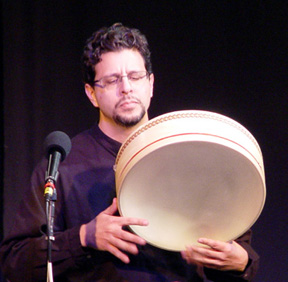
Yousif
Sheronick
One of the top American frame
drummers, located in New York. Yousif has
performed or recorded with Branford Marsalis,
Foday Musa Suso, Philip Glass, and Glen Velez,
among others, and is a member of the percussion
ensemble Ethos. He performs in a unique world
music inspired chamber music duo with violist
Kathryn Lockwood called Lockwood / Sheronick
Project.
|
|
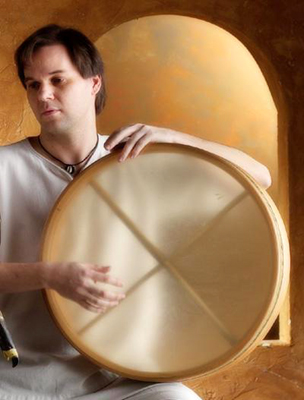
N.
Scott Robinson
American frame drummer and
multi-percussionist who is located in Baltimore,
Maryland. He has worked with Malcolm Dalglish,
Paul Winter Consort, Annea Lockwood, Glen
Velez, R. Carlos Nakai, Bill Miller, and Benny
Carter, among others. Composer of 9
pieces for frame drums in solo, duo, and
ensemble format published by HoneyRock Publications
and New World View Music. He is the founder
of theNorth American Frame Drum Association, Inc., and reularly performs with Wind & Fire
(with Mark Holland), Malcolm Dalglish, Ensemble
Datura, and the Indian vocalist K.S.
Resmi.
|
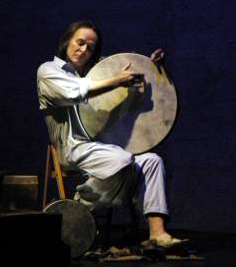
Hearn Gadbois
American frame drummer now
living in the Czech Republic.
|
|
Hakim Ludin
Frame drummer originally
from Afghanistan, now living in Germany.
|
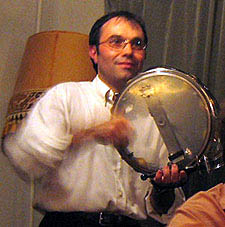
Guillaume
Toutain
French tambourinist who studied
with Carlo Rizzo and Glen Velez. He was able
to reverse engineer the Carlo Rizzo poly-timbral
tambourine and make them available for other
players renaming the instrument "Melodic
Tambourine."
|
|
Fredrik
Gille
Swedish frame drummer who
plays with the group Bazar blå and has
worked with Andreas Vollenweider, Johan Hedin,
and Erik Steen Flamenco Fusion, among others.
|
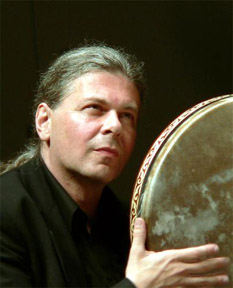
Vladimir Ivanoff
Frame drummer from Bulgaria.
|
|
Shane Shanahan
American frame drummer who
often plays with Yo-Yo Ma's Silk Road Ensemble
and Glen Velez.
|
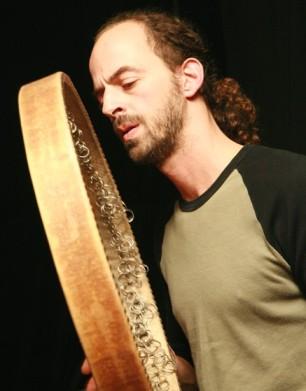
Alexis Nonis
Greek frame drummer with
the group Endofonon.
|
|
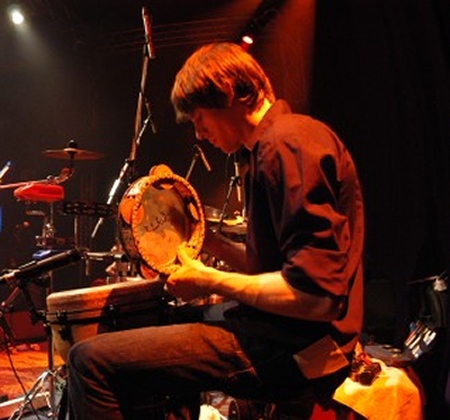
Matt
Kilmer
American percussionist who
uses frame drums in his work with the singer
Haale.
|
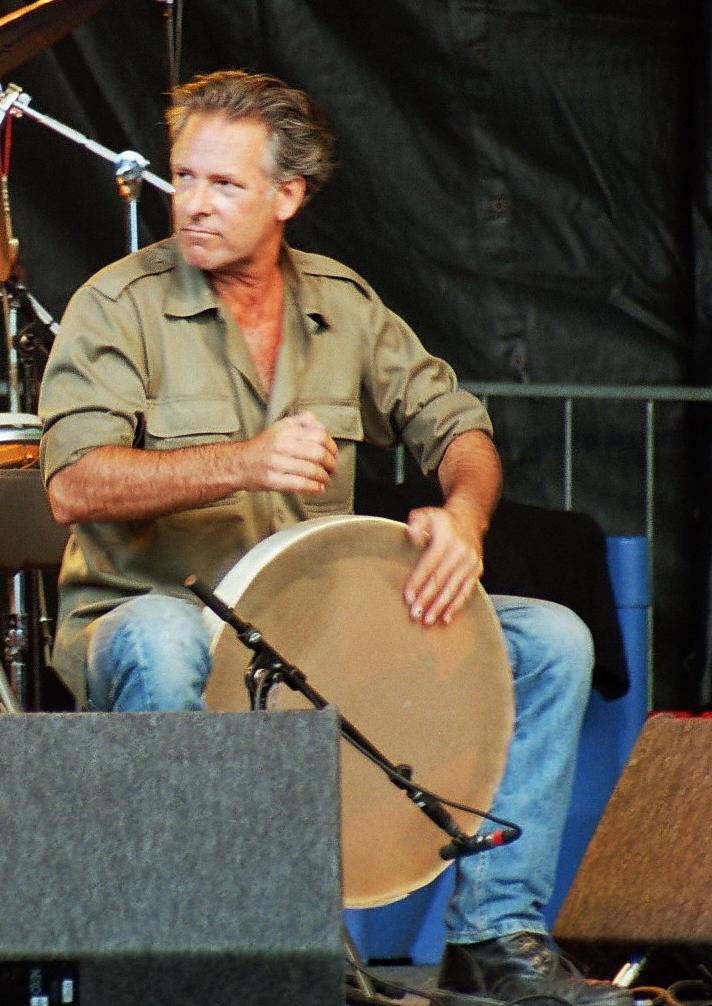
Steve
Shehan
American musician based in France,
Steve Shehan is one of the most creative percussionists
working today. He plays a host of instruments in very
refined, musically sensitive, and endlessly creative
ways including his "drumset" made from a
djembe with bass drum pedal, axatse hi-hat, congas,
djembe, floor tom on right and darabuca on left with
ride, sizzle, and crash cymbals. He often plays this
set up quite effectively with a pair of Moroccan grass
brushes. He also performs on hang (hand steel pan),
likembe, cristol organ, fame drum, and percussion.
His frame drum style is unique in that he plays free
hand style on an ocean drum or Persian daf and employs
tamburello/bodhran-like techniques with djembe/conga
soloing feels. He has worked with Bob Dylan, Paul
McCartney, Paul Simon, and Peter Gabriel, among many
others. He plays in a unique world-jazz trio in France
called Hadouk Trio (highly recommended DVDs &
CDs) and has many of his own recordings out available
on his website for order. |